You raise VO2 max by training your heart and muscles to deliver and use more oxygen, and two kinds of work do it reliably: steady aerobic exercise, and short hard intervals. In trials of healthy adults, both added roughly 5 mL/kg/min over a few weeks. Intervals added slightly more. How much you gain depends on where you start, how long you stay with it, and some biology you do not control.
What is VO2 max, and what does it predict?
VO2 max is the most oxygen your body can take in and use during all-out exercise, usually written in milliliters per kilogram of body weight per minute (mL/kg/min). Higher scores are associated with lower long-term risk of death and heart disease. That is an association found in groups of people, and it does not guarantee anything for you.
Here is how far the evidence goes:
- A 2009 JAMA meta-analysis of 33 cohort studies (about 103,000 participants) found that each 1-MET higher fitness level was associated with a 13% lower risk of all-cause death (risk ratio 0.87). People in the lowest fitness group (under 7.9 METs) had a 1.70 times higher risk than those in the highest group (10.9 METs or more). (Kodama et al., JAMA 2009)
- A 2018 study followed 122,007 adults who had treadmill stress tests at one academic medical center between 1991 and 2014, for a median of 8.4 years. Low fitness was associated with a hazard ratio of 5.04 for death compared with elite fitness, and the gap was comparable to or larger than that for smoking, diabetes or coronary artery disease. (Mandsager et al., JAMA Network Open 2018)
- A 2024 review updating the American Heart Association's 2016 statement concludes that fitness belongs among routine health measures, because its link to risk holds independently of common risk factors. (Ross et al., Progress in Cardiovascular Diseases 2024)
Two limits matter. These are observational studies, so they show that fit people live longer on average and leave open whether raising your own score adds years. And both large studies estimated fitness from treadmill performance in METs (1 MET is about 3.5 mL/kg/min) rather than measuring gas exchange. Treat VO2 max as a useful marker of how you are doing today.
What is a good VO2 max for your age?
A good VO2 max is one at or above the median for your age and sex, and higher is better. In the largest US reference sample built on measured values, the median for men fell from 48.0 mL/kg/min in their twenties to 24.4 in their seventies, and for women from 37.6 to 18.3. Scores fall about 10% per decade on average in that sample (Kaminsky et al., 2015).
The table gives the 25th, 50th and 75th percentiles from the FRIEND registry, which collected 7,783 maximal treadmill tests from adults without known cardiovascular disease in 2014 and 2015 (Kaminsky et al., Mayo Clinic Proceedings 2015).
| Age | Men 25th | Men 50th | Men 75th | Women 25th | Women 50th | Women 75th |
|---|---|---|---|---|---|---|
| 20 to 29 | 40.1 | 48.0 | 55.2 | 30.5 | 37.6 | 44.7 |
| 30 to 39 | 35.9 | 42.4 | 49.2 | 25.3 | 30.2 | 36.1 |
| 40 to 49 | 31.9 | 37.8 | 45.0 | 22.1 | 26.7 | 32.4 |
| 50 to 59 | 27.1 | 32.6 | 39.7 | 19.9 | 23.4 | 27.6 |
| 60 to 69 | 23.7 | 28.2 | 34.5 | 17.2 | 20.0 | 23.8 |
| 70 to 79 | 20.4 | 24.4 | 30.4 | 15.6 | 18.3 | 20.8 |
Read it with three cautions:
- It is a snapshot. The data are from 2014 and 2015, so they are more than a decade old.
- The sample is people sent for testing. Participants had no known heart disease, but the authors note some had diabetes, obesity or other conditions, so these are not elite or ideal targets.
- Method matters. The same paper compared its measured values with Cooper Clinic norms predicted from treadmill time. Medians in the measured registry were lower than the Cooper Clinic's from the forties on for men and from the thirties on for women. A watch or app estimate is not the same thing as a measured test, so compare like with like.
How to increase VO2 max: what the training studies show
Both steady endurance training and interval training raise VO2 max, and intervals edge ahead by a small margin. A 2015 meta-analysis of 28 controlled trials (723 healthy adults aged 18 to 45, average starting VO2 max about 41) found endurance training raised VO2 max by about 4.9 mL/kg/min over no exercise, and high-intensity intervals by about 5.5. Head to head, intervals came out about 1.2 mL/kg/min ahead, which the authors graded a possible small benefit. Gains were larger for people who started less fit and in longer programs (Milanović et al., Sports Medicine 2015).
Here is how the options compare in the studies this guide opened:
| Approach | What it involves | What the evidence shows |
|---|---|---|
| Steady aerobic work | Moderate effort, 30 to 60 minutes, several days a week | Raised VO2 max about 5 mL/kg/min in the 2015 meta-analysis |
| Longer intervals | Repeated hard efforts of 1 to 4 minutes with recovery | Slightly larger gains than steady work on average, with a longer session than sprints |
| Sprint intervals | Two to six all-out efforts of 20 to 30 seconds | In one 12-week trial in sedentary men, 3 x 20-second sprints raised peak oxygen uptake 19%, the same as 45 minutes of steady cycling (9 and 10 people per group; Gillen et al., PLoS One 2016) |
| Reduced-exertion intervals | Two 20-second sprints inside a 10-minute ride | Reviewed in 2024 as a minimal-dose option that can improve fitness; the long-term record is thin (Metcalfe and Vollaard 2024) |
How often and how hard?
The national guidelines ask adults for 150 to 300 minutes a week of moderate activity, or 75 to 150 minutes of vigorous activity, plus muscle-strengthening on two or more days (Physical Activity Guidelines for Americans, 2nd edition, 2018). A plan for VO2 max can build on that:
- Keep most of your minutes easy and conversational. Our guide to zone 2 training covers that base.
- Add one or two interval sessions a week, no more, and keep a day of easy movement or rest between hard days.
- Give it at least eight weeks before you judge. The trials above ran 8 to 12 weeks.
- Lift on two days a week, as the guidelines ask. Our guide to muscle loss after 50 explains why that matters with age.
Will everyone gain the same amount?
No. In the HERITAGE Family Study, 481 sedentary adults trained for 20 weeks. The average gain was about 400 mL/min, but some people gained almost nothing and others gained more than 1.0 L/min. The authors' maximal heritability estimate for that variation in response was 47% (Bouchard et al., Journal of Applied Physiology 1999). That study is 27 years old and enrolled sedentary adults, so read it as a reason to judge yourself against your own baseline. A small gain does not mean you did it wrong.
Because VO2 max is divided by body weight, changing weight also changes the score. Losing body fat while keeping muscle raises mL/kg/min without changing how much oxygen you can use in total. An InBody scan shows which one is moving.
What can the CAROL bike and a PNOE test do for you?
OutRecover's CAROL bike runs a 9-minute guided ride with two 20-second sprints, the reduced-exertion format described above. Its service page says the bike adjusts resistance to your output automatically, suits most fitness levels, and is not recommended during an acute injury or with certain cardiac conditions.
One small randomized trial used CAROL bikes. Thirty-two inactive adults (average age about 41) trained for 8 weeks either on the bike or with 30-minute moderate sessions five days a week. Among the 27 who finished, fitness rose 12% in the bike group (from 25.3 to 28.4 mL/kg/min) and 7% in the moderate group. More people in the bike group dropped out (four of 16, three of them from illness, against one of 16). The study was funded by the American Council on Exercise, tested on a bike rather than a treadmill, and was short. The authors recorded blood pressure peaking at 218 mmHg systolic during sprints and advised screening before starting, especially for inactive people or those with risk factors (Cuddy et al., Int J Environ Res Public Health 2019).
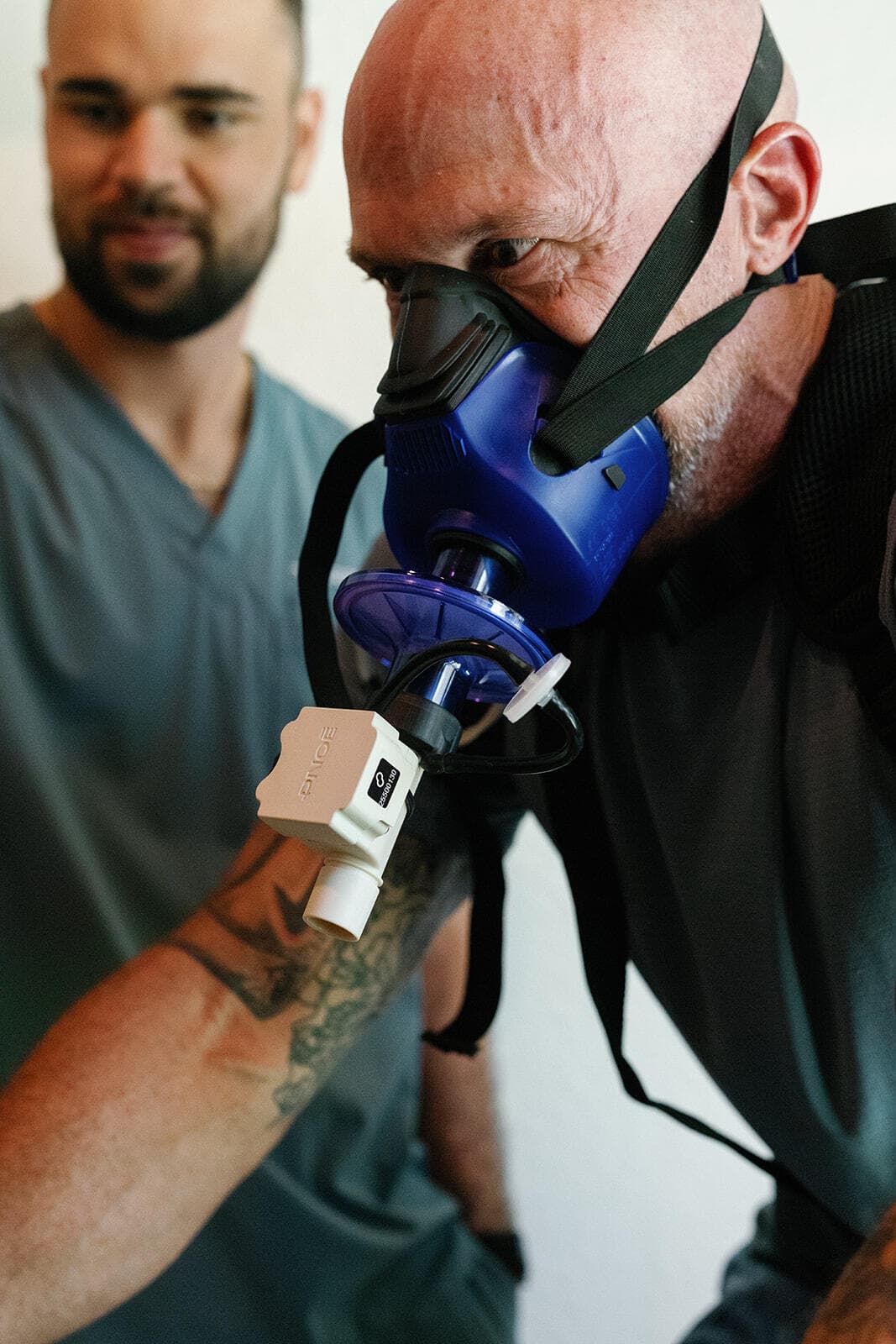
The PNOE metabolic test is how you measure the result instead of guessing at it. Its page describes a portable analyzer that measures oxygen use and carbon dioxide output through a mask, during either a resting test or a graded exercise test on a bike or treadmill, and says results are reviewed with you right away or in a follow-up consult. Its prep notes: fast for at least 4 hours before a resting test, and skip intense exercise for 24 hours before. Testing once before you start and again after a training block shows your own change. Our research summary on biometric testing covers the clinical background, and the resting metabolic rate guide explains the other test the studio offers.
Do recovery services raise VO2 max?
Not on their own. We did not find a trial showing that red light, compression, sauna or cold exposure raises VO2 max, so we do not claim it. What they can do is support a training week. OutRecover's OutTrain and OutPerform packages bundle red light, compression, sauna, cold plunge and an InBody scan for people training several times a week, and the evidence for those therapies is limited and mixed (see our guides on active recovery and overtraining syndrome). The training itself is what moves the number.
Who should get clearance before hard intervals?
Check with your doctor first if you have heart disease, high blood pressure, diabetes, chest pain, unexplained breathlessness, or you have been inactive for a long time. All-out sprints push heart rate close to maximum, and the CAROL trial authors advised screening before starting for anyone inactive or with risk factors. If you are recovering from surgery or an injury, your surgeon or physical therapist sets when hard cardio is safe, and anything new, including a studio session, goes through them first.
A quick checklist to bring to that visit:
- What is a safe top heart rate for me?
- Do I need a stress test before sprint work?
- Do my medications change how I should train?
- When can I add intervals, and how do I ramp up?
Your next step
Find your starting point. Book a PNOE test to measure your number, or if you would rather start with a trial run, try a CAROL ride after you have your doctor's go-ahead. Then follow one steady week plus one interval session for eight weeks, and test again. Compare the result with your own baseline first and the table second.
Sources
- Kodama S, et al. Cardiorespiratory fitness as a quantitative predictor of all-cause mortality and cardiovascular events in healthy men and women: a meta-analysis. JAMA, 2009. https://pubmed.ncbi.nlm.nih.gov/19454641/
- Mandsager K, et al. Association of cardiorespiratory fitness with long-term mortality among adults undergoing exercise treadmill testing. JAMA Network Open, 2018. https://pubmed.ncbi.nlm.nih.gov/30646252/
- Ross R, et al. Update to the 2016 American Heart Association cardiorespiratory fitness statement. Progress in Cardiovascular Diseases, 2024. https://pubmed.ncbi.nlm.nih.gov/38387825
- Kaminsky LA, Arena R, Myers J. Reference standards for cardiorespiratory fitness measured with cardiopulmonary exercise testing: data from the FRIEND registry. Mayo Clinic Proceedings, 2015. https://pmc.ncbi.nlm.nih.gov/articles/PMC4919021/
- Milanović Z, Sporiš G, Weston M. Effectiveness of high-intensity interval training (HIT) and continuous endurance training for VO2max improvements: a systematic review and meta-analysis of controlled trials. Sports Medicine, 2015. https://pubmed.ncbi.nlm.nih.gov/26243014/
- Gillen JB, et al. Twelve weeks of sprint interval training improves indices of cardiometabolic health similar to traditional endurance training despite a five-fold lower exercise volume and time commitment. PLoS One, 2016. https://pubmed.ncbi.nlm.nih.gov/27115137
- Metcalfe RS, Vollaard NBJ. Reduced-exertion high-intensity interval training (REHIT): a feasible approach for improving health and fitness? Applied Physiology, Nutrition, and Metabolism, 2024. https://pubmed.ncbi.nlm.nih.gov/38688037/
- Cuddy TF, Ramos JS, Dalleck LC. Reduced exertion high-intensity interval training is more effective at improving cardiorespiratory fitness and cardiometabolic health than traditional moderate-intensity continuous training. International Journal of Environmental Research and Public Health, 2019. https://pmc.ncbi.nlm.nih.gov/articles/PMC6388288
- Bouchard C, et al. Familial aggregation of VO2max response to exercise training: results from the HERITAGE Family Study. Journal of Applied Physiology, 1999. https://pubmed.ncbi.nlm.nih.gov/10484570/
- U.S. Department of Health and Human Services. Physical Activity Guidelines for Americans, 2nd edition (Top 10 things to know). Office of Disease Prevention and Health Promotion, 2018. https://odphp.health.gov/our-work/nutrition-physical-activity/physical-activity-guidelines/current-guidelines/top-10-things-know
