If you have felt tired, slower and sore for several weeks, and a few easy days have not fixed it, you are asking the right question. The answer has three parts. Most hard-training fatigue is a normal dip that clears with rest. A longer dip is a signal to look at load, food and sleep. And a small number of athletes land in overtraining syndrome, which is a medical diagnosis made by a clinician after other causes are ruled out. This guide shows how to tell where you might be and what to do next.
What is overtraining syndrome?
Overtraining syndrome (OTS) is a state of prolonged maladaptation: performance drops, fatigue and mood changes persist, and the body's hormonal, nervous system and immune responses are affected, all after training load has outrun recovery. The 2013 joint consensus statement of the European College of Sport Science and the American College of Sports Medicine (Meeusen et al.) describes it as the far end of a spectrum and says telling it apart from its milder neighbors is "very difficult" and depends on clinical outcome and on ruling other things out (Meeusen et al., 2013).
It is also uncommon. A clinical review calls OTS "extremely rare" while noting that exact prevalence figures are lacking (Kreher and Schwartz, 2012). Short-term overreaching is far more common, with reported incidence between 5% and 60% depending on the group studied (Kreher, 2016).
Overreaching or overtraining: where do you sit on the spectrum?
The consensus separates three states by how long performance stays down and how long recovery takes. The table below follows the review by Kreher and Schwartz, which summarizes that framework.
| State | What it looks like | Time to recover |
|---|---|---|
| Functional overreaching | A short dip after a hard block, then better performance after rest | Days to weeks |
| Nonfunctional overreaching | A longer dip, with mood or hormonal symptoms, but full recovery after rest | Weeks to months |
| Overtraining syndrome | Performance down for more than two months, more severe symptoms, and an added stressor not explained by another disease | Months |
Source: Kreher and Schwartz, 2012.
The same review makes a point worth sitting with: the difference between the last two states rests on how long recovery takes, not on how bad the symptoms feel, so it can usually only be named in hindsight. If under roughly 14 to 21 days of rest brings you back to your previous level, clinicians call it nonfunctional overreaching. Longer than that, some diagnose OTS. You cannot score yourself on this. You can use it to decide when a longer dip deserves a visit to a doctor.
What are the symptoms of overtraining?
The usual picture is performance that falls or stalls despite more effort, with fatigue that sleep does not clear. Kreher and Schwartz list fatigue, depression, loss of motivation, insomnia, irritability, a racing or unusually slow resting heart rate, appetite loss, weight loss, poor concentration, anxiety, waking unrefreshed, and heavy, sore, stiff muscles. They note some signs show up more in aerobic sports (fatigue, slow pulse) and others in anaerobic sports (insomnia, agitation, fast pulse) (Kreher and Schwartz, 2012).
Two early signs are easy to spot in a training log: a higher perceived effort for a workout you used to find routine, and starting a session fine but being unable to finish it or find a finishing kick (Kreher, 2016).
Ordinary muscle soreness is a different thing. If the ache is the one that peaks a day or two after a new workout, see our guide to delayed onset muscle soreness.
What should you rule out with a doctor first?
Plenty of conditions cause fatigue and slow training. Anemia, thyroid disease, infection, asthma, a heart problem and depression all look like overtraining and are far more common in endurance athletes than OTS itself (Kreher, 2016). The consensus treats OTS as a diagnosis of exclusion, which means these come first.
Kreher and Schwartz say a sports medicine provider may consider a metabolic panel, a complete blood count, inflammation markers, iron studies, creatine kinase and thyroid stimulating hormone, and an honest look at nutrition and calorie burn (Kreher and Schwartz, 2012). No single blood test or biomarker diagnoses OTS, and the consensus says none of the proposed markers meets every criterion for general use (Meeusen et al., 2013).
Bring this to the appointment:
- Your training log for the last two to three months, including any sudden jump in volume or intensity.
- Sleep, travel, work and family stress, since stress outside training counts.
- What you eat on training days, and whether your weight has changed.
- Mood changes, however small, including low motivation or anxiety.
- Any recent illness and how soon you trained after it.
If low mood is part of the picture, say so. A clinician can sort out whether it is a result of overreaching or a condition that needs its own care.
Could it be low energy availability (REDs)?
Sometimes the missing piece is food. Relative energy deficiency in sport (REDs) is defined by the International Olympic Committee as a syndrome of impaired physical or psychological functioning in female and male athletes caused by prolonged or severe low energy availability, meaning too little dietary energy for the demands of exercise (IOC consensus statement, 2023). The outcomes the statement lists include changes to energy metabolism, immunity, bone, hormones and heart and blood health, which can lead to poorer well-being, more injuries and lower performance.
It affects men too. The statement notes most males can sustain lower energy availability longer before disturbances show, yet problematic low energy availability still occurs in male athletes (IOC consensus statement, 2023). Its primary approach to treatment is restoring adequate energy availability, mainly through changes to diet and exercise with the right mix of macronutrients and micronutrients, under clinical guidance. The ECSS and ACSM consensus also lists caloric restriction and low carbohydrate or protein intake among the factors to exclude when evaluating suspected OTS (Meeusen et al., 2013).
What helps, and how long does recovery take?
Treat the cause first. If a doctor finds anemia, a thyroid problem or an infection, that gets its own treatment. For overreaching and OTS, the central treatment is rest, though some clinicians favor relative rest, meaning reduced training rather than none. Kreher and Schwartz report that when full rest raises stress or low mood, relative rest with clear expectations is the alternative, and they describe rebuilding volume before intensity (Kreher and Schwartz, 2012). Cleveland Clinic describes a general sequence of dropping high-intensity work, cutting how often and how hard you train (commonly by 50% to 70%), and then full rest if needed, with a clinician setting the length (Cleveland Clinic).
On timing, sources agree it varies and runs longer than most athletes expect. Cleveland Clinic says earlier stages usually last a few weeks and severe ones months or longer. An older review reported that symptoms normally resolved in 6 to 12 weeks with careful regimens but could last far longer or return if athletes went back to hard training too early (Budgett, 1998). That figure is a snapshot from 1998, so use it for the idea, not as a promise.
Three levers sit inside your control while you recover:
- Training load. Lower the volume and intensity, then rebuild volume before intensity.
- Sleep. A review of sleep and athletic performance notes athletes are at high risk of short or poor sleep, and that sleep loss can impair strength and speed and slow recovery after injury (sleep and athletic performance review, 2022). Our guide to sleep and recovery covers the habits.
- Energy intake. Eat enough for the work you do, including carbohydrate and protein, and have a clinician check it if weight is falling.
Low-intensity movement can fit inside a reduced plan. Our guide to active recovery covers what that can look like, with your clinician's go-ahead.
Where do monitoring and recovery services fit?
Monitoring can help you notice a trend. It cannot diagnose OTS: the clinical reviews say no validated test or biomarker does, and physiologic measures such as heart rate and heart rate variability have not shown consistent results for sorting the stages (Kreher and Schwartz, 2012). Kreher also notes that newer heart rate variability and sleep monitors are not yet validated for this (Kreher, 2016). A training log and a repeatable benchmark workout still do most of the work.
Here is how OutRecover's own pages describe two tools:
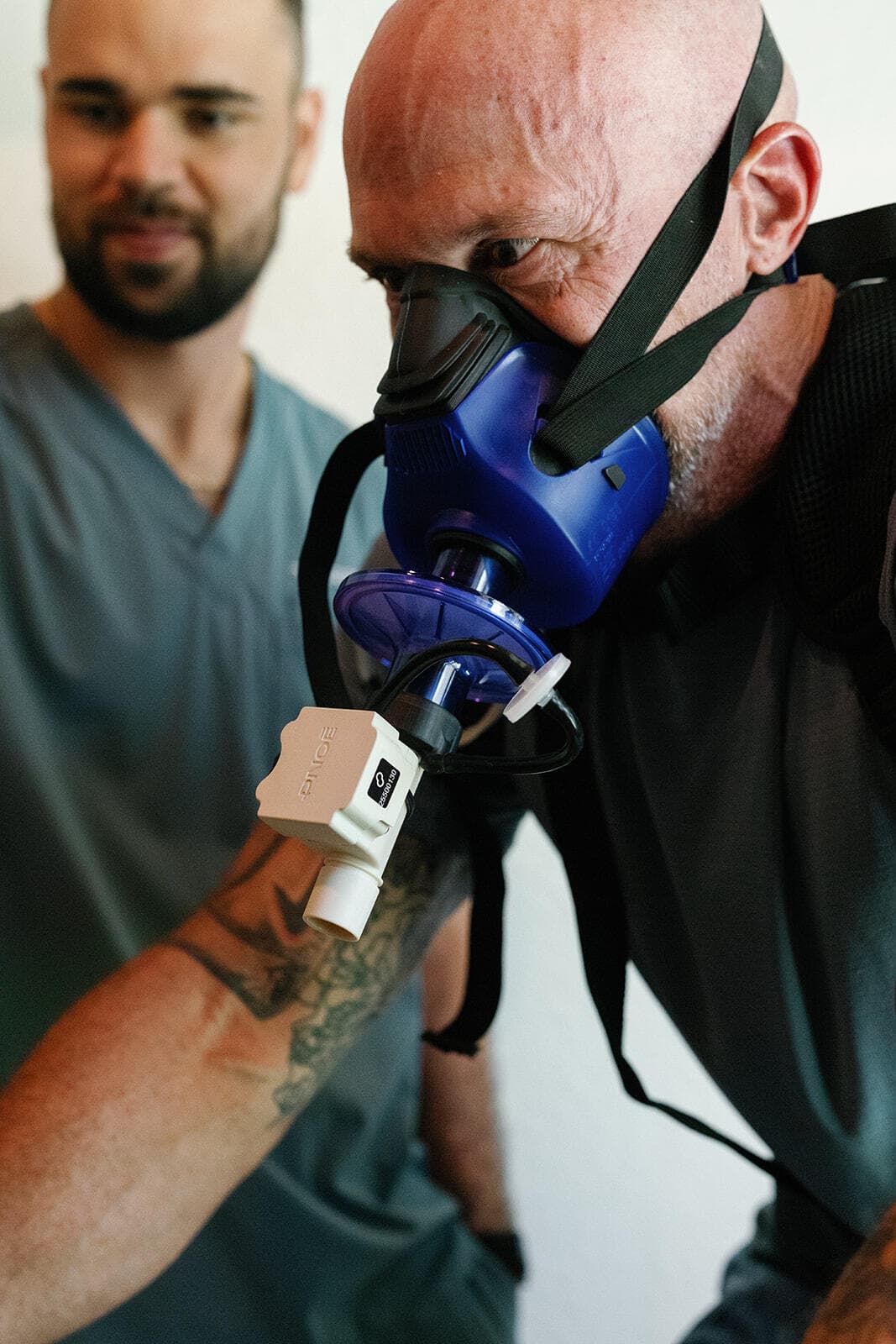
- PNOE metabolic test. A breath analysis that measures oxygen use and carbon dioxide output to calculate metabolic rate, fuel use and cardiorespiratory fitness, at rest or during exercise. It gives you numbers to review with a coach or clinician. Our research summary explains the evidence for biometric testing in general. It does not tell you whether you are overtrained.
- InBody scan. A one-minute bioelectrical impedance scan of muscle, fat and water, useful as a baseline and for tracking change; see our InBody guide. The IOC statement includes guidelines for doing body composition assessment safely, so treat a scan as one input to bring to a professional, never a verdict about your energy intake or health.
For the recovery side, the OutTrain package bundles red light, Normatec compression, infrared sauna, a dry cold plunge and an InBody scan, and its page lists runners, cyclists, endurance athletes and pickleball players among who it is for. Evidence for these therapies in recovery is limited and mixed, and none is a treatment for OTS, which is why they belong beside rest and not in place of it. The OutPerform package is built for heavy training blocks and adds more sessions plus IVs. If you are in a true overreached state, more sessions is not the goal; wait for your doctor's clearance and a plan with lower load first.
What to do this week
Use this as a decision rule:
- Fatigue under about two weeks, performance mostly intact: take two or three easy days, sleep more, eat enough, and see whether you rebound.
- Two or more weeks of lower performance despite rest, or any low mood, poor sleep, weight loss or recurring illness: book a visit with a doctor or sports medicine provider and bring the list above.
- Chest pain, fainting, a very fast or very slow pulse, or thoughts of harming yourself: get care right away.
Wellness services do not replace a doctor's plan. If you have had surgery or have a medical condition, clear anything new with your clinician first. When you are ready to plan a return, call the studio at 675 Piper Boulevard in North Naples to talk through what fits your week.
Sources
- Meeusen R, Duclos M, Foster C, et al. Prevention, diagnosis, and treatment of the overtraining syndrome: joint consensus statement of the European College of Sport Science and the American College of Sports Medicine. Medicine and Science in Sports and Exercise, 2013. https://pubmed.ncbi.nlm.nih.gov/23247672/
- Mountjoy M, Ackerman KE, Bailey DM, et al. 2023 International Olympic Committee's consensus statement on Relative Energy Deficiency in Sport (REDs). British Journal of Sports Medicine, 2023. https://pubmed.ncbi.nlm.nih.gov/37752011/
- International Olympic Committee. 2023 IOC consensus statement on REDs (full text). British Journal of Sports Medicine, 2023. https://stillmed.olympics.com/media/Documents/Athletes/Medical-Scientific/Consensus-Statements/REDs/BJSM-IOC-consensus-statement-on-Relative-Energy-Deficiency-in-Sport-REDs.pdf
- Kreher JB, Schwartz JB. Overtraining syndrome: a practical guide. Sports Health, 2012. https://pmc.ncbi.nlm.nih.gov/articles/PMC3435910
- Kreher JB. Diagnosis and prevention of overtraining syndrome: an opinion on education strategies. Open Access Journal of Sports Medicine, 2016. https://pmc.ncbi.nlm.nih.gov/articles/PMC5019445
- Budgett R. Fatigue and underperformance in athletes: the overtraining syndrome. British Journal of Sports Medicine, 1998. https://pubmed.ncbi.nlm.nih.gov/9631215
- Cleveland Clinic. Overtraining syndrome: symptoms, causes and treatment options. Cleveland Clinic Health Library. https://my.clevelandclinic.org/health/diseases/overtraining-syndrome
- Sleep and athletic performance: impacts on physical performance, mental performance, injury risk and recovery, and mental health. Sleep Medicine Clinics, 2022. https://pmc.ncbi.nlm.nih.gov/articles/PMC9960533
