An InBody scan is a body composition test: you stand barefoot on a platform, hold two handles, and about a minute later you get a printout that splits your weight into muscle, fat and water. It is quick and painless, and it is most useful for watching how your numbers move when you repeat it under the same conditions. A single reading is an estimate with a margin of error. This guide covers what the numbers are, how they compare with the clinical reference method, what throws them off, and how to prepare so the scan tells you something.
What does an InBody scan measure?
An InBody scan uses bioelectrical impedance analysis (BIA). Small electrical currents travel through your body between electrodes at the hands and feet, and the device measures how much the tissue resists them. An equation then converts that resistance into estimates of fat-free mass (everything that is not fat) and total body water (Kyle et al., ESPEN review, 2004).
The word that matters is estimate. The European consensus on sarcopenia notes that BIA equipment "does not measure muscle mass directly" but derives it from whole-body electrical conductivity, using an equation calibrated against DXA lean mass in a specific population (EWGSOP2, 2019). OutRecover's InBody service page describes the same method: you stand on the device, hold the hand electrodes, and the scan takes about 60 seconds.
What is on the printout?
OutRecover's service page lists segmental lean mass, body fat percentage, visceral fat and hydration. InBody's own materials add skeletal muscle mass and describe the water readings.
| Line on the sheet | What it is | What to keep in mind |
|---|---|---|
| Skeletal muscle mass | An estimate of the muscle weight in your body | Weakest agreement with DXA in the 2025 study below, so watch its trend rather than its value |
| Body fat percentage | Fat as a share of your total weight | Moves with hydration; InBody says some prep errors skew it |
| Segmental lean mass | Lean tissue in each arm, each leg and the trunk | Useful for spotting a gap between left and right |
| Body water | Water in your body; InBody states that about 73% of fat-free mass is water | A snapshot of that day, shaped by what you drank and ate |
| Visceral fat | A fat estimate for the abdomen, listed on OutRecover's page | Another estimate |
Sources for the table: InBody result sheet guide, InBody test guide and InBody 580 product page. Which printout format you get depends on the model your studio uses, so ask.
How accurate is an InBody scan compared with DXA?
Against DXA, a clinical X-ray method, InBody devices track body fat percentage fairly well and skeletal muscle mass poorly. In a 2025 study of 108 active adults, the InBody 770 agreed with DXA on body fat percentage (concordance 0.86) but only weakly on skeletal muscle percentage (0.25). It read skeletal muscle at 31.2 kg on average, against 23.1 kg by DXA (Frontiers in Sports and Active Living, 2025).
An earlier study of 102 people, published in 2021, found the InBody 770 underestimated fat mass and overestimated total fat-free mass by 2.33 kg on average (3.6%), with wide person-to-person spread. The authors tested people across a range of hydration and found that range did not change those gaps (Fleck et al., 2021).
Two cautions about reading that. Both studies used the InBody 770, and your studio may run a different model. And in the 2025 study the correlations with DXA were strong (0.89 for skeletal muscle percentage) even where agreement was weak, meaning the device ranked people sensibly but missed the absolute value. That is why the rest of this guide leans on change over time rather than a single number.
What throws the number off?
Hydration, recent exercise and a recent meal can all move a BIA reading, and the studies disagree on how much. One lab gave 39 adults 2 liters of water and found the multifrequency method read body fat percentage about 2 to 2.6 points higher, because it classed the extra water as fat (Jeong et al., 2023). A trial in 55 adults, using a simpler foot-to-foot single-frequency device, found meals and drinks moved body fat percentage by about 1 point, which its authors judged small and within the technique's imprecision (Androutsos et al., 2015).
| Factor | What the research found | What InBody advises |
|---|---|---|
| Drinking a large volume just before | Body fat read 2.1 to 2.6 points higher after 2 L of water (2023) | Normal fluids the day before, hydrate one hour prior |
| A meal | About 1 point change in body fat percentage in healthy adults (2015) | Wait at least 3 hours after eating |
| Exercise | ESPEN review: resistance fell about 3% right after exercise and returned to normal an hour later (2004) | Wait until fully recovered, 1 to 3 days |
| Heat, cold, sweating | No study cited here; InBody's manuals say sweat and blood flow change body water | Allow 20 minutes after hot or cold exposure |
The ESPEN row is a snapshot more than twenty years old, and the InBody column comes from InBody USA's test guide. InBody's H30 user manual adds that it is better to test before a shower or bath, because sweating and blood flow change body water (InBody H30 manual, 2023). By the same logic, our suggestion is to scan before a sauna or cold plunge session, not after. That last point is an inference, not something the manual states about saunas.
Swelling matters too. The ESPEN guideline says whole-body single-frequency BIA is not appropriate where tissue hydration is abnormal, edema included, and that segmental and multifrequency methods, which is what InBody uses, may do better but still need validation (Kyle et al., 2004). If you are weeks out from surgery with a swollen limb, read your numbers loosely. Our guide to swelling after surgery explains what is normal and when to call your surgeon.
How should you prepare for an InBody scan?
Prepare the same way every time, and follow the maker's checklist. The first three items below do the most for repeatability.
- Same time of day for every scan.
- Normal fluids the day before, and a drink one hour before.
- No meal in the three hours before.
- No hard workout until you have fully recovered, which InBody puts at 1 to 3 days.
- Stand upright for 5 to 10 minutes before the test.
- Use the restroom first.
- Remove watches and heavy jewelry, and wear light clothing.
- No lotion on hands or feet, and bare feet (OutRecover's page asks you to remove shoes and socks).
- Give yourself 20 minutes to cool down or warm up if you have been in extreme heat or cold. In Naples in summer, that includes the walk from a hot parking lot.
If you have a metal implant such as a joint replacement, InBody says it may skew fat-free mass results, and that any skew will be consistent from test to test, so your first scan becomes your baseline. The ESPEN guideline also advises noting any prosthesis. Tell whoever runs your scan.
How do you track change with repeat scans?
Use repeat scans to watch a trend under identical conditions, and judge change by direction across several scans rather than by a single jump. InBody suggests testing every 2 to 4 weeks under the same conditions. ESPEN states that assessing changes in fat-free mass, fat mass or body water of less than 1.5 to 2 kg is limited by the precision of BIA (Kyle et al., 2004). That was written about 2004 devices, so a current multifrequency machine may do better, but no newer figure is cited here.
That ceiling matters for strength training. A 2011 meta-analysis of 49 studies found that resistance training added a pooled average of 1.1 kg of lean body mass over about 20 weeks in older adults (Peterson et al., 2011). That is a 15-year-old snapshot, but the scale is the point: the muscle you might build in a few months is close to the size of the device's own noise.
A study of exercise-trained adults on a four-week reduced-calorie diet found that InBody 770 changes in fat mass, fat-free mass and body fat percentage did not differ significantly from DXA's, at the group level, though the InBody showed more variability (Antonio et al., 2019).
A practical way to read your series (our own suggestion, with no validated threshold behind it):
- Treat your first scan as a baseline, and write down the prep you used.
- Repeat it in the same slot, with the same prep, every few weeks.
- Count a change as real only if it repeats on two or three scans in a row.
- Check it against something the scan cannot see, such as the weight you lift or how a chair stand feels.
Who should not have an InBody scan?
People with a pacemaker or another implanted electronic device should not have one. InBody's manuals say individuals with medical implant devices such as pacemakers, or essential support devices, must not use the equipment, because the test passes a small current through the body (InBody 570 manual; InBody H30 manual, 2023). OutRecover's service page says the same: not suitable for clients with pacemakers or other implanted electronic devices.
The ESPEN review anticipates no pacemaker interference and knows of no incidents, but cannot rule out an effect. The maker's instruction, and the studio's rule, is to skip the scan.
On pregnancy, the InBody 570 manual says the current is low-level and not harmful, but "we do not recommend pregnant women test." The H30 manual advises everyone to consult a medical provider before using the device. Ask your obstetrician or midwife before booking.
Where does a scan fit with strength training?
A scan gauges progress and trains nothing. The sarcopenia consensus tests strength first, with grip strength or a timed chair stand, and uses muscle quantity to confirm, so your strength numbers count for more than any printout (EWGSOP2, 2019). Our guide to sarcopenia and muscle loss after 50 lists those tests and what the evidence says about training and protein.
For surgical patients, OutRecover's research summary on body composition covers the wider evidence. Several of the studies it summarizes used CT or DXA rather than a standing BIA device, so it is worth reading with that in mind.
Where OutRecover's InBody scan fits
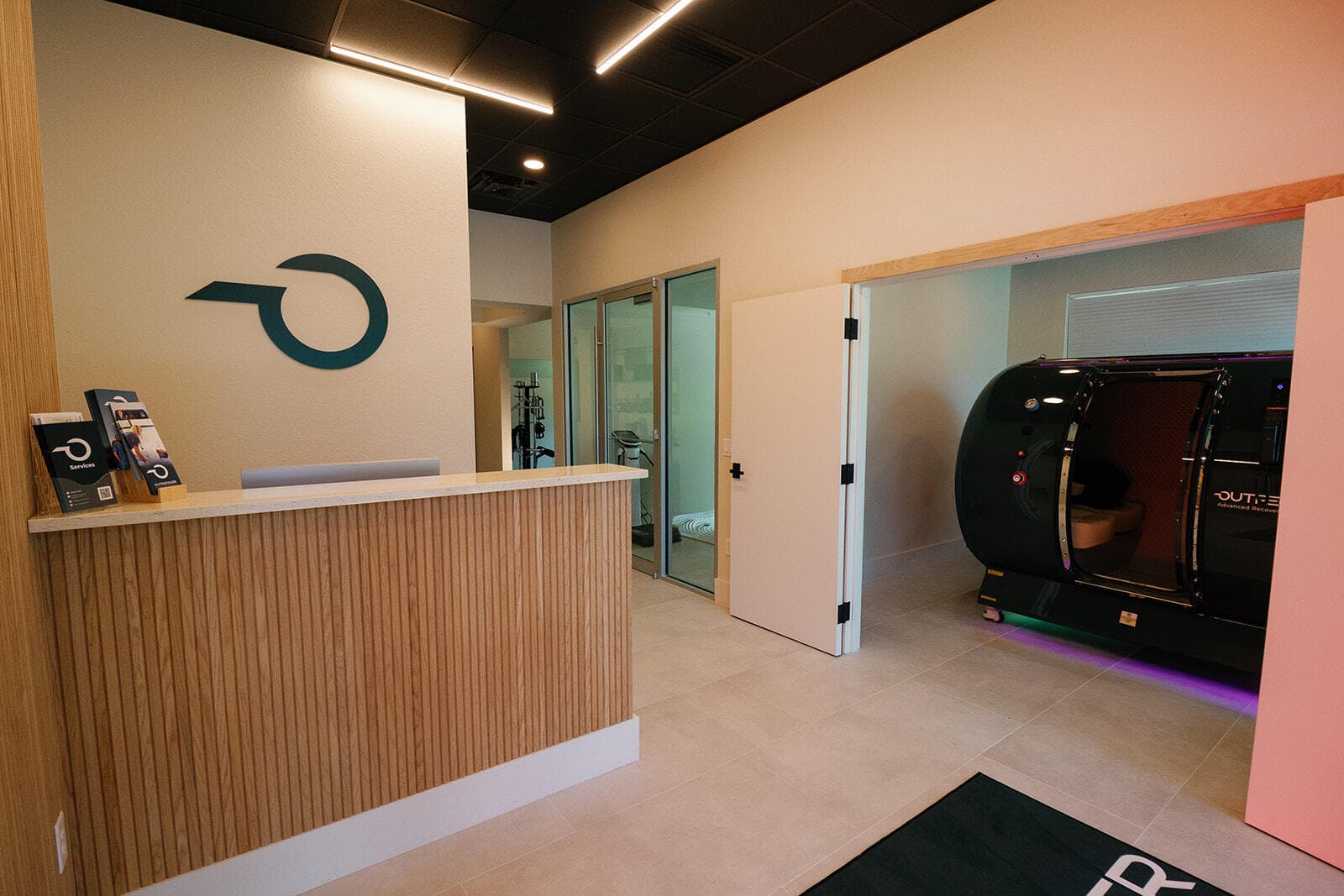
OutRecover offers the InBody scan as a single session at its North Naples studio, with no package or membership required. Its page lists the uses as a baseline before a program, tracking change over time, muscle imbalances and hydration. See the InBody service page for current pricing and booking. The scan measures, and it does not treat anything. Think of it as a way to keep score.
Two athletic recovery packages include an InBody scan: OutTrain, built for runners, cyclists and endurance athletes, tennis, pickleball and golf players, and team-sport athletes and lifters, and OutPerform, built for competitive athletes and people training several times a week. Check each package page for what is bundled with the scan. If you are recovering from surgery, clear anything new with your surgeon first.
Before you book, ask the studio which InBody model it uses, whether it screens for implants, and whether you can book your repeat scans at the same time of day.
Sources
- Kyle UG, Bosaeus I, De Lorenzo AD, et al. Bioelectrical impedance analysis, part I: review of principles and methods. Clinical Nutrition, 2004. https://pubmed.ncbi.nlm.nih.gov/15380917
- Kyle UG, Bosaeus I, De Lorenzo AD, et al. Bioelectrical impedance analysis, part II: utilization in clinical practice (ESPEN guidelines). Clinical Nutrition, 2004. https://espen.org/documents/BIA2.pdf
- Cruz-Jentoft AJ, Bahat G, Bauer J, et al. Sarcopenia: revised European consensus on definition and diagnosis (EWGSOP2). Age and Ageing, 2019. https://pmc.ncbi.nlm.nih.gov/articles/PMC6322506/
- Fleck SJ, Hayes A, Stadler G, et al. Urine specific gravity effect on total and segmental body composition validity of multifrequency bioelectrical impedance analysis compared with dual energy x-ray absorptiometry. Journal of Strength and Conditioning Research, 2021. https://pubmed.ncbi.nlm.nih.gov/33337697
- Wearables for health monitoring: body composition estimates of commercial smartwatch and clinical bioelectrical impedance device. Frontiers in Sports and Active Living, 2025. https://pmc.ncbi.nlm.nih.gov/articles/PMC12669227
- Jeong S, Bonner R, Firari A, et al. The effect of acute hydration on body composition assessed by multi-frequency and single-frequency bioelectrical impedance. Journal of Sports Medicine and Physical Fitness, 2023. https://pubmed.ncbi.nlm.nih.gov/37335581
- Androutsos O, Gerasimidis K, Karanikolou A, Reilly JJ, Edwards CA. Impact of eating and drinking on body composition measurements by bioelectrical impedance. Journal of Human Nutrition and Dietetics, 2015. https://pubmed.ncbi.nlm.nih.gov/25158295
- Antonio J, Kenyon M, Ellerbroek A, et al. Comparison of DXA versus a multi-frequency bioelectrical impedance (InBody 770) device for body composition assessment after a 4-week hypoenergetic diet. Journal of Functional Morphology and Kinesiology, 2019. https://pmc.ncbi.nlm.nih.gov/articles/PMC7739224
- Peterson MD, Sen A, Gordon PM. Influence of resistance exercise on lean body mass in aging adults: a meta-analysis. Medicine and Science in Sports and Exercise, 2011. https://pmc.ncbi.nlm.nih.gov/articles/PMC2995836
- InBody USA. The InBody Test (preparation, testing considerations, testing frequency). Accessed 2026. https://inbodyusa.com/general/inbody-test
- InBody USA. Result Sheet Interpretation. Accessed 2026. https://inbodyusa.com/general/result-sheet
- InBody. InBody 580 body composition analyzer, product page. Accessed 2026. https://inbody.com/kr/en/products/category/body-composition/4
- InBody. InBody 570 user's manual. https://uk.inbody.com/wp-content/uploads/2019/01/570_manual_ENG_D_150520.pdf
- InBody. InBodyDial H30 user's manual, 2023. https://www.inbody.com/assets/download/InBody_H30_User_Manual_2023_Rev01_USA_231214.pdf
- OutRecover. InBody Body Composition Analysis (service page). Accessed 2026. https://outrecover.com/services/inbody-scan