If stairs feel slower, a jar lid is harder, or you reach for the railing more than you used to, you may be noticing muscle loss. Sarcopenia is the medical name for age-related loss of muscle strength and function. The best-supported response is not a supplement or a gadget: it is progressive strength training, enough protein, and balance practice, started before a fall makes the case for you. This guide covers how clinicians define and measure it, how fast it moves, and where studio tools fit.
What is sarcopenia, and how is it measured?
Sarcopenia is age-related loss of muscle strength and function, defined by cut-offs on a few simple tests. The 2019 European consensus (EWGSOP2) screens with a short questionnaire called SARC-F, then tests strength first, with grip strength or a timed chair stand. Low muscle quantity confirms it, and walking speed or similar tests grade severity (EWGSOP2, 2019).
| Test | EWGSOP2 cut-off for low |
|---|---|
| Grip strength | Under 27 kg (men), under 16 kg (women) |
| Chair stand | More than 15 seconds for five rises |
| Muscle mass, appendicular lean mass by height squared | Under 7.0 kg/m² (men), under 5.5 kg/m² (women) |
| Gait speed (severity) | 0.8 m/s or slower |
Source: EWGSOP2, 2019, Table 3.
A U.S. group, the Sarcopenia Definitions and Outcomes Consortium, reached a different conclusion on one point. Its 2020 position statements say a definition should include weakness (low grip strength) and slowness (low usual gait speed). In its analyses, both predicted falls, mobility limitation, hip fractures and death, while lean mass measured by DXA did not predict those outcomes in community-dwelling older adults (SDOC, 2020). The practical lesson: how strong you are and how fast you walk tell you more than a number on a body-composition printout.
How fast do muscle and strength decline after 50?
Strength falls faster than muscle size. A 2012 quantitative review found that at around age 75, longitudinal studies show muscle mass lost at roughly 0.64 to 0.98% a year, while strength is lost at 3 to 4% a year in men and 2.5 to 3% a year in women. Where both were measured in the same people, strength dropped two to five times faster than mass (Mitchell et al., 2012).
Two cautions. These are group averages from a 2012 review, so they describe groups and cannot forecast your own course. The review also notes that cross-sectional comparisons vary widely by method. What holds across sources is the direction: strength erodes steadily without training.
Why does muscle loss after 50 matter?
Weak legs and poor balance raise the chance of a fall, and falls are the leading cause of injury among adults 65 and older. The CDC reports that more than one in four older adults falls each year, that less than half tell their doctor, and that falling once doubles the chance of falling again (CDC, current page). About 37% of people who fall report an injury that needed treatment or limited their activity for at least a day.
The CDC also notes that more than 95% of hip fractures are caused by falls (CDC STEADI materials), and lists poor strength and balance among the risk factors that can be addressed (CDC, older adult falls data). For active people, the stake is practical: keeping the golf, pickleball, stairs and travel you already enjoy.
How to build muscle after 50: what the evidence supports
Progressive resistance training is the first-line answer. A 2026 meta-analysis of exercise in older adults with sarcopenia concluded that exercise is a first-line intervention with clinically meaningful gains in muscle mass, strength and physical performance (moderate-certainty evidence), and that resistance training or multicomponent programs work best (Lucio et al., 2026). The National Strength and Conditioning Association's 2019 position statement calls resistance training a powerful way to counter loss of muscle strength and mass in older adults (Fragala et al., 2019). The ACSM's 2009 position stand says all older adults should be regularly active and avoid inactivity (ACSM, 2009), and the CDC asks older adults for muscle-strengthening work on two or more days a week, plus balance activities (CDC, adult activity guidelines).
"Progressive" is the word to hold onto. The load, reps or difficulty must rise as you adapt. Three rules follow from the sources:
- Train the big muscle groups: legs, hips, back, chest, shoulders, arms.
- Work hard enough that the last reps are demanding, with good form, then add load when it gets easier.
- Do it twice a week or more, every week. The benefit stops when the training does.
If you have a heart condition, joint replacement, osteoporosis or a recent injury, ask your physician or physical therapist what loading is safe before you start.
How much protein do you need after 50?
More than the standard allowance. The 2013 PROT-AGE position paper recommends at least 1.0 to 1.2 g of protein per kilogram of body weight per day for healthy people over 65, and at least 1.2 g/kg for those who exercise (PROT-AGE, 2013). The 2014 ESPEN expert group gave the same range for healthy older people, and 1.2 to 1.5 g/kg for those at risk of malnutrition from illness (ESPEN, 2014).
Worked example, for illustration: a person who weighs 75 kg (about 165 lb) would aim for roughly 75 to 90 g a day under the healthy-adult range. PROT-AGE says people with severe kidney disease are an exception, so check with your doctor if you have kidney problems. Both papers are over ten years old, so read them as established guidance.
Does vitamin D help with muscle loss?
Only if you are low. A 2014 meta-analysis of randomized trials found a small benefit of vitamin D on muscle strength (SMD 0.17), none on muscle mass or power, and larger effects in people whose blood level was under 30 nmol/L and in those 65 or older (Beaudart et al., 2014).
For falls, the U.S. Preventive Services Task Force in 2018 found no benefit from vitamin D in community-dwelling older adults not known to be deficient and recommended against it for that purpose (USPSTF, 2018). Its 2024 update does not address vitamin D, which is under separate review (USPSTF, 2024). The sensible step is a blood test through your doctor, then supplement only if the result says you need it.
Which balance exercises for seniors prevent falls?
Exercise that challenges balance, done regularly, prevents falls. The 2019 Cochrane review of 108 trials with 23,407 community-dwelling older adults found that balance and functional exercises reduced the rate of falls by 24% (high-certainty evidence), and that programs combining several exercise types, typically balance plus resistance work, probably reduced it by 34%. The review was uncertain about resistance training on its own (Sherrington et al., 2019). The USPSTF's 2024 recommendation also recommends exercise interventions for adults 65 and older at increased risk of falls (Grade B).
So strength alone is not the whole plan. Pair it with standing practice such as heel-to-toe walking and sit-to-stand repetitions, the examples the CDC gives, and progress them: eyes on a fixed point, then a narrower stance, then a softer surface, always near a counter or wall.
What if you cannot lift heavy? Blood flow restriction training
Blood flow restriction (BFR) training pairs light loads with cuffs that partly restrict blood flow out of the limb. A 2022 meta-analysis of 10 trials in healthy adults 60 and over found BFR improved strength more than conventional low-load training and not differently from high-intensity training, and called it an option for older people who cannot perform high-load exercise (Labata-Lezaun et al., 2022). A second 2022 meta-analysis of 14 studies found high-load training still produced slightly larger strength gains than low-load BFR, with similar muscle growth (Fabero-Garrido et al., 2022).
A 2020 systematic review in adults over 50 reached a cautious conclusion: BFR may help, but most included studies were at moderate or high risk of bias (Baker et al., 2020). Read that as a promising alternative. It does not show that BFR beats lifting.
Safety needs real screening. The 2019 BFR position stand reports minimal adverse events related to clots across the literature, and notes that higher cuff pressure raises the cardiovascular response and discomfort (Patterson et al., 2019). A 2022 risk-stratification proposal lays out a screening checklist covering clotting history, hormone medications and diabetes risk factors, and flags some higher-risk patients as needing physician clearance first (Nascimento et al., 2022). For the full research summary, see our blood flow restriction evidence page.
A sample week (an illustration, not a prescription)
This shows how the CDC's weekly minimums can look in practice. Your own plan should come from your doctor, physical therapist or trainer, based on your health.
| Day | What | Notes |
|---|---|---|
| Monday | Strength: squat or sit-to-stand, row, press, hip hinge | Last reps hard, form clean |
| Tuesday | Walk, plus 5 minutes of balance practice | Near a counter |
| Wednesday | Rest or easy movement | |
| Thursday | Strength: same pattern, add load if last week felt easy | |
| Friday | Walk or bike, plus balance practice | |
| Saturday | Activity you enjoy: golf, pickleball, swimming | |
| Sunday | Rest | Protein spread across meals all week |
Where studio services fit
Nothing at OutRecover treats sarcopenia, and its pages say its services are wellness-based and do not diagnose or treat disease. What the studio offers is a place to do the training the evidence points to, with equipment that can lower the barrier if heavy lifting is hard.
- Blood flow restriction (KAATSU): light exercise with pressure-monitored cuffs. The page lists muscle loss prevention among its uses and says it is not appropriate with a history of deep vein thrombosis, certain circulatory disorders or active infection. See the research above and in the science summary.
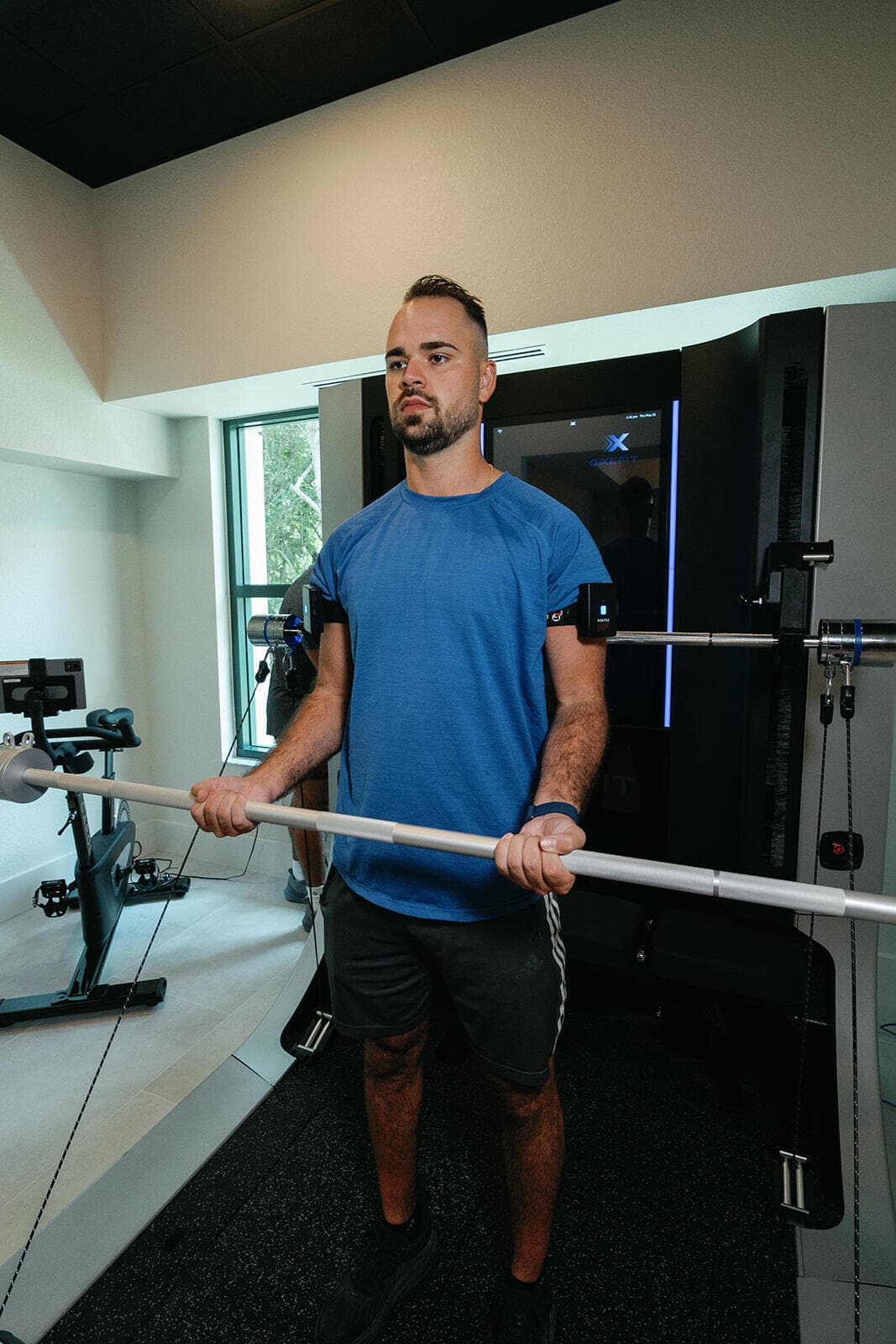
- OxeFit: AI-guided strength training that adjusts resistance through your range of motion and records each session. OutRecover's own research summary states that no trials evaluate OxeFit itself; the evidence above is for resistance training in general.
- Precision training: a trainer-led session that rotates between OxeFit, BFR and the AI bike, with an assessment before the first session. A trainer helps most with form and progression.
- AI bike (CAROL): a guided short-sprint bike workout. It adds cardio and does not replace strength work, and the page says it is not recommended with certain cardiac conditions.
- InBody scan: a bioelectrical impedance reading of muscle, fat and water. It is a tracking tool with limits (below), and the page says it is not suitable for people with pacemakers or other implanted electronic devices.
What about the InBody scan? EWGSOP2 lists bioimpedance (BIA) among the methods for estimating muscle quantity in usual care, but accuracy varies. A 2023 comparison with DXA in 42 hospitalized older adults noted that BIA accuracy for muscle mass in older adults is inconsistent across studies and that hydration status may bias estimates (J Clin Med, 2023). Use a scan to watch your own trend under the same conditions (same time of day, same hydration), and remember that in the SDOC analysis strength and walking speed predicted outcomes while lean mass did not. A grip test and a chair-stand time cost nothing and tell you a lot.
Your next step
Today, time yourself standing up from a chair five times without using your hands. If it takes more than 15 seconds, or you cannot do it, tell your doctor and ask for a strength and balance assessment or a physical therapy referral. If you are cleared and want a place to train, book a session or take the two-minute quiz, and tell the team about any heart condition, blood clot history or implanted device at intake. For related reading, see our guides on pickleball injuries and how to prepare for knee replacement, where strength before surgery matters too.
Sources
- Cruz-Jentoft AJ, et al. Sarcopenia: revised European consensus on definition and diagnosis (EWGSOP2). Age and Ageing, 2019. https://pmc.ncbi.nlm.nih.gov/articles/PMC6322506/
- Bhasin S, et al. Sarcopenia Definition: The Position Statements of the Sarcopenia Definition and Outcomes Consortium. Journal of the American Geriatrics Society, 2020. https://pubmed.ncbi.nlm.nih.gov/32150289
- Mitchell WK, et al. Sarcopenia, dynapenia, and the impact of advancing age on human skeletal muscle size and strength; a quantitative review. Frontiers in Physiology, 2012. https://pmc.ncbi.nlm.nih.gov/articles/PMC3429036
- Centers for Disease Control and Prevention. Facts About Older Adult Falls. Current page. https://www.cdc.gov/falls/data-research/facts-stats/index.html
- Centers for Disease Control and Prevention. Patient and Caregiver Resources, STEADI. Current page. https://www.cdc.gov/steadi/patient-resources/index.html
- Centers for Disease Control and Prevention. Older Adult Falls Data. Current page. https://www.cdc.gov/falls/data-research/index.html
- Lucio MCF, et al. Systematic review and meta-analysis of the effects of exercise in older adults with sarcopenia. Scientific Reports, 2026. https://www.nature.com/articles/s41598-026-55850-w
- Fragala MS, et al. Resistance Training for Older Adults: Position Statement From the National Strength and Conditioning Association. Journal of Strength and Conditioning Research, 2019. https://pubmed.ncbi.nlm.nih.gov/31343601
- American College of Sports Medicine. Exercise and Physical Activity for Older Adults (position stand). Medicine and Science in Sports and Exercise, 2009. https://pubmed.ncbi.nlm.nih.gov/19516148
- Centers for Disease Control and Prevention. Older Adult Activity: An Overview. Current page. https://www.cdc.gov/physical-activity-basics/guidelines/older-adults.html
- Bauer J, et al. Evidence-based recommendations for optimal dietary protein intake in older people: a position paper from the PROT-AGE Study Group. Journal of the American Medical Directors Association, 2013. https://pubmed.ncbi.nlm.nih.gov/23867520
- Deutz NEP, et al. Protein intake and exercise for optimal muscle function with aging: recommendations from the ESPEN Expert Group. Clinical Nutrition, 2014. https://pubmed.ncbi.nlm.nih.gov/24814383
- Beaudart C, et al. The effects of vitamin D on skeletal muscle strength, muscle mass, and muscle power: a systematic review and meta-analysis of randomized controlled trials. Journal of Clinical Endocrinology and Metabolism, 2014. https://pubmed.ncbi.nlm.nih.gov/25033068
- US Preventive Services Task Force. Interventions to Prevent Falls in Community-Dwelling Older Adults (archived 2018 recommendation). https://www.uspreventiveservicestaskforce.org/uspstf/recommendation/falls-prevention-in-older-adults-interventions-2018
- US Preventive Services Task Force. Falls Prevention in Community-Dwelling Older Adults: Interventions (2024 recommendation). https://www.uspreventiveservicestaskforce.org/uspstf/recommendation/falls-prevention-community-dwelling-older-adults-interventions
- Sherrington C, et al. Exercise for preventing falls in older people living in the community. Cochrane Database of Systematic Reviews, 2019. https://pubmed.ncbi.nlm.nih.gov/30703272
- Labata-Lezaun N, et al. Effectiveness of Blood Flow Restriction Training on Muscle Strength and Physical Performance in Older Adults: A Systematic Review and Meta-analysis. Archives of Physical Medicine and Rehabilitation, 2022. https://pubmed.ncbi.nlm.nih.gov/35026149
- Fabero-Garrido R, et al. Effects of Low-Load Blood Flow Restriction Resistance Training on Muscle Strength and Hypertrophy Compared with Traditional Resistance Training in Healthy Adults Older Than 60 Years. Journal of Clinical Medicine, 2022. https://pubmed.ncbi.nlm.nih.gov/36556004
- Baker BS, et al. Does Blood Flow Restriction Therapy in Patients Older Than Age 50 Result in Muscle Hypertrophy, Increased Strength, or Greater Physical Function? A Systematic Review. Clinical Orthopaedics and Related Research, 2020. https://pubmed.ncbi.nlm.nih.gov/31860546
- Patterson SD, et al. Blood Flow Restriction Exercise: Considerations of Methodology, Application, and Safety. Frontiers in Physiology, 2019. https://pubmed.ncbi.nlm.nih.gov/31156448
- Nascimento DC, et al. A Useful Blood Flow Restriction Training Risk Stratification for Exercise and Rehabilitation. Frontiers in Physiology, 2022. https://pmc.ncbi.nlm.nih.gov/articles/PMC8963452
- Evaluation of Multi-Frequency Bioelectrical Impedance Analysis against Dual-Energy X-ray Absorptiometry for Estimation of Low Muscle Mass in Older Hospitalized Patients. Journal of Clinical Medicine, 2023. https://pmc.ncbi.nlm.nih.gov/articles/PMC10779600
