With a knee replacement four to eight weeks out, the most useful work is small and specific: quit nicotine if you use it, get your blood sugar and protein in order, tell your team about every supplement, set up your home, and ask your surgeon the questions only they can answer. Exercise before surgery helps a little, and the research is honest about how little. This guide gives you a week-by-week order of operations and the evidence behind each step.
How to prepare for knee replacement surgery, week by week
Start with the items that take the longest to change. Nicotine needs weeks off to matter, blood sugar moves slowly, and home changes take a weekend. Treat the table below as a template, then replace its timing with whatever your surgeon's office gives you. Your surgeon's instructions always win.
| When | What to do | Why it sits here |
|---|---|---|
| Weeks 8 to 6 before | Tell your surgeon about nicotine, vaping, alcohol use, diabetes and every supplement. Book any dental work. Ask for prehab exercises. Start a protein plan. | Nicotine and blood sugar take the longest to improve, and dental work is scheduled well ahead of surgery (AAOS). |
| Weeks 6 to 4 | Stay nicotine-free. Train as your surgeon or therapist directs. Do the medical check-up and tests your team schedules. | The ERAS Society recommends 4 weeks or more without smoking before surgery. |
| Weeks 4 to 2 | Set up the home: clear rugs, rearrange rooms, borrow a walker. Cook and freeze meals. Line up your driver and helper. | A tested walker route and a stocked freezer cost nothing and prevent the first-week scramble. |
| Final 2 weeks | Follow your team's written list for supplements and medicines. Pack your bag. Report any fever, cold, or break in the skin of the operated leg. | Some supplements are stopped about two weeks ahead, only if your anesthesia team says so (ASA). |
| Day before and morning of | Shower as instructed, skip shaving the knee, and follow the fasting instructions you were given. | Fasting rules differ by hospital, so use your hospital's version, not a general one. |
Does prehab before knee replacement work?
Yes, a little, mostly before the operation and for a short while after. A 2023 meta-analysis in JAMA Network Open pooled 48 randomized trials and found moderate-certainty evidence that prehab improved knee function and strength before surgery, and function at 6 weeks after it. Punnoose et al., 2023 Other differences were low or very low quality.
The picture gets weaker as you look further out. An earlier review of 35 studies found small to moderate effect sizes, with better function and quadriceps strength after knee replacement but no significant difference in pain. Moyer et al., 2017 A 2024 review judged 24 of 28 trials at high risk of bias and concluded the bias and inconsistency prevent firm conclusions about outcomes up to a year. Adebero et al., 2024 A 2022 systematic review said prehab may increase strength and shorten hospital stay, all rated low certainty. Konnyu et al., 2022
The ERAS Society's 2020 consensus statement goes furthest: it says current evidence does not support preoperative physiotherapy as an essential intervention, because the effects in isolation are too small to be clinically important. ERAS Society, 2020 It adds that broader programs (exercise plus nutrition and psychological preparation) need hip- and knee-specific studies, and that any benefit may be limited to frail patients or those with several health conditions.
What that means for you: prehab is low-risk and may leave you a bit stronger on day one, but it will not make or break your recovery. Ask your surgeon which exercises they want. The AAOS suggests isometric exercises to hold leg muscle strength, upper-body work to make a walker or crutches easier, and learning your post-op exercises now. AAOS OrthoInfo
What should you eat before knee replacement surgery?
Eat a balanced diet with enough protein, and ask your surgeon or a dietitian for a target. The AAOS advises a nutritious, well-balanced diet. The American Society for Enhanced Recovery and the Perioperative Quality Initiative recommend routine nutrition screening before surgery and say protein delivery matters more than total calories. Wischmeyer et al., 2018
A 2021 review of orthopedic nutrition reports that ERAS protocols call for 1.2 to 2.0 grams of protein per kilogram of body weight a day, spread across meals at 20 to 40 grams per sitting. Hirsch et al., 2021 As arithmetic only: for someone weighing 80 kilograms (about 176 pounds), 1.2 grams per kilogram is 96 grams a day. If you have kidney disease or diabetes, get a personal target first.
Two cautions. Fasting before the operation is the hospital's call: the ERAS statement allows clear fluids until 2 hours and solids until 6 hours before anesthesia, but follow your own instructions. And the AAOS says to have no alcohol for at least 48 hours before surgery.
Do blood sugar and smoking change your risk?
Both do, and both are fixable ahead of time. The AAOS says smoking affects circulation, delays healing and may raise infection risk, and that vaping counts. AAOS, Surgery and Smoking The ERAS Society recommends 4 weeks or more without smoking, graded as high-quality evidence. The AAHKS advises stopping all nicotine products at least 4 to 6 weeks ahead. AAHKS
For blood sugar, the AAHKS says readings that frequently reach 180 mg/dL or more count as uncontrolled and bring a much higher risk, and that your surgeon may delay surgery until control improves. HbA1c, the lab test your team will use, reflects average glucose over the previous two to three months, which is why a change this month shows up slowly. Khan et al., 2026 If you have diabetes, ask for your target number and who is managing it.
Which supplements and medicines should you stop before surgery?
Your surgeon and anesthesiologist decide which supplements and medicines to stop, so ask them rather than a website. The American Society of Anesthesiologists says some supplements can prolong anesthesia, raise bleeding risk, raise blood pressure or interfere with other drugs, and that in some cases your anesthesiologist may recommend stopping supplements at least two weeks before. ASA, 2020 The ASA also notes that half of people who use herbal supplements do not tell their doctors before surgery.
The AAOS adds that your doctor may stop certain medications or supplements a week or two ahead, and that corticosteroids, insulin and blood thinners need managing before and after. So write one list: every prescription, over-the-counter product, vitamin, herb and powder, with doses. Bring the bottles to your pre-surgery visit. Do not stop a prescription on your own.
How do you get your home ready?
Plan for a walker, a helper and no clutter. The AAOS checklist is practical: double batches of meals frozen for the first weeks, daily items at arm level, rugs removed, cords secured, a borrowed walker or crutches tried in your actual rooms, and for the bathroom a shower chair, grab bar or raised toilet seat. AAOS OrthoInfo
Add a reacher, a long-handled shoehorn and sponge, and a shoulder bag for your things while you use a walker. If you drive or a helper does, the AAOS suggests applying for a temporary disabled parking permit several weeks ahead. For what comes after, see our knee replacement recovery timeline and, for the swelling most people meet early, how to reduce swelling after surgery.
Does sleep matter before surgery?
Possibly, but the evidence is mixed. A 2024 systematic review of 32 studies with 18,792 patients listed preoperative sleep disorders among ten factors strongly associated with chronic pain after knee replacement. Li et al., 2024 A 2021 study of 163 knee and hip patients found poor sleepers had more pain before surgery, but poor sleep was not an independent predictor of pain a year later. Larsen et al., 2021
Association is not proof that fixing sleep fixes pain. Still, a steady bedtime costs nothing, and arthritis pain often disrupts sleep. Tell your surgeon if it does, so the plan can include it.
What should you ask your surgeon?
Bring this list to your pre-surgery visit and write the answers down.
- Which medicines and supplements do I stop, and on what date?
- What are the fasting rules for my surgery time?
- Which exercises should I do now, and how often?
- What blood sugar or HbA1c number do you want, and who helps me reach it?
- If I use nicotine, what support will you give me to stop?
- When must dental work be finished?
- Is any service outside your office, such as oxygen, compression or PEMF, fine for me before surgery?
- What will pain control look like, and who do I call with problems?
- Will I need a walker, and for how long?
The AAOS publishes a longer list in its questions patients should ask their surgeon.
Where do studio services fit before surgery?
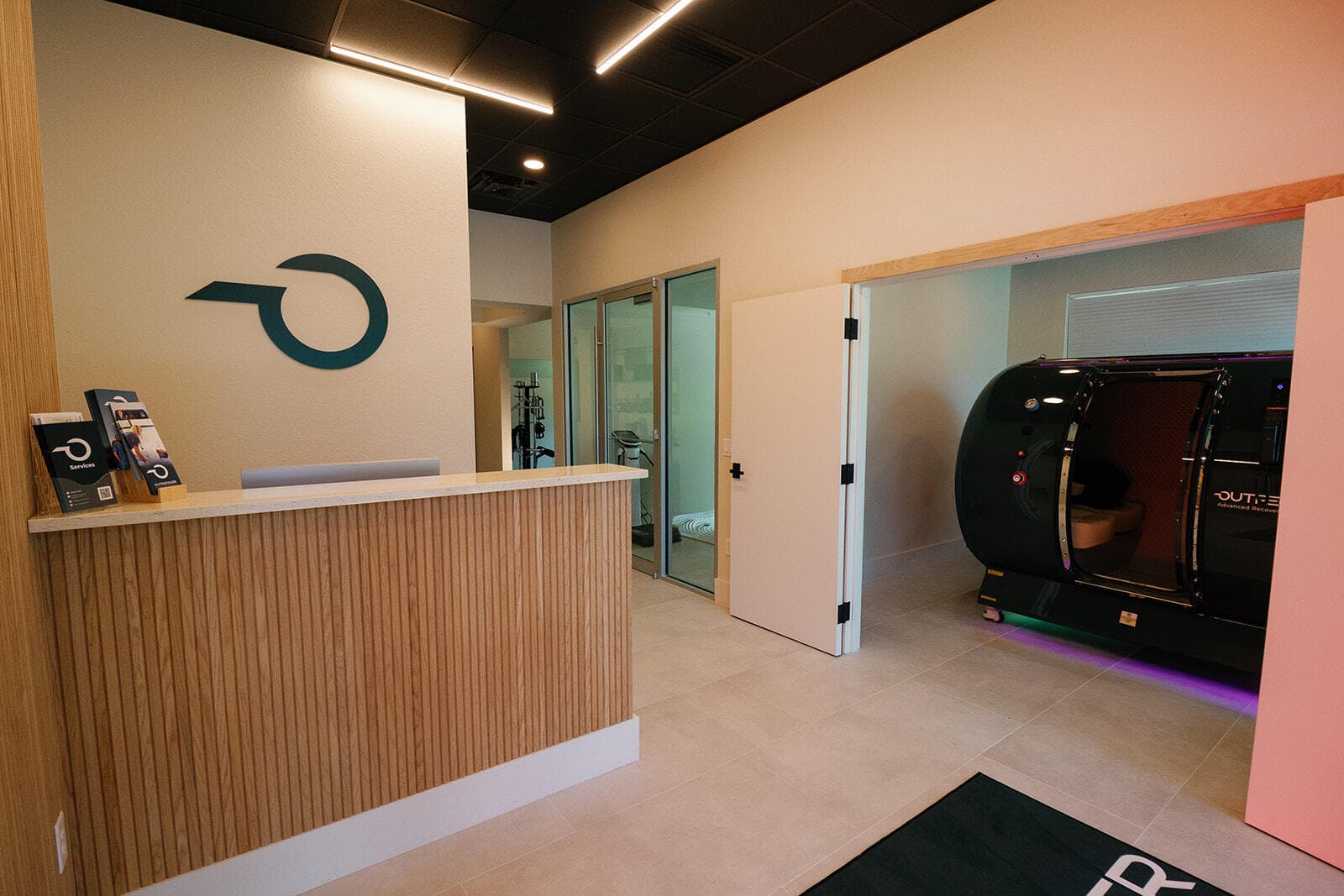
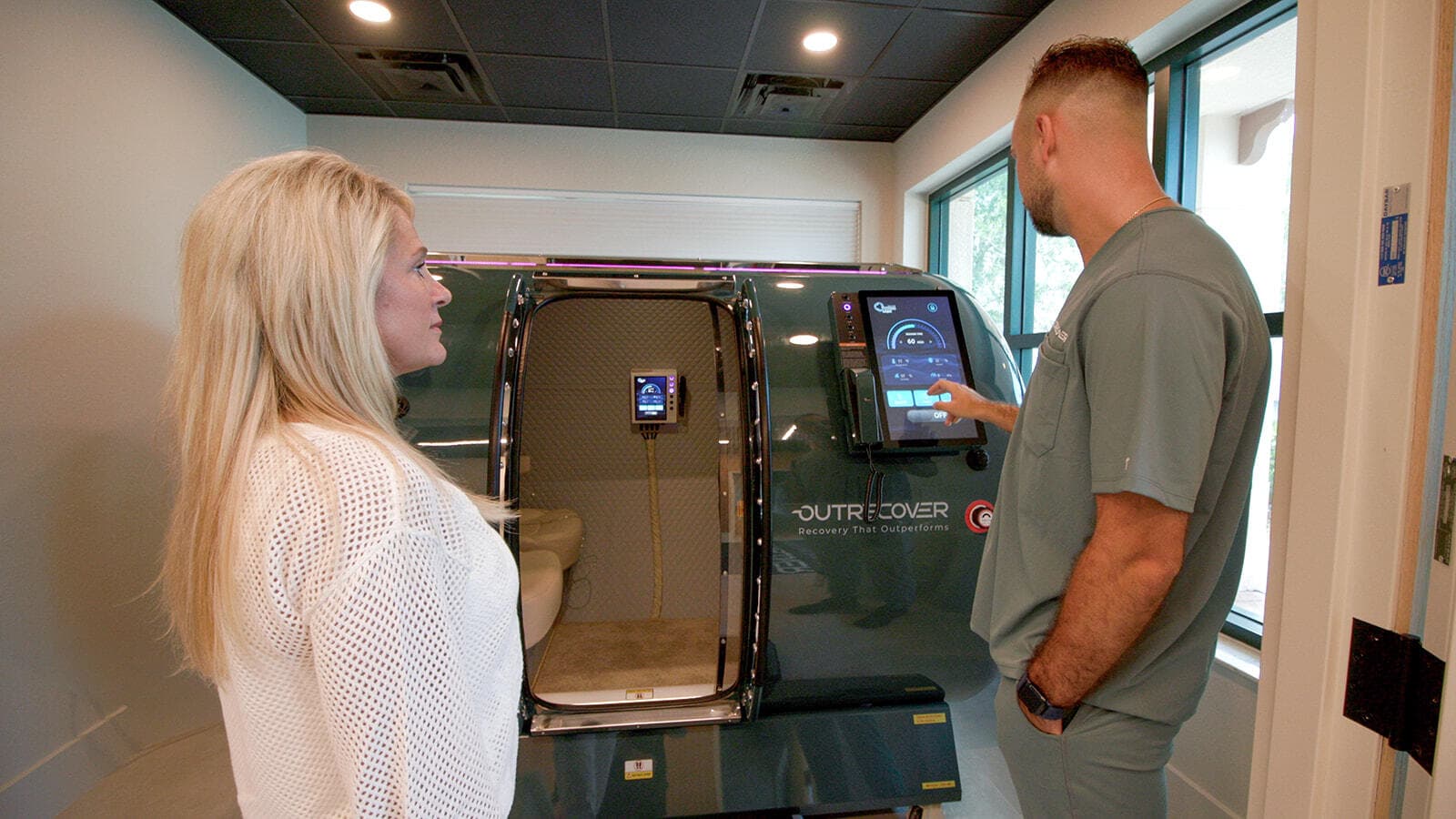
Studio services fit before surgery as optional support next to the plan above, never in place of it. OutRecover's OutReady package combines hyperbaric oxygen therapy, a pre-op IV through partner OutInfuse (which needs medical approval) and compression. OutPrepare adds PEMF, which can be swapped for red light, and molecular hydrogen. Sessions after surgery follow your surgeon's clearance, and we schedule around your surgery date.
Here is what the evidence supports. For hyperbaric oxygen, OutRecover's own research page places the strongest evidence in wound healing, decompression sickness, carbon monoxide poisoning and radiation injury, not in preparing for elective joint surgery. A 2026 narrative review calls the perioperative evidence limited by differences in protocols and patients and asks for multicenter randomized trials. González Flores et al., 2026 The one knee-replacement trial we found gave oxygen after surgery, in a small single-center study, and saw lower muscle-injury markers on day three but no significant difference in range of motion, quadriceps strength or swelling at 14 days. Scientific Reports, 2025 We found no trial of oxygen sessions before a knee replacement.
Compression and PEMF rest on other evidence: pneumatic compression's strongest record is clot prevention in hospital settings, and PEMF's best-supported use is osteoarthritis pain, according to our research pages. We have not found trials of either as pre-surgery preparation. People choose them for comfort and a clinician-guided routine, and you should too, with your surgeon's agreement. Compression is avoided over active DVT sites, open wounds or skin infections, and PEMF is not recommended with pacemakers or electrical implants.
Your next step
This week, build your list. Write down every supplement and medicine, note your nicotine and blood sugar status, and send your surgeon the questions above. Then pick a date for the home setup. If you want to ask about OutReady or OutPrepare, tell the studio your surgery date and get your surgeon's clearance first.
Sources
- Punnoose A, Claydon-Mueller LS, Weiss O, Zhang J, Rushton A, Khanduja V. Prehabilitation for Patients Undergoing Orthopedic Surgery: A Systematic Review and Meta-analysis. JAMA Network Open, 2023. https://pubmed.ncbi.nlm.nih.gov/37052919
- Moyer R, Ikert K, Long K, Marsh J. The Value of Preoperative Exercise and Education for Patients Undergoing Total Hip and Knee Arthroplasty: A Systematic Review and Meta-Analysis. JBJS Reviews, 2017. https://pubmed.ncbi.nlm.nih.gov/29232265
- Adebero T, Omana H, Somerville L, Lanting B, Hunter SW. Effectiveness of prehabilitation on outcomes following total knee and hip arthroplasty for osteoarthritis. Disability and Rehabilitation, 2024. https://pubmed.ncbi.nlm.nih.gov/38349251
- Konnyu KJ, Thoma LM, Cao W, et al. Prehabilitation for Total Knee or Total Hip Arthroplasty: A Systematic Review. American Journal of Physical Medicine & Rehabilitation, 2022. https://pmc.ncbi.nlm.nih.gov/articles/PMC9464791
- Wainwright TW, Gill M, McDonald DA, et al. Consensus statement for perioperative care in total hip replacement and total knee replacement surgery: ERAS Society recommendations. Acta Orthopaedica, 2020. https://pmc.ncbi.nlm.nih.gov/articles/PMC7006728
- American Academy of Orthopaedic Surgeons. Preparing for Joint Replacement Surgery. OrthoInfo. https://orthoinfo.aaos.org/en/treatment/preparing-for-joint-replacement-surgery/
- American Academy of Orthopaedic Surgeons. Orthopaedic Surgery and Smoking. OrthoInfo. https://orthoinfo.aaos.org/en/treatment/surgery-and-smoking/
- American Association of Hip and Knee Surgeons. Decreasing Your Risk of Infection (knee care). HipKneeInfo, revised 2018. https://hipkneeinfo.org/knee-care/decreasing-your-risk-of-infection/
- Khan U, Crespi Z, Nham F, El Othmani M. Diabetes Optimization in Total Joint Arthroplasty. JAAOS Global Research and Reviews, 2026. https://pmc.ncbi.nlm.nih.gov/articles/PMC12908745
- American Society of Anesthesiologists. Herbal and Dietary Supplements and Anesthesia. 2020. https://madeforthismoment.asahq.org/wp-content/uploads/2020/10/ASA_Supplements-Anesthesia_Updated-1.pdf
- Wischmeyer PE, Carli F, Evans DC, et al. American Society for Enhanced Recovery and Perioperative Quality Initiative Joint Consensus Statement on Nutrition Screening and Therapy Within a Surgical Enhanced Recovery Pathway. Anesthesia & Analgesia, 2018. https://pubmed.ncbi.nlm.nih.gov/29369092
- Hirsch KR, Wolfe RR, Ferrando AA. Pre- and Post-Surgical Nutrition for Preservation of Muscle Mass, Strength, and Functionality Following Orthopedic Surgery. Nutrients, 2021. https://pmc.ncbi.nlm.nih.gov/articles/PMC8156786
- Li J, Guan T, Zhai Y, Zhang Y. Risk factors of chronic postoperative pain after total knee arthroplasty: a systematic review. Journal of Orthopaedic Surgery and Research, 2024. https://pmc.ncbi.nlm.nih.gov/articles/PMC11134678
- Boye Larsen D, Laursen M, Simonsen O, et al. The association between sleep quality, preoperative risk factors for chronic postoperative pain and postoperative pain intensity 12 months after knee and hip arthroplasty. British Journal of Pain, 2021. https://pmc.ncbi.nlm.nih.gov/articles/PMC8611299
- González Flores JE, Vázquez Hernández DB, et al. Hyperbaric Oxygen Therapy in Modern Surgical Practice: Mechanistic Basis and Clinical Applications Across Specialties. Cureus, 2026. https://pmc.ncbi.nlm.nih.gov/articles/PMC12924891
- Effect of hyperbaric oxygen therapy on postoperative muscle damage and inflammation following total knee arthroplasty: a randomized controlled trial. Scientific Reports, 2025. https://www.nature.com/articles/s41598-025-06223-2