Most people walk with a walker within two or three days of a total knee replacement, drive somewhere between three and six weeks, and are back to most daily activities by about six weeks. The knee itself keeps settling for months. Swelling, stiffness and night pain that fade slowly are the usual pattern, and this guide shows what the major sources say is normal at each stage so you can tell it apart from a problem.
Recovery varies with your health, your fitness before surgery and whether one or both knees were done (HSS). Your surgeon's plan comes first. Everything below is a general picture of recovery, and your knee sets its own pace.
What does a knee replacement recovery timeline look like?
The timeline below combines the American Academy of Orthopaedic Surgeons (AAOS), Hospital for Special Surgery (HSS) and MedlinePlus. Where sources give a range, the range is shown. Read each row as typical. Missing a row by a week or two is no cause for alarm.
| Stage | What the sources report |
|---|---|
| Hospital, days 1 to 3 | Physical therapy starts within 24 hours. Most people walk with a walker, cane or crutches within two or three days (HSS). A stay is typically 1 to 3 days, and some people go home the same day (AAOS). |
| Weeks 1 to 2 | Moderate to severe swelling is expected in the first days or weeks (AAOS). Therapy centers on getting the knee to bend and straighten. AAOS suggests walking for 30 minutes, two to three times a day, if your team agrees (AAOS exercise guide). |
| Weeks 3 to 6 | Most people use a walker for about three weeks, then a cane for two to three more (HSS). Many return to nearly all daily activities in this window (MedlinePlus). Light ankle-weight exercises can usually begin at 4 to 6 weeks (AAOS exercise guide). |
| Weeks 6 to 12 | Walking without a cane is typical around week six. Strength work runs from about week 6 to 16 (HSS PT guide). Cycling and golf return within two to three months for most people (HSS). |
| 3 to 6 months | Mild to moderate swelling can last for about 3 to 6 months (AAOS). In one small study, bend stopped improving around month three (Mutsuzaki, 2017). |
| 6 to 12 months | HSS says full strength and mobility can take six months or more (HSS). MedlinePlus gives 4 months to a year for full recovery (MedlinePlus). |
If you are still before surgery, how to prepare for knee replacement covers the weeks leading up to it.
How far should your knee bend, and when?
Range of motion is how far your knee can straighten and bend. The sources do not set one universal target, so these are findings, not goals. In a retrospective study of 193 patients in Japan, a bend of about 85 degrees at day five and 105 degrees at one month was associated with reaching 120 degrees at 12 months (Oka, 2020). In a smaller study of 26 patients, straightening kept improving until about six months and bending peaked around three months (Mutsuzaki, 2017).
Both studies are single-country and modest in size, so use them as context for a conversation with your therapist. If your bend stalls, tell your surgeon early. AAOS notes that scar tissue can limit motion after a replacement, and a surgeon may recommend manipulation under anesthesia (AAOS).
Swelling after knee replacement: how long does it last?
Expect swelling that peaks early and fades slowly. AAOS says moderate to severe swelling is common in the first days or weeks, with mild to moderate swelling for about 3 to 6 months (AAOS). In a study of 85 patients, knee swelling rose about 35% above pre-surgery levels on day one and was still about 11% above them at day 90 (Pua, 2015). That study also linked more swelling with weaker thigh muscles and slower walking.
Some swelling is part of healing. New or sudden swelling in the calf, ankle or foot is different: AAOS lists it as a possible blood clot warning (see below). For the general mechanics of swelling after any operation, read how to reduce swelling after surgery.
Pain and sleep: what is normal?
Pain tends to fall steadily. In a German study that tracked driving ability, average pain ratings dropped from about 5 right after surgery to about 3 at weeks three to four and about 2 at week six (Kirschbaum, 2020). AAOS asks you to use opioids only as directed, stop as soon as pain improves, and talk to your doctor if pain has not begun to improve within a few days (AAOS).
Sleep is often the hardest part. A 2025 review reports that sleep disruption is most severe in the first six weeks and improves over six months to a year, often without fully returning to normal (Zhu, 2025). In a Korean cohort, 46.6% still had night pain at three months, falling to 7.4% at one year (Lee, 2022). AAOS says you may sleep on your back, either side or your stomach (AAOS).
When can you drive after a knee replacement?
Most people drive again around four to six weeks after surgery. AAOS says you can resume when your knee bends enough to sit comfortably in the car and your muscle control gives adequate braking and acceleration reaction time (AAOS). It also ties driving to being off opioid pain medication.
Studies fit that range:
- Brake response times of 29 right-knee patients were back to baseline by week four (Dalury, 2010).
- In a prospective study, reaction time and brake force were back to baseline at week six (Kirschbaum, 2020).
- In a 2026 survey of 408 hip and knee patients, 11% of knee patients drove within two weeks and 65% by week six. The median for knee patients was six weeks. Across all 408 patients it was four weeks after a left-leg operation and six weeks after a right-leg one (Danielsen, 2026).
A simple decision rule: drive only when you are off opioids, you can sit in the car comfortably, you can press the pedal firmly without hesitation, and your surgeon has said yes. Right knee, add a margin.
When should you call your surgeon?
Call right away for any sign of infection or a blood clot. AAOS lists these signs (AAOS):
- Infection: a persistent fever above 100 degrees, shaking chills, increasing redness, tenderness or swelling around the wound, drainage from the wound, or increasing pain at rest and with activity.
- Blood clot in the leg: pain in your leg or calf unrelated to your incision, tenderness or redness above or below the knee, or increasing swelling of the calf, ankle or foot.
- Clot that has reached the lung: shortness of breath, sudden chest pain, or localized chest pain with coughing. AAOS says to tell your doctor right away. If you cannot reach them, go to an emergency department.
AAOS also notes that infection can follow dental procedures, urinary tract infections or skin infections, so mention your new knee to any provider (AAOS).
What are the best knee replacement recovery tips?
The evidence supports a short list:
- Do the exercises. AAOS suggests 20 to 30 minutes of exercise once or several times a day and keeping up ankle pumps until swelling goes away (AAOS exercise guide).
- Raise your leg and ice it. AAOS recommends both for swelling, and says compression stockings may also help (AAOS). One 88-patient trial found stockings made no difference in swelling or pain, and most swelling had already formed by the morning after surgery (Munk, 2012), so expect to combine several measures.
- Keep the wound clean and dry and change the dressing only as directed (AAOS).
- Pace yourself. Skip the elliptical for the first 12 weeks, per an HSS physical therapist (HSS PT guide).
- Keep a swelling and bend log. Write down morning bend, swelling at day's end and pain at night. It gives your therapist and surgeon facts to work with.
Where do recovery-studio services fit?
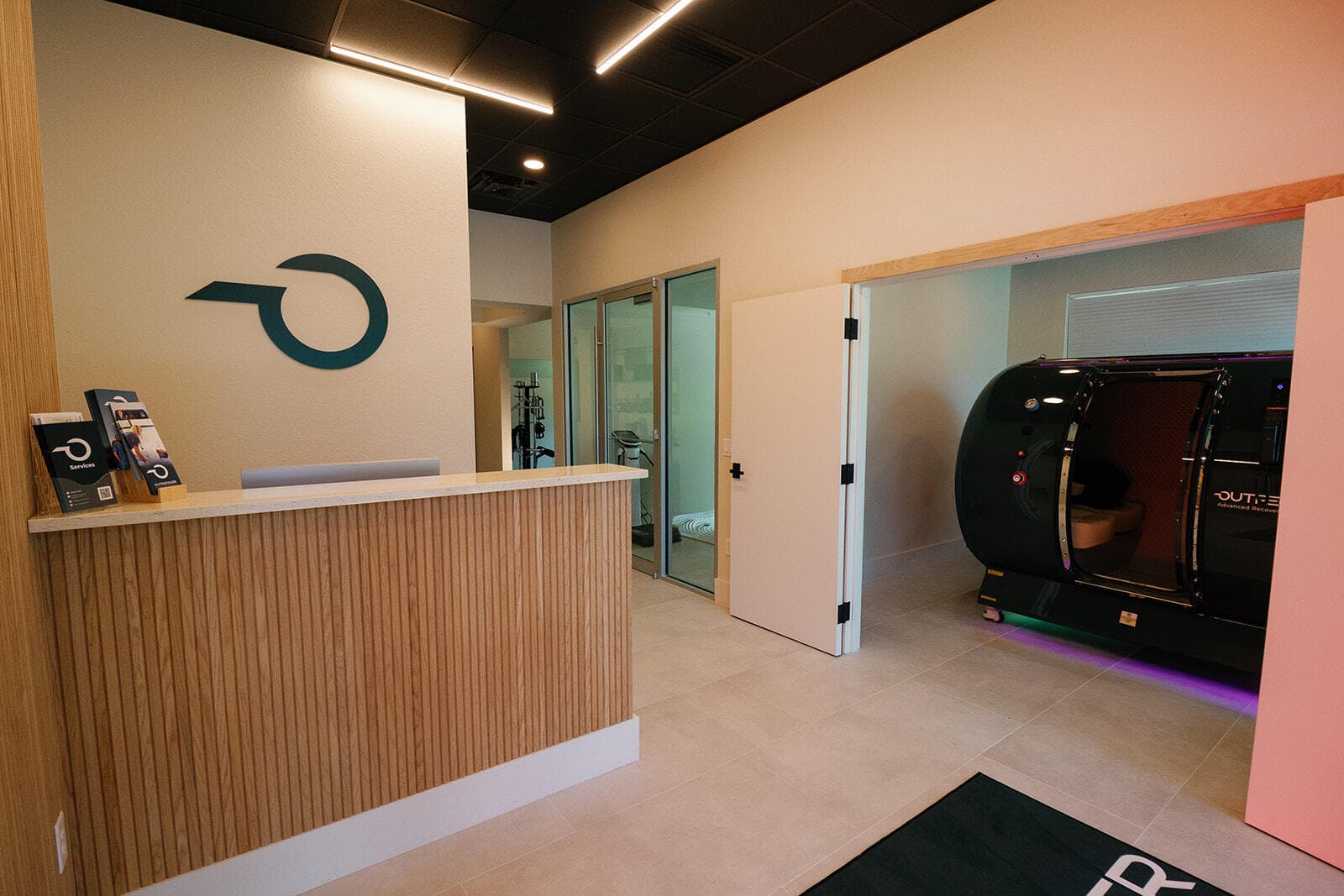
Recovery-studio services are optional extras that sit alongside your surgeon's and therapist's plan. Ask your surgeon before starting any of them, and start only after you are cleared. The evidence for each after a knee replacement is limited or mixed, and the studio's own pages say its services are wellness-based.
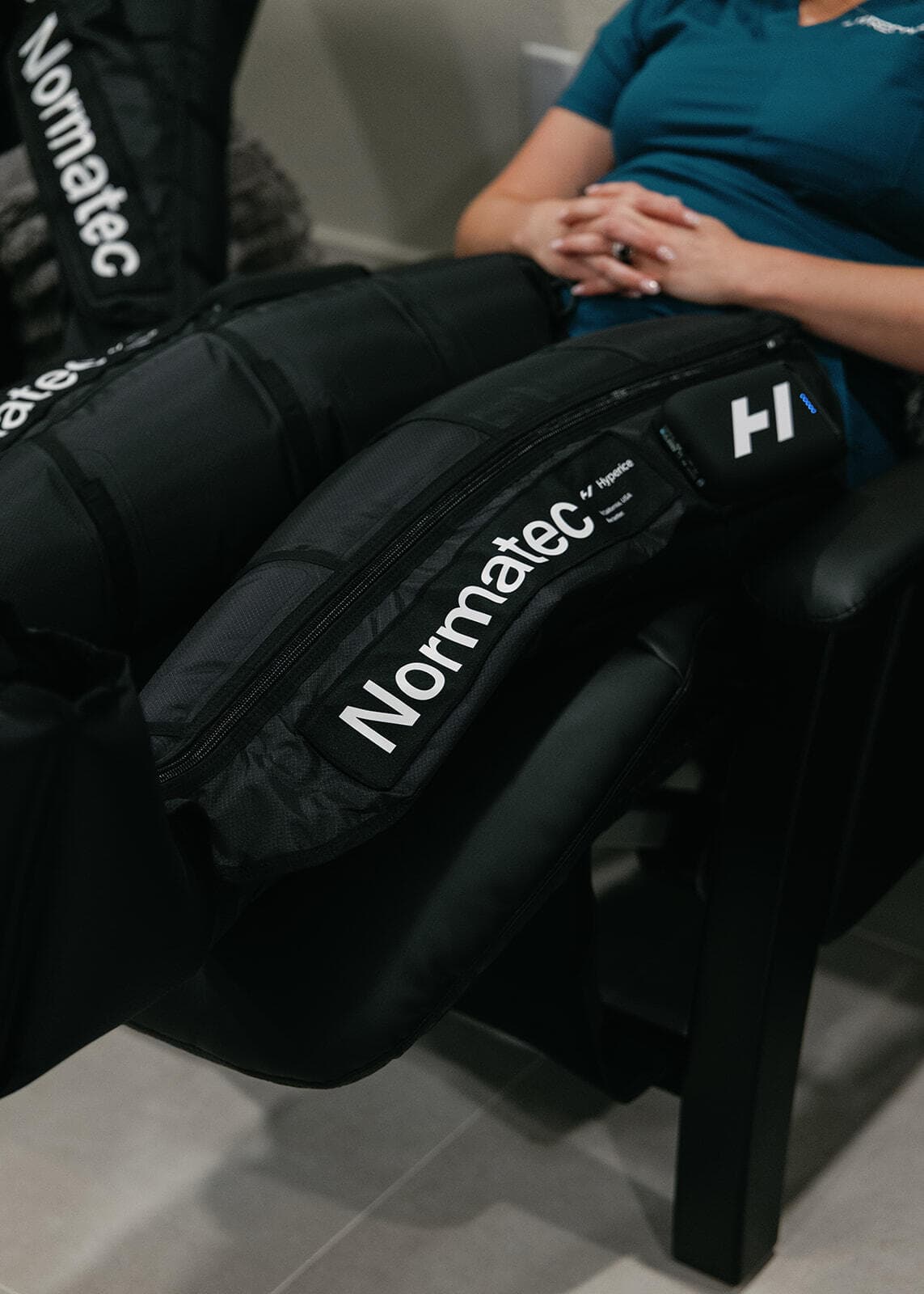
Compression. Pneumatic compression boots are a standard part of hospital care: AAOS lists inflatable leg coverings among the measures a surgeon may prescribe to prevent clots and reduce leg swelling (AAOS). Small trials found hospital pneumatic devices were linked to less swelling, one of them paired with pain relief (Tamir, 1999; Maradei-Pereira, 2022). Those were in-hospital devices in the first week. In the sources opened for this guide, no trial tested studio-style sessions weeks later. OutRecover offers Normatec compression for legs and BOA Max lymphatic compression, and its pages list avoiding active clot sites, open wounds and skin infections. The summary is on the science page.
Laser. A 2026 systematic review found four randomized trials (133 people, three on knee replacement) of photobiomodulation. Three showed less pain and swelling, and the authors called the results promising but the evidence insufficient (Eladl, 2026). A 45-patient trial using a low-level 804 nm laser found less swelling at three months than controls (Bahrami, 2022). Those were low-level lasers, and we found no knee replacement trial of Class IV laser specifically.
PEMF. A 2020 review of PEMF after joint replacement reported no adverse effects and suggested early use might help, but noted PEMF is "not currently part of usual clinical practice" (Lullini, 2020). PEMF therapy at the studio is not recommended for people with pacemakers or electrical implants, so ask your surgeon and the studio to confirm your knee hardware is not a concern.
Packages. OutHeal is the package the studio lists for joint replacements, scheduled around your surgery date and your surgeon's clearance. OutRestore focuses on swelling and circulation, and OutRepair is built for smaller procedures such as knee arthroscopy. These packages also include other services this guide does not review.
Your next step
Write down three questions for your next surgeon or therapist visit: What is my bend target this week? What swelling should I call about? When can I drive and start any extra services? If you are curious about the studio side, the team can talk through what fits your surgeon's plan. Call the studio or take the recovery quiz on its site.
Sources
- American Academy of Orthopaedic Surgeons. Activities After Total Knee Replacement. OrthoInfo, reviewed 2024. https://orthoinfo.aaos.org/en/recovery/activities-after-knee-replacement
- American Academy of Orthopaedic Surgeons. Total Knee Replacement. OrthoInfo. https://orthoinfo.aaos.org/en/treatment/total-knee-replacement/
- American Academy of Orthopaedic Surgeons. Total Knee Replacement Exercise Guide. OrthoInfo. https://orthoinfo.aaos.org/en/recovery/total-knee-replacement-exercise-guide/
- American Academy of Orthopaedic Surgeons. Revision Total Knee Replacement (stiffness section). OrthoInfo. https://orthoinfo.aaos.org/en/treatment/revision-total-knee-replacement
- Hospital for Special Surgery. Knee Replacement Surgery. HSS Health Library. https://www.hss.edu/health-library/conditions-and-treatments/list/knee-replacement
- Hospital for Special Surgery. 6 Things to Know About Recovery After Knee Replacement. HSS Health Library. https://www.hss.edu/health-library/move-better/knee-replacement-recovery
- Hospital for Special Surgery. The Best Exercises After Knee Replacement, from a PT. HSS Health Library. https://www.hss.edu/health-library/move-better/exercises-after-knee-replacement
- MedlinePlus. Knee Replacement. National Library of Medicine. https://medlineplus.gov/kneereplacement.html
- MedlinePlus. Knee joint replacement (encyclopedia, reviewed 2024). National Library of Medicine. https://medlineplus.gov/ency/article/002974.htm
- Mutsuzaki H, et al. Target range of motion for rehabilitation after total knee arthroplasty. Journal of Rural Medicine, 2017. https://pubmed.ncbi.nlm.nih.gov/28593015
- Oka T, et al. Importance of knee flexion range of motion during the acute phase after total knee arthroplasty. Physical Therapy Research, 2020. https://pmc.ncbi.nlm.nih.gov/articles/PMC7814201
- Pua YH. The time course of knee swelling post total knee arthroplasty and its associations with quadriceps strength and gait speed. Journal of Arthroplasty, 2015. https://pubmed.ncbi.nlm.nih.gov/25737387
- Kirschbaum S, et al. Reaction time and brake pedal force after total knee replacement: timeframe for return to car driving. Knee Surgery, Sports Traumatology, Arthroscopy, 2020. https://pmc.ncbi.nlm.nih.gov/articles/PMC8458211
- Zhu Z, et al. Perioperative sleep disturbances in total knee arthroplasty: incidence, mechanisms, and management strategies. Journal of Orthopaedic Surgery and Research, 2025. https://pmc.ncbi.nlm.nih.gov/articles/PMC12590825
- Lee NK, et al. Presence of night pain, neuropathic pain, or depressive disorder does not adversely affect outcomes after total knee arthroplasty. Journal of Korean Medical Science, 2022. https://pmc.ncbi.nlm.nih.gov/articles/PMC9641149
- Dalury DF, Tucker KK, Kelley TC. When can I drive? Brake response times after contemporary total knee arthroplasty. Clinical Orthopaedics and Related Research, 2010. https://pmc.ncbi.nlm.nih.gov/articles/PMC3008874
- Danielsen O, Lauritsen J, Lindberg-Larsen M. When do patients resume driving after fast-track hip and knee arthroplasty: a cohort study of 408 patients. Acta Orthopaedica, 2026. https://pmc.ncbi.nlm.nih.gov/articles/PMC13602197
- Munk S, et al. Effect of compression therapy on knee swelling and pain after total knee arthroplasty. Knee Surgery, Sports Traumatology, Arthroscopy, 2012. https://pubmed.ncbi.nlm.nih.gov/22453307
- Tamir L, et al. Sequential foot compression reduces lower limb swelling and pain after total knee arthroplasty. Journal of Arthroplasty, 1999. https://pubmed.ncbi.nlm.nih.gov/10220188
- Maradei-Pereira JAR, Sauma ML, Demange MK. Thromboprophylaxis with unilateral pneumatic device led to less edema and blood loss compared to enoxaparin after knee arthroplasty: randomized trial. BMC Musculoskeletal Disorders, 2022. https://pmc.ncbi.nlm.nih.gov/articles/PMC9664627
- Eladl HM, et al. Systematic review on the effectiveness of photobiomodulation therapy on enhancing musculoskeletal rehabilitation outcomes after total knee and hip arthroplasty. Photobiomodulation, Photomedicine, and Laser Surgery, 2026. https://pubmed.ncbi.nlm.nih.gov/42581717
- Bahrami H, et al. Low-level laser and light therapy after total knee arthroplasty improves postoperative pain and functional outcomes: a three-arm randomized clinical trial. Arthroplasty Today, 2022. https://pmc.ncbi.nlm.nih.gov/articles/PMC9732130
- Lullini G, et al. Role of pulsed electromagnetic fields after joint replacements. World Journal of Orthopedics, 2020. https://pmc.ncbi.nlm.nih.gov/articles/PMC7298453