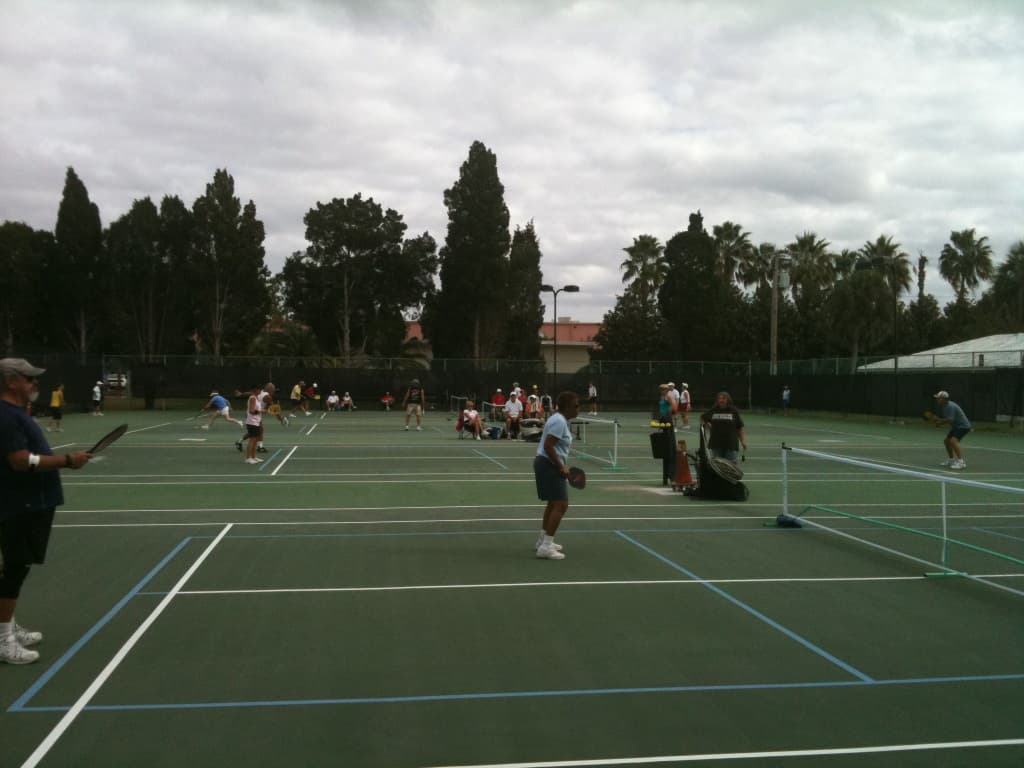
Most pickleball injuries that reach an emergency room come from falls, and most happen to players over 50. So pickleball injury prevention is mostly about warming up, keeping your feet under you, wearing real court shoes and building up slowly. Naples is serious about the game (the US Open Pickleball Championships come to East Naples Community Park each spring), so here is what the research says, where it runs thin, and when an injury needs a doctor first.
Which pickleball injuries are most common, and in whom?
Fractures and strains or sprains are the most common pickleball injuries seen in US emergency departments, each close to a third of cases. A 10-year analysis of national data (injuries from 2013 to 2022) found falls behind about two in three, and the wrist was the most injured body part, at 12.7%. These are hospital numbers, so they skew serious.
| Age group | Leading mechanism | Leading diagnosis | Leading body part |
|---|---|---|---|
| 35 to 64 | Fall (55.7%) | Strain or sprain (38.1%) | Lower leg (17.7%) |
| 65 to 80 | Fall (71.5%) | Fracture (35.6%) | Lower trunk, including hip and pelvis (13.8%) |
Source: Yu et al., 2025. Among players 81 and older, falls caused 96% of injuries.
About 7% of patients in that analysis were admitted, and the lower trunk was the injury site for 42.2% of admissions (Yu et al., 2025). An earlier analysis of data through 2017 (a snapshot now) found 90.9% of injured players were 50 or older. Overuse problems such as outer-elbow pain rarely appear here, since a 2026 systematic review says those patients see primary care or physical therapy. For that side, read our pickleball elbow guide.
Do women and men get hurt differently?
Yes. In emergency visits by players 60 and older from 2010 to 2019, men were 3.5 times as likely as women to have a strain or sprain, while women were 3.7 times as likely to have a fracture and 9.3 times as likely to break a wrist (95% confidence interval 3.6 to 23.9, so the exact size is uncertain).
A broken wrist usually follows a fall onto an outstretched hand, and AAOS notes that with osteoporosis even a minor fall can do it. The 2026 review suggests bone health screening for older women who play. Ask your doctor whether a bone density test makes sense for you.
Why do Achilles and calf injuries show up in players who never had one?
Achilles tears were once rare after 60. At one multistate orthopedic clinic, patients whose rupture happened in pickleball averaged 64.5 years old against 48.6 for other Achilles patients, and 67.4% had surgery against 45.4% (McCahon et al., 2024, records from 2013 to 2023, 43 pickleball cases).
The same group reached 28 of those players. Sixty-eight percent were hurt within their first month of playing, and 32% the first time they played; 47% returned to the sport (Lencer et al., 2025). Both are small case series, so read them as a pattern rather than a rate.
What you control is how fast you ramp up and how you move. Mayo Clinic Press advises avoiding backpedaling, building strength, and standing ready with wide feet and bent knees. Calf strains are the smaller version: Harvard Health describes sudden upper-calf pain or cramping.
A build-up rule (our judgment). No source we read gives a safe weekly dose for pickleball. If you are new or returning after a long break, make your first two to four weeks shorter and easier than you want: fewer games, softer pace, no hard lunges.
What does a good pickleball warm-up look like?
A dynamic warm-up of about 7 to 10 minutes just before play, at least twice a week, is the best-supported habit, with a caveat: the evidence comes from other sports and general research. A 2024 expert review (Level V, the lowest tier of evidence) recommends that dose, and a Cleveland Clinic therapist suggests three to five minutes for people just starting, especially older adults.
The strongest data come from soccer. A 2017 meta-analysis of four trials in recreational and sub-elite football found the FIFA 11+ warm-up cut overall injuries by about 39% (rate ratio 0.61). The 2026 pickleball review recommends a dynamic warm-up but lists testing one in pickleball players as future work (Okhovat et al.). The 2024 review warns that low adherence may erase the benefit, so make it a habit.
Here is a routine to try, built from that review's four parts (raise your heart rate, move through range, rehearse the sport, build intensity) plus FIFA 11+ balance work. It is an illustration, not a tested protocol.
- Two minutes of easy walking or marching, arms swinging.
- Calves and ankles: 10 slow heel raises, 10 toe raises, ankle circles each way. The 2026 review lists a dynamic calf warm-up among measures for Achilles overload.
- Hips and legs: 10 leg swings front to back and side to side per leg, one hand on the fence, then 6 walking lunges and 8 squats.
- Balance: one-leg stand for 20 to 30 seconds per side, the hold length FIFA 11+ uses.
- Shoulders and wrists: 10 arm circles each direction, 10 wrist circles.
- Court movement: two minutes of soft dinks and half-speed sidesteps. Keep the first rallies easy.
After a joint replacement, ask your surgeon or physical therapist before returning, as HSS advises.
Can balance training lower your chance of falling?
Yes, in older adults generally. A Cochrane review (2019) of 39 trials with 7,920 participants found balance and functional exercises cut the rate of falls by 24% (high-certainty evidence). Those adults were 60 and older and were not pickleball players, but falls lead the pickleball injury data. The review was uncertain about programs that are mainly resistance training, walking or dance, so strength work alone does not replace balance practice.
Do shoes and court surfaces matter?
Probably, though the proof is thin. Cleveland Clinic's therapist says court shoes support your ankles as you turn and pivot, and advises against running shoes, which suit forward motion. AAOS lists footwear with appropriate support among ankle sprain precautions; the foot turning inward causes about 90% of ankle sprains.
No study we read measured injury rates by shoe type in pickleball. The 2026 review notes that friction data across pickleball courts are limited and calls routine surface inspection reasonable. Check for wet patches, dust on painted lines and worn treads.
How do you play pickleball in Florida heat?
The CDC says people 65 and older are less likely to sense and respond to changes in temperature and advises drinking more water than usual without waiting for thirst. Its HeatRisk dashboard gives a forecast by zip code.
- Heat cramps: stop, rest in shade, drink water or an electrolyte sports drink (NIA).
- Heat exhaustion: thirst, dizziness, weakness, nausea, heavy sweating, cold clammy skin. Cool down, drink, and get care if you do not improve.
- Heat stroke: body temperature above 104°F, confusion, fainting or no sweating. This is an emergency.
The NIA notes beta blockers make heat-related fainting more likely, and the CDC says many medicines can leave you dehydrated or overheated. Among players 60 and older, 11.1% of pickleball emergency cases from 2010 to 2019 were cardiovascular events. If you take heart or blood pressure medicine, ask your doctor about exercising in heat.
How much recovery do you need between sessions?
Sleep has a published target: the CDC recommends 7 to 9 hours for ages 61 to 64 and 7 to 8 for 65 and older. No source we read gives a rest-day number for recreational pickleball, so use the next morning as your gauge.
| Next morning | Reasonable read | What to do (our judgment) |
|---|---|---|
| Soreness that eases as you move | Normal after a harder session | Warm up as usual, keep the first game easy |
| Achilles or heel stiffness, worse with activity | Matches AAOS's Achilles tendinitis symptoms | Cut sprints and lunges, move at low impact, see a clinician if it lingers |
| Sharp pain, a pop, swelling, cannot push off | Possible tear or fracture | Stop and get seen |
What should you do in the first 48 hours after a strain or sprain?
A 2020 BJSM editorial proposes PEACE for the first days (Protect for 1 to 3 days, raise the limb, Avoid anti-inflammatory medicines, Compress, Educate), then LOVE (Load, Optimism, Vascularisation, Exercise) (Dubois and Esculier, 2020). It is expert opinion from two clinicians rather than a trial, and the AAOS patient page still recommends RICE.
| RICE (AAOS) | PEACE and LOVE (BJSM) | |
|---|---|---|
| Rest | Take a break from the activity | Protect for 1 to 3 days; long rest weakens tissue |
| Ice | Cold packs, 20 minutes out of each hour | Questions it: no high-quality evidence |
| Compression | Elastic bandage | Supports it after an ankle sprain, despite conflicting studies |
| Raising the limb | Above the heart | Do it; evidence weak, risk low |
| Medicines | Not covered on that page | Avoid anti-inflammatories; may harm long-term healing |
Both protect briefly, compress, raise the limb, then move early. They split on ice and medicine, and Harvard Health's guidance still suggests ice and an NSAID or acetaminophen for a calf strain. If you take an anti-inflammatory for another reason, keep taking it as directed and ask your clinician.
When should you see a doctor?
Go to an emergency room or urgent care now for:
- A wrist that looks bent or out of place, or numb or pale fingers after a fall (AAOS).
- A pop at the back of the ankle, then severe pain and swelling, trouble walking, or inability to stand on your toes, which AAOS links to an Achilles tear.
- Hip or groin pain after a fall that makes it hard to stand or walk. The lower trunk was the most common injury site among admissions in the 2025 analysis.
- Heat stroke signs listed above.
See a clinician within days if a calf strain has not improved in a few days (Harvard Health), or an ankle sprain still hurts after 4 to 6 weeks (AAOS).
Where do studio services fit?
None of the studies above tested a recovery service on pickleball players, and none replace a diagnosis. A suspected fracture or tear goes to a doctor first. A studio can help organize recovery between sessions, with modest evidence for each piece:
- Compression. A meta-analysis of 12 studies (2022, 322 people) found pneumatic compression lowered muscle soreness (SMD -0.33) without changing jump height; the authors call the benefit moderate. OutRecover's compression page lists active DVT, open wounds and skin infection as reasons to avoid it.
- Cold. A Cochrane review (2012, an older review) found some evidence that cold-water immersion eases muscle soreness versus rest. Those trials used water, and we did not find a review of dry plunges. Since PEACE and LOVE questions ice for injuries, keep the dry cold plunge for sore muscles and leave a fresh sprain out of it. Its page lists uncontrolled hypertension and Raynaud's as reasons to skip it.
- Blood flow restriction. A BJSM meta-analysis (2017, 20 studies, mostly knee surgery, knee arthritis and age-related muscle loss) found low-load training with restriction raised strength moderately (g = 0.52), less than heavy lifting (g = 0.67). No study tested it to prevent pickleball injuries. A 2019 position stand covers safety, and the KAATSU page lists DVT history as a reason to skip it.
- Infrared sauna. We did not review sauna as recovery. If you played in heat, drink first; the sauna page says to bring water and leave if dizzy.
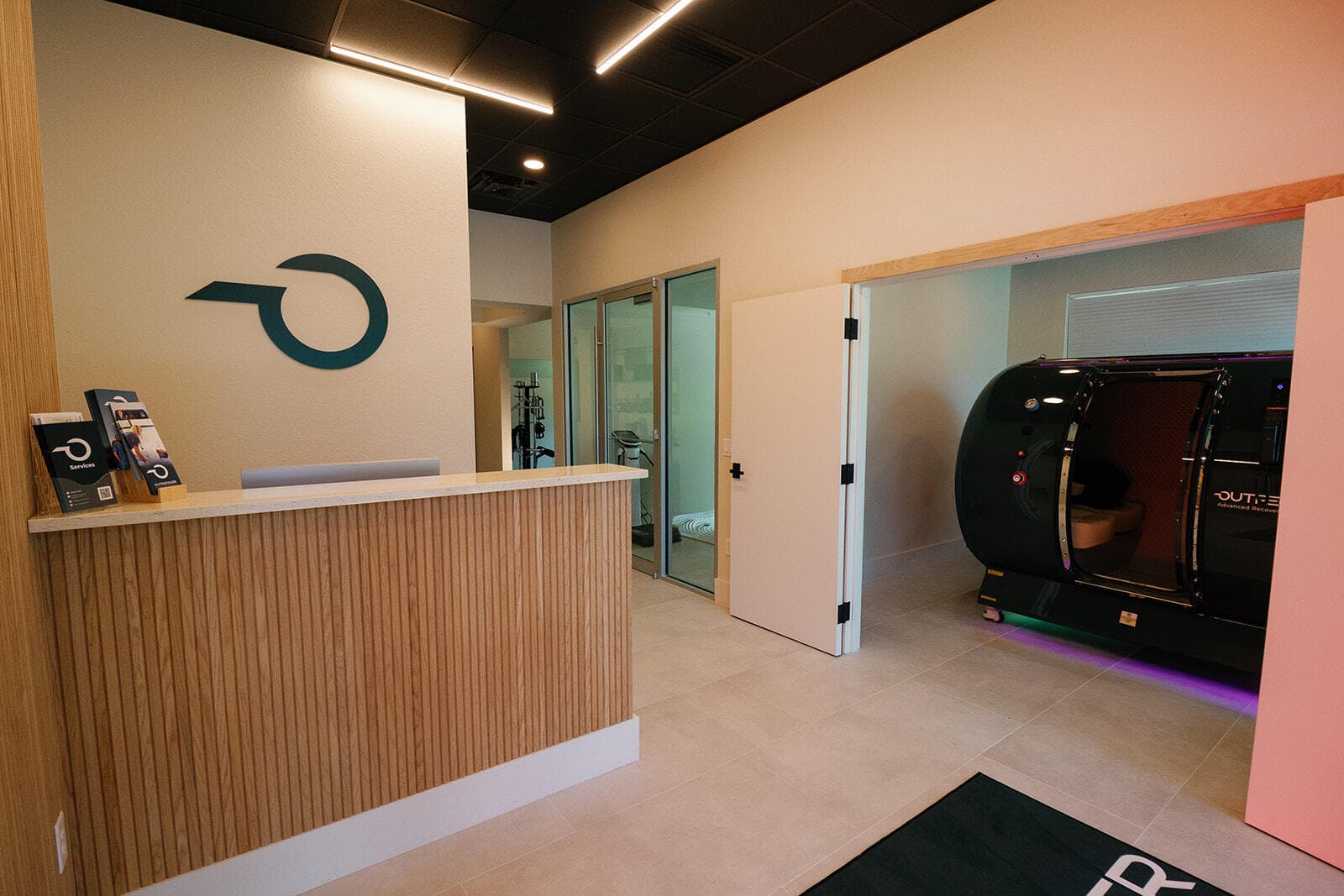
OutTrain is built for athletes, and its listing names pickleball players among them; it bundles red light, compression, the infrared sauna, the dry cold plunge and an InBody scan. OutFlex is for muscle strains such as calf, hamstring and quad, using PEMF, Class IV laser and red light. We did not review the evidence for those three therapies, so read the studio's research pages first. If you are recovering from surgery, clear anything new with your surgeon.
Before your next game, run the warm-up, look at your shoes and check the heat forecast. If something already hurts and matches an urgent sign above, get it seen first.
Sources
- Yu J, Yendluri A, Linden GS, et al. Increasing incidence of pickleball injuries presenting to US emergency departments: a 10-year epidemiologic analysis of mechanisms and trends. Orthopaedic Journal of Sports Medicine, 2025. https://pmc.ncbi.nlm.nih.gov/articles/PMC11758564
- Forrester MB. Pickleball-related injuries treated in emergency departments. Journal of Emergency Medicine, 2020. https://pubmed.ncbi.nlm.nih.gov/31796221
- Weiss H, Dougherty J, DiMaggio C. Non-fatal senior pickleball and tennis-related injuries treated in United States emergency departments, 2010 to 2019. Injury Epidemiology, 2021. https://injepijournal.biomedcentral.com/articles/10.1186/s40621-021-00327-9
- Okhovat A, Ferkel E, Richards SA. Lower extremity injuries in adult pickleball players: a systematic review. Cureus, 2026. https://pmc.ncbi.nlm.nih.gov/articles/PMC13264005
- McCahon JAS, Miller M, Riebesell S, et al. Pickleball and the rising incidence of Achilles tendon injuries in the elderly. Foot and Ankle Specialist, 2024. https://pubmed.ncbi.nlm.nih.gov/39377135
- Lencer AJ, McCahon JAS, Kohring AS, et al. Pickleball and the return to sport after Achilles tendon rupture. Journal of the American Academy of Orthopaedic Surgeons, 2025. https://pubmed.ncbi.nlm.nih.gov/41202173
- American Academy of Orthopaedic Surgeons. Distal radius fractures (broken wrist). OrthoInfo. https://orthoinfo.aaos.org/en/diseases--conditions/distal-radius-fractures-broken-wrist/
- American Academy of Orthopaedic Surgeons. Achilles tendon rupture (tear). OrthoInfo. https://orthoinfo.aaos.org/en/diseases--conditions/achilles-tendon-rupture-tear
- American Academy of Orthopaedic Surgeons. Achilles tendinitis. OrthoInfo. https://orthoinfo.aaos.org/en/diseases--conditions/achilles-tendinitis
- American Academy of Orthopaedic Surgeons. Sprained ankle. OrthoInfo. https://orthoinfo.aaos.org/en/diseases--conditions/sprained-ankle
- American Academy of Orthopaedic Surgeons. Sprains, strains and other soft-tissue injuries. OrthoInfo. https://orthoinfo.aaos.org/en/diseases--conditions/sprains-strains-and-other-soft-tissue-injuries
- Mayo Clinic Press. Play on, picklers! The health benefits of pickleball. https://mcpress.mayoclinic.org/nutrition-fitness/play-on-picklers-the-health-benefits-of-pickleball
- Harvard Health Publishing. What to do if you get "tennis leg". https://www.health.harvard.edu/diseases-and-conditions/what-to-do-if-you-get-tennis-leg
- Sople D, Wilcox RB. Dynamic warm-ups play pivotal role in athletic performance and injury prevention. Arthroscopy, Sports Medicine, and Rehabilitation, 2024. https://pmc.ncbi.nlm.nih.gov/articles/PMC12034053
- Cleveland Clinic. 8 benefits of pickleball. https://health.clevelandclinic.org/is-pickleball-good-exercise
- Thorborg K, Krommes KK, Esteve E, et al. Effect of specific exercise-based football injury prevention programmes on the overall injury rate in football: a systematic review and meta-analysis of the FIFA 11 and 11+ programmes. British Journal of Sports Medicine, 2017. https://pubmed.ncbi.nlm.nih.gov/28087568
- Hospital for Special Surgery. Playing pickleball after knee or hip replacement: what to know. https://www.hss.edu/health-library/move-better/pickleball-after-knee-hip-replacement
- Sherrington C, Fairhall NJ, Wallbank GK, et al. Exercise for preventing falls in older people living in the community. Cochrane Database of Systematic Reviews, 2019. https://pubmed.ncbi.nlm.nih.gov/30703272
- Centers for Disease Control and Prevention. Protect yourself from the dangers of extreme heat. https://www.cdc.gov/climate-health/php/resources/protect-yourself-from-the-dangers-of-extreme-heat.html
- Centers for Disease Control and Prevention. Heat and older adults (aged 65+). https://www.cdc.gov/heat-health/risk-factors/heat-and-older-adults-aged-65.html
- Centers for Disease Control and Prevention. About heat and your health. https://www.cdc.gov/heat-health/about/index.html
- National Institute on Aging. Hot weather safety for older adults. https://www.nia.nih.gov/health/safety/hot-weather-safety-older-adults
- Centers for Disease Control and Prevention. About sleep. https://www.cdc.gov/sleep/about/index.html
- Dubois B, Esculier JF. Soft-tissue injuries simply need PEACE and LOVE. British Journal of Sports Medicine, 2020. https://pubmed.ncbi.nlm.nih.gov/31377722
- Wisniowski P, Cieslinski M, Jarocka M, et al. The effect of pressotherapy on performance and recovery in the management of delayed onset muscle soreness: a systematic review and meta-analysis. Journal of Clinical Medicine, 2022. https://pmc.ncbi.nlm.nih.gov/articles/PMC9028309
- Bleakley C, McDonough S, Gardner E, et al. Cold-water immersion (cryotherapy) for preventing and treating muscle soreness after exercise. Cochrane Database of Systematic Reviews, 2012. https://pmc.ncbi.nlm.nih.gov/articles/PMC6492480
- Hughes L, Paton B, Rosenblatt B, et al. Blood flow restriction training in clinical musculoskeletal rehabilitation: a systematic review and meta-analysis. British Journal of Sports Medicine, 2017. https://pubmed.ncbi.nlm.nih.gov/28259850
- Patterson SD, Hughes L, Warmington S, et al. Blood flow restriction exercise: considerations of methodology, application, and safety. Frontiers in Physiology, 2019. https://pubmed.ncbi.nlm.nih.gov/31156448
- US Open Pickleball Championships. Official tournament site. https://www.usopenpickleball.com
- OutRecover. Service and package pages: compression therapy, dry cold plunge, blood flow restriction, infrared sauna, OutTrain, OutFlex. https://outrecover.com