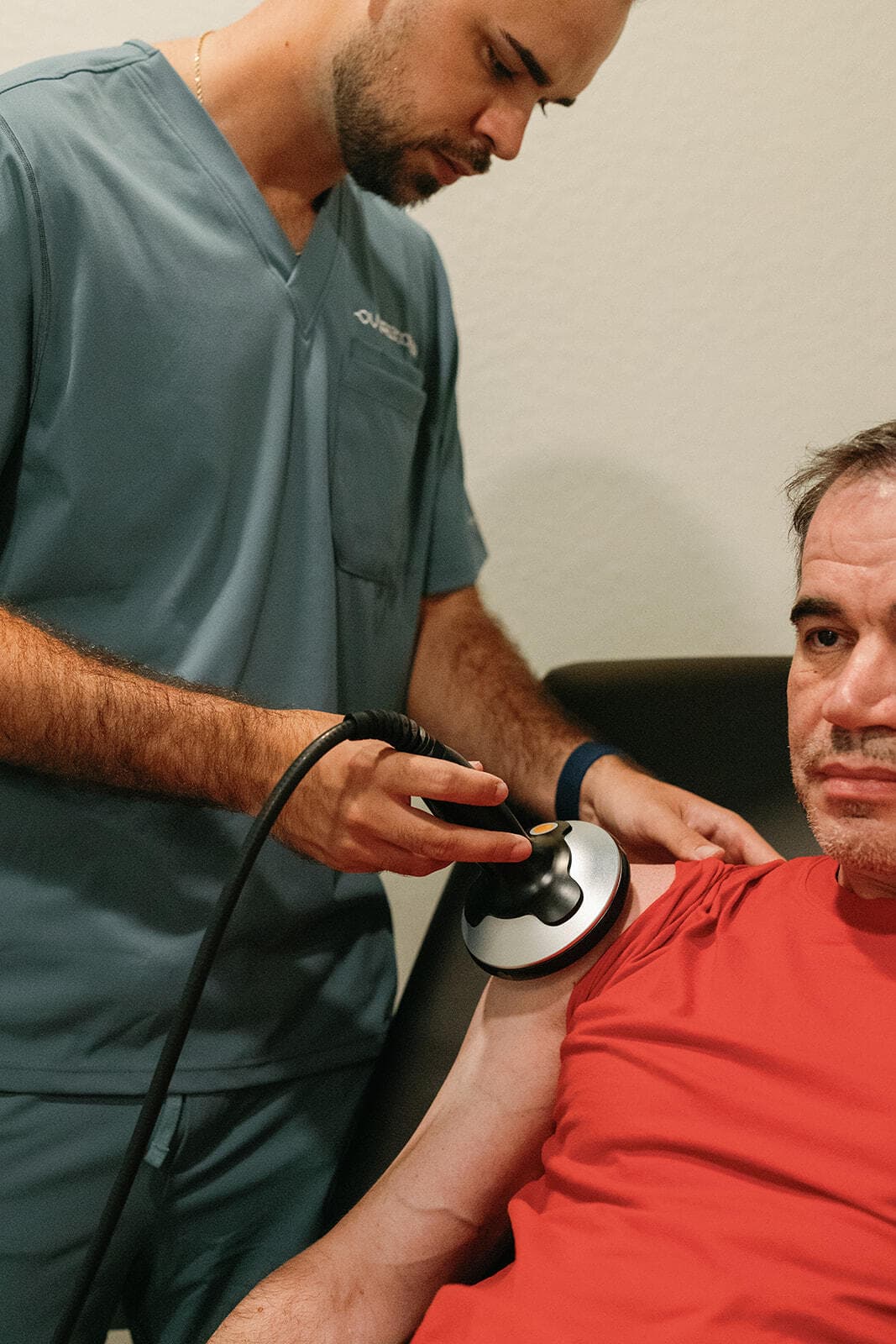
If the outside of your elbow has hurt for weeks, worst when you grip the paddle, shake a hand or lift a coffee pot, you most likely have pickleball elbow. It is a tendon problem, it is common, and most people get better with load management and a progressive exercise plan. Some popular add-ons, including shockwave and injections, have a weaker record than their marketing suggests. This guide sorts out which is which.
What is pickleball elbow?
Pickleball elbow is the everyday name for lateral epicondylitis, also called tennis elbow or lateral elbow tendinopathy. The American Academy of Orthopaedic Surgeons (AAOS) describes degeneration or microtearing of the forearm tendons where they attach to the bony bump on the outside of the elbow, usually the extensor carpi radialis brevis tendon. The pain builds over weeks, often with a weaker grip and sometimes aching at night.
If the pain sits on the inside of the elbow instead, that is golfer's elbow (medial epicondylitis). Mayo Clinic notes that pickleball players get it too. Our guide to golfer's elbow treatment covers that side.
Why does pickleball cause it?
Repeated gripping and wrist extension overload the tendon, and pickleball asks for both in short, fast bursts. AAOS lists improper stroke technique and improper equipment as risk factors in racquet sports. A critical review of pickleball injuries in older athletes notes that newer players tend to pick heavier paddles (about 8.5 oz against about 7.2 oz for lighter ones), which may raise the risk of lateral epicondylitis, and it recommends a loose, neutral grip.
A five-year series from one academic center listed backhand shots and a tight grip as the likely mechanism for lateral epicondylitis, with technique, grip size and forearm strengthening as the prevention advice. That series is small (eight elbow cases, 75% lateral epicondylitis, average age 65), so read it as a pattern that fits the mechanism and nothing firmer.
The age fit is real. In national emergency department data for 2013 to 2017, 90.9% of pickleball injuries were in people 50 or older. A later analysis found injuries rose from 2014 to 2023, with most in people aged 60 to 79. Those counts come from emergency visits, so they cannot tell you how common slow tendon pain is. They show who is on the court.
A quick check of your setup:
- Grip: squeeze the handle loosely enough that you could still wiggle the paddle. A death grip loads the tendon on every shot.
- Handle size: if your fingers overlap your palm by a lot or can barely wrap, the size may be off. A coach or pro-shop fitter can check this in minutes.
- Backhand: a one-handed backhand with a stiff wrist is the usual trigger. A two-handed backhand spreads the load.
- Paddle weight: if you recently switched to a heavier paddle and the pain started afterward, say so when you see a clinician.
How is it diagnosed?
A clinician diagnoses lateral epicondylitis mostly by talking and pressing. AAOS says the doctor asks how symptoms developed, presses on the lateral epicondyle and has you straighten your wrist and fingers against resistance. X-rays, MRI or nerve tests are for ruling out other causes, such as elbow arthritis, a neck problem or nerve compression at the elbow.
That matters if your pain does not match the pattern. Numbness, tingling, pain that starts in the neck, a swollen or locked joint, or pain after a fall all call for an exam before you start any treatment.
What is the best pickleball elbow treatment?
The best-supported pickleball elbow treatment is boring: reduce the load that irritates the tendon, then rebuild its strength with exercise. AAOS reports that 80 to 95% of patients succeed with nonsurgical treatment, starting with several weeks of rest from painful activity, then therapy-guided strengthening.
Here is how the main options compare:
| Option | What the research says | How sure it is |
|---|---|---|
| Load management and exercise | First-line care, per AAOS; best-studied | Moderate |
| Counterforce brace | Short-term pain relief; weaker long-term | Mixed |
| Corticosteroid injection | Quick relief, worse at 1 year in one large trial | One trial; caution advised |
| PRP injection | Slower than steroid early, better later in pooled trials | Low |
| Shockwave | Older reviews show little benefit; newer ones are split | Mixed |
| Laser (low-level and high-intensity) | Small effects, low-certainty evidence | Low |
Does exercise work, and which kind?
Exercise has the strongest record. A 2021 meta-analysis of six trials (429 people) found that adding eccentric exercise to other care lowered pain and raised strength, and beat other exercise types for pain, with no clear difference in strength or function. Its authors note the small number of trials and varied exercise plans, so it cannot name one perfect program.
In a 2017 trial of 34 people, eccentric-concentric training plus isometric holds gave the largest improvement in pain and function, though the study is small and rated level III. A 2026 systematic review of isometric exercise for tendinopathies found limited support for isometrics beating other types, though they were tolerable and may relieve pain in the short term.
The practical read: pick a progressive plan, and have a physical therapist set the load. AAOS publishes a therapeutic exercise handout that says to do it under a doctor's supervision, and a therapist can tailor it.
Do braces help?
A counterforce brace is a cheap, low-risk way to take some strain off the tendon while you rebuild. A 2020 systematic review of 17 trials (1,145 people) concluded that a brace is a reasonable short-term strategy, but that physiotherapy did better over the long term. Short-term benefit looked larger in people 45 or younger, and many pickleball players are older, so do not expect a brace to do the whole job.
Should you get a cortisone shot?
Be cautious. A cortisone (corticosteroid) shot often eases pain fast, and AAOS says steroids are very effective anti-inflammatories but should be used very sparingly here. The strongest cautionary evidence is a 2013 JAMA trial of 165 people: at one year, 83% of the steroid group reported complete recovery or much improvement against 96% of the placebo group, and 54% had a recurrence against 12%. Physiotherapy made no difference to the one-year results.
That is one trial from 2013, in a community sample with an average age near 50, so read it as a caution. If you and your doctor use a shot to get through a tournament or a work deadline, know that the relief may not last.
What about PRP injections?
Platelet-rich plasma (PRP) uses a concentrate from your own blood. AAOS says some studies are inconclusive and others promising. A 2023 meta-analysis of 13 trials found PRP had no edge over steroid at one month but did better at three and six months, with the evidence graded low quality. PRP is a procedure done by a doctor.
What does the research say about shockwave?
The evidence for shockwave on the elbow is mixed, and older reviews are unkind to it. A Cochrane review of nine placebo-controlled trials (1,006 people, searched in 2005) found little or no benefit for pain and function. A 2022 meta-analysis of two trials with six-month follow-up (129 people) also found no benefit against placebo or no treatment, with low certainty. A radial shockwave trial of 56 people found it no better than sham at three months.
Newer pooled analyses are more split. A 2026 network meta-analysis of 23 randomized trials found that radial shockwave did best for pain at rest and long-term arm function, and focused shockwave for short-term grip strength and function. A 2025 review found shockwave beat therapeutic ultrasound for pain, with no clear difference in function. AAOS says many doctors consider shockwave experimental, though some sources show it can be effective.
Put plainly: shockwave may help some people, the clearest gains in newer reviews are short-term, and the trials disagree. In our view it is something to consider after a well-run exercise program has stalled, and it never replaces one.
Does laser help?
Laser has small effects and low-certainty evidence. A 2010 review of low-level laser for tendinopathy found 12 positive and 13 inconclusive or null trials, with benefit tied to using the right dose. A 2018 umbrella review of seven reviews found benefits that varied in size and no reports of harm, and called the overall results poor.
For the high-intensity (Class IV) lasers used in studios, a 2026 network meta-analysis rated the certainty for lateral epicondylitis as low and found differences against low-level laser too small to be clinically relevant. A 2026 review of four trials (169 people) found high-intensity laser improved arm function more than shockwave in the short and medium term, with no clear difference in pain or grip strength and low to moderate certainty.
How do you return to pickleball?
Return in steps, and let the elbow set the pace. AAOS says nonsurgical care starts with several weeks of reduced activity, and that doctors may suggest an equipment check. The sequence below is a common-sense outline that no trial tested, so ask your clinician to adjust it.
- Calm it down. Stop or cut the activities that provoke pain for a few weeks, and ask your clinician which everyday tasks are fine.
- Build strength. Start the forearm exercise plan from your therapist. Progress only when the last step is tolerable the next day.
- Fix the setup. Check handle size and paddle weight, and loosen your grip.
- Hit gently. Start with short, easy dinking sessions, avoiding hard backhands.
- Add back volume. Raise time and intensity one change at a time, and stop a session if pain climbs.
When should you see a doctor?
See a doctor if the pain has lasted more than a few weeks despite rest, if it wakes you at night, if you cannot grip normally, or if you have numbness, tingling, swelling, a visible deformity or pain after a fall. AAOS says surgery is considered if symptoms do not respond after 6 to 12 months of nonsurgical treatment, so tendon pain is worth following up if it lingers.
Where do studio services fit?
Studio services sit beside a doctor's or therapist's plan; they do not replace it. Focused shockwave and Class IV laser are both offered at OutRecover, and both fit the "try after exercise stalls" slot described above. Our own shockwave research summary lists plantar fasciitis, calcific shoulder tendinitis and knee osteoarthritis as its best-supported uses, which is not the elbow, and our laser research summary rates overall evidence quality as low to moderate.
OutResolve, our chronic tendon pain package, is built for stubborn tennis and golfer's elbow. It combines Class IV laser and/or shockwave with PEMF, and your clinician sets the plan for each visit. We make no outcome claim for it. H-Wave is offered for chronic pain, and we did not find a trial of it for lateral elbow pain, so we do not claim it here.
If you have had a recent injection or are recovering from elbow surgery, clear anything new with your surgeon first. For the wider picture of pickleball injuries, see pickleball injuries.
Your next step
Book a visit with your doctor or a physical therapist if the pain has lasted more than a few weeks, and start the exercise plan they give you. If you want to add shockwave or laser, call the studio to talk through what fits, and bring your doctor's notes.
Sources
- American Academy of Orthopaedic Surgeons (OrthoInfo). Tennis Elbow (Lateral Epicondylitis). AAOS, page names 2023 contributors, opened 2026. https://orthoinfo.aaos.org/en/diseases--conditions/tennis-elbow-lateral-epicondylitis/
- Mayo Clinic. Golfer's elbow (Medial epicondylitis): Symptoms and causes. Mayo Clinic. https://www.mayoclinic.org/diseases-conditions/golfers-elbow/symptoms-causes/syc-20372868
- Coombes BK, Bisset L, Brooks P, Khan A, Vicenzino B. Effect of corticosteroid injection, physiotherapy, or both on clinical outcomes in patients with unilateral lateral epicondylalgia: a randomized controlled trial. JAMA, 2013. https://pubmed.ncbi.nlm.nih.gov/23385272
- Forrester MB. Pickleball-Related Injuries Treated in Emergency Departments. Journal of Emergency Medicine, 2019. https://pubmed.ncbi.nlm.nih.gov/31796221
- McMillan P, Lake LP, Burkhart A, Reddy E, Hale IC, Grawe BM. The Epidemiology of Pickleball Injuries Presenting to US Emergency Departments. Sports Health, 2025. https://pubmed.ncbi.nlm.nih.gov/40653665
- Pickleball Injuries in the Aging Athlete: A Critical Analysis Review. PMC, cites 2024 sources. https://pmc.ncbi.nlm.nih.gov/articles/PMC11496387
- Pickleball-related injuries treated at a tertiary academic center over five years: a cross-sectional study. PMC, recent. https://pmc.ncbi.nlm.nih.gov/articles/PMC13188509
- Buchbinder R, Green S, Youd JM, Assendelft WJJ, Barnsley L, Smidt N. Shock wave therapy for lateral elbow pain. Cochrane Database of Systematic Reviews, 2005. https://www.cochrane.org/evidence/CD003524_shock-wave-therapy-elbow-pain
- Cheema AS, Doyon J, Lapner P. TENS and ESWT in lateral epicondylitis: a systematic review and meta-analysis. JSES International, 2022. https://pmc.ncbi.nlm.nih.gov/articles/PMC9998734
- Radial extracorporeal shock wave therapy is not more effective than placebo in the management of lateral epicondylitis: a double-blind, randomized, placebo-controlled trial. American Journal of Physical Medicine & Rehabilitation, 2016. https://pubmed.ncbi.nlm.nih.gov/26544854
- Comparative effectiveness of focused versus radial extracorporeal shockwave therapy and leukocyte-poor versus leukocyte-rich platelet-rich plasma for lateral epicondylitis: a network meta-analysis. PMC, 2026. https://pmc.ncbi.nlm.nih.gov/articles/PMC13566096
- Alharbi M. Comparative efficacy of extracorporeal shockwave therapy and ultrasound on pain and functional outcomes in lateral epicondylitis. European Journal of Orthopaedic Surgery and Traumatology, 2025. https://pubmed.ncbi.nlm.nih.gov/40668449
- The beneficial effects of eccentric exercise in the management of lateral elbow tendinopathy: a systematic review and meta-analysis. PMC, 2021. https://pmc.ncbi.nlm.nih.gov/articles/PMC8432114
- Stasinopoulos D, Stasinopoulos I. Comparison of effects of eccentric training, eccentric-concentric training, and eccentric-concentric training combined with isometric contraction in the treatment of lateral elbow tendinopathy. Journal of Hand Therapy, 2017. https://pubmed.ncbi.nlm.nih.gov/27823901
- Soliman EFF, et al. Isometric Exercises for Tendinopathies: A Systematic Literature Review. Clinical Therapeutics, 2026. https://pubmed.ncbi.nlm.nih.gov/42203537
- The effects of counterforce brace on pain in subjects with lateral elbow tendinopathy: a systematic review and meta-analysis of randomized controlled trials. PubMed, 2020. https://pubmed.ncbi.nlm.nih.gov/32635812
- Hohmann E, Tetsworth K, Glatt V. Corticosteroid injections for the treatment of lateral epicondylitis are superior to platelet-rich plasma at 1 month but platelet-rich plasma is more effective at 6 months. Journal of Shoulder and Elbow Surgery, 2023. https://pubmed.ncbi.nlm.nih.gov/37247780
- Tumilty S, Munn J, McDonough S, Hurley DA, Basford JR, Baxter GD. Low level laser treatment of tendinopathy: a systematic review with meta-analysis. Photomedicine and Laser Surgery, 2010. https://pubmed.ncbi.nlm.nih.gov/19708800
- Mamais I, Papadopoulos K, Lamnisos D, Stasinopoulos D. Effectiveness of Low Level Laser Therapy (LLLT) in the treatment of lateral elbow tendinopathy: an umbrella review. Laser Therapy, 2018. https://pmc.ncbi.nlm.nih.gov/articles/PMC7034252
- Comparison of the effectiveness of high-intensity laser therapy versus low-level laser therapy in musculoskeletal disorders: a systematic review and network meta-analysis. PMC, 2026. https://pmc.ncbi.nlm.nih.gov/articles/PMC12909518
- High-intensity laser therapy versus extracorporeal shockwave therapy for lateral elbow tendinopathy: a systematic review and meta-analysis. PMC, 2026. https://pmc.ncbi.nlm.nih.gov/articles/PMC12938723
