If you train hard and sleep badly, the sleep is the first thing to fix, ahead of any recovery gadget. Adults need 7 or more hours a night, and the research on athletes points the same way: short or broken sleep goes with worse performance and, in young athletes, more injuries. Most of that evidence is observational, so this guide says plainly where it stops.
How much sleep do you need if you train hard?
The CDC lists 7 or more hours a night for adults aged 18 to 60, 7 to 9 hours for ages 61 to 64, and 7 to 8 hours from 65 on (CDC, About Sleep). The American Academy of Sleep Medicine (AASM) and the Sleep Research Society published a joint consensus statement on the amount of sleep a healthy adult needs in 2015.
| Age | CDC recommendation |
|---|---|
| 18 to 60 | 7 or more hours |
| 61 to 64 | 7 to 9 hours |
| 65 and older | 7 to 8 hours |
Those figures are the floor for health, and say nothing about a training target. The 2021 expert consensus on athletes, written by sleep and sports scientists and published in the British Journal of Sports Medicine, found elite athletes often sleep under 7 hours with poor quality, and said a one-size rule such as 7 to 9 hours is unlikely to be ideal for performance. It asks for an individual approach that takes the athlete's own sense of how much sleep they need into account (Walsh et al., 2021).
How are sleep and recovery connected?
Sleep is where the body does its repair work, and the research on that is thinner than the marketing suggests. The same 2021 consensus found that performance drops after a night or more without sleep. The effect of a more ordinary one to three nights of shortened sleep, which is what most of us live with, "remains unclear". It also notes that athlete sleep studies often lack tight controls and include few women (Walsh et al., 2021).
One of the better-known performance trials is small. In 11 Stanford varsity basketball players who aimed for 10 hours in bed for 5 to 7 weeks, nightly sleep rose by about 111 minutes on average, sprint time improved from 16.2 to 15.5 seconds and free-throw accuracy rose 9%. The players were compared with their own baseline, with no separate control group (Mah et al., 2011).
Does poor sleep raise injury risk?
In teenagers, yes, as an association. In a survey of 112 middle and high school athletes, those sleeping under 8 hours a night were 1.7 times as likely to have been injured as those sleeping 8 or more (95% confidence interval 1.0 to 3.0), a retrospective Level III study from one school (Milewski et al., 2014). A systematic review and meta-analysis of seven studies found adolescents who chronically slept poorly had higher odds of sports or musculoskeletal injury (odds ratio 1.58, 95% CI 1.05 to 2.37), and said the effect of a single poor night could not yet be judged (adolescent sleep and sports injuries review, 2019).
Two cautions for an adult reader. These studies are in teens, so they do not prove the same size of effect at 45. And they are observational: tired athletes may also train differently, eat differently or be under more stress. Treat sleep as one risk factor you can change, and never as the sole cause of an injury.
How does sleep help muscle recovery?
Muscle is rebuilt from protein, and sleep loss appears to blunt that process in the lab. In a randomized crossover study of 13 healthy young adults, one night of total sleep deprivation cut muscle protein synthesis by 18%, raised cortisol 21% and lowered testosterone 24%, compared with a normal night (Lamon et al., 2021).
Keep the size of the evidence in view. It is 13 people, a full night awake rather than the 5 or 6 hours many people get, and a measure taken after one meal. It supports the idea that sleep matters for repair. It does not show how many hours rebuild how much muscle, and the bench evidence for this mechanism is still building. For the soreness side of the story, see delayed onset muscle soreness.
Which sleep habits have support?
The CDC's short list for adults is the best-supported place to start:
- Go to bed and get up at the same time each day, weekends included.
- Keep the bedroom quiet, dark and a comfortable temperature.
- Sleep at least 7 hours.
- Avoid large meals, beverages, caffeine and alcohol before bed.
- Keep TVs, computers and phones out of the bedroom.
- Exercise regularly.
(CDC, Healthy Sleep, Healthy Brain, 2024). The CDC's NIOSH training adds a relaxing routine before bed, low light for 1 to 2 hours, and finishing exercise at least 3 hours before bed if you struggle to fall asleep (NIOSH, Prepare for Sleep, reviewed 2020).
If you try these and still sleep badly, the CDC suggests keeping a sleep diary and talking with a provider, who can order a sleep study if needed (CDC, About Sleep).
What about caffeine and alcohol?
Caffeine is the easier fix. In a randomized trial, 400 mg of caffeine taken at bedtime, 3 hours before or 6 hours before bed each disrupted sleep compared with placebo. The authors concluded people should avoid substantial caffeine for at least 6 hours before bedtime (Drake et al., 2013). NIOSH puts the half-life of caffeine at 5 to 6 hours, and longer in some people.
Alcohol helps you fall asleep, then costs you later. NIOSH says it "promotes sleep onset but causes early awakening and sleep disturbances" and advises drinking, if at all, several hours before bed (NIOSH, 2020). A 2020 meta-analysis of polysomnography studies found alcohol associated with worse snoring severity, altered sleep stages and higher apnea-hypopnea index in people prone to snoring or sleep apnea (alcohol, snoring and sleep apnea meta-analysis, 2020).
Do naps help an athlete?
For young, trained men, a well-timed nap helps. A 2023 meta-analysis of 22 randomized trials (291 men aged 18 to 35) found that a nap of 30 to under 60 minutes, taken between 12:30 and 16:50 after a normal night's sleep, improved physical and cognitive performance and reduced perceived fatigue. The benefit faded if training started less than 60 minutes after waking, probably because of sleep inertia (Mesas et al., 2023).
The authors flag small studies, publication bias, and results that apply only to young men. They could not say whether a nap makes up for a short night. Use this as a decision rule:
- Slept 7 or more hours? A nap is optional. If you take one, keep it under an hour and early afternoon.
- Short night before a hard session? A short nap is reasonable, and you should allow an hour after waking before you train.
- Napping and then lying awake at night? Drop the nap and fix the night first.
When is it more than a bad week? Insomnia and sleep apnea
Two conditions are worth ruling out, and both have effective treatment.
Chronic insomnia. The American College of Physicians' 2016 guideline recommends cognitive behavioral therapy for insomnia (CBT-I) as the initial treatment for all adults with chronic insomnia disorder. It is a strong recommendation based on moderate-quality evidence, and medication comes in only after CBT-I alone has not worked (ACP guideline, 2016).
Obstructive sleep apnea. Mayo Clinic advises seeing a healthcare professional if you snore loudly, especially with pauses in the snoring, or if you or a partner notices gasping or choking at night. It also lists severe daytime drowsiness, such as falling asleep at work or while driving, among the problems to raise. Snoring alone does not mean apnea, and not everyone with apnea snores (Mayo Clinic, obstructive sleep apnea). Treatment options include a pressure device worn at night or a mouthpiece.
If you wake unrefreshed after 7 or more hours, or your training stalls while you are tired all day, book a visit with your doctor. Say what you told this page: how long you sleep, what wakes you, and what changed.
Where do studio services fit?
Studio services do not treat sleep, and we found no review showing that any of them improves sleep in healthy adults, so this guide makes no sleep claim for them. What the studio can do is help with the training side of the load, with the evidence limited and mixed for most of it.
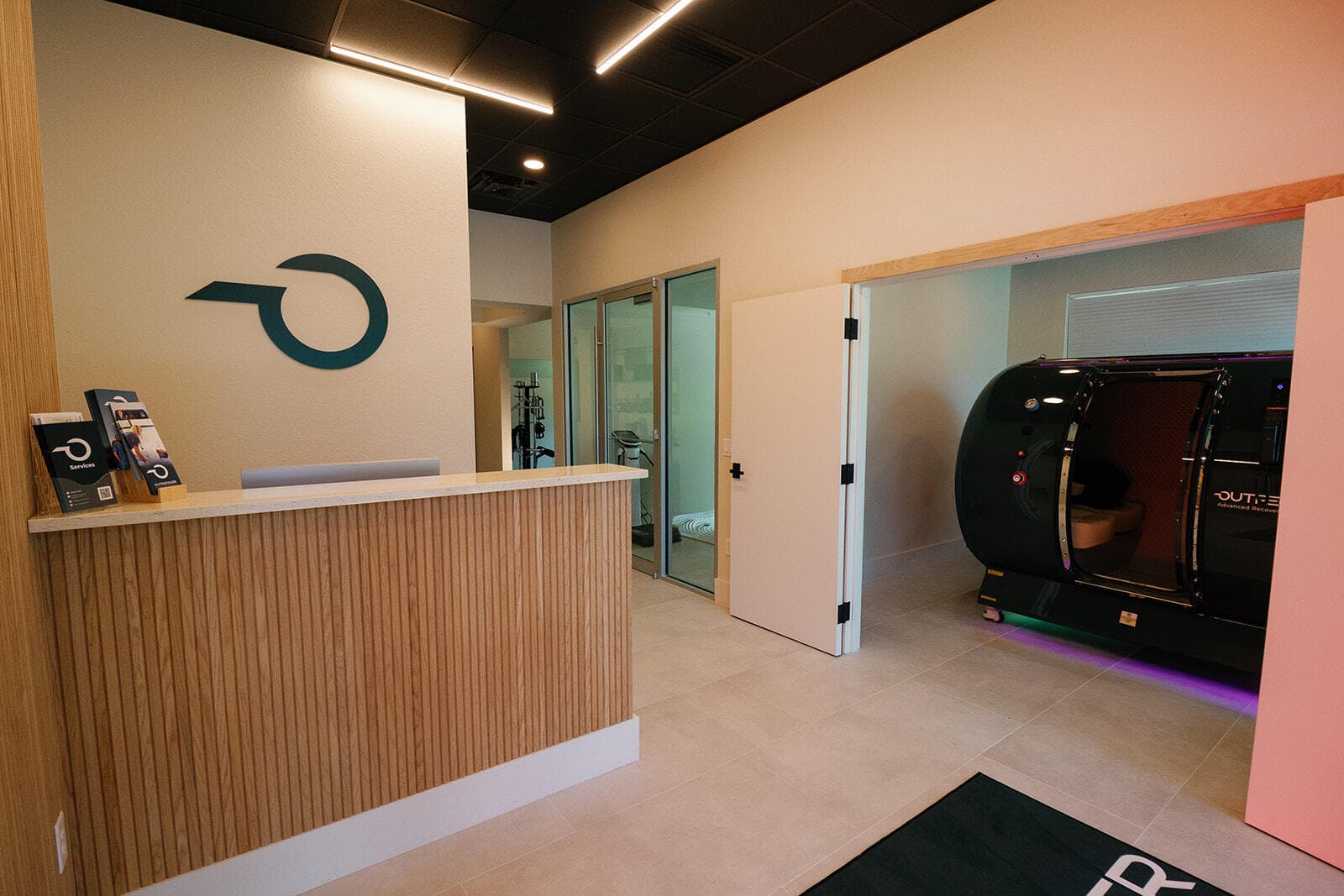
OutRecover's infrared sauna, dry cold plunge, red light therapy and Normatec compression are used by people for post-workout comfort, and each has a research summary on the site (infrared sauna, cold plunge). For an honest read of one of them, see compression boots benefits. The OutTrain package bundles red light (swappable for PEMF), compression, sauna, cold plunge and an InBody scan for runners, cyclists, racquet-sport players and lifters. OutPerform is the larger version for people training several times a week.
These can make a hard week more comfortable, and none of them replaces the nights. If sleep is your problem, the first stop is the habits above and a doctor for the red flags.
If your sleep is poor because you are doing too much, read overtraining syndrome, and for planning easier days, active recovery.
What to do this week
- Keep a sleep diary for 7 days: bed time, wake time, caffeine, alcohol, naps, training time.
- Move caffeine to before lunch and set a fixed wake time.
- Pick one habit from the CDC list and hold it for two weeks.
- If nothing improves, or any apnea sign above fits, call your doctor and bring the diary.
Recovering from surgery or an injury? Clear anything new with your surgeon or physical therapist first.
Sources
- Watson NF, et al. Recommended Amount of Sleep for a Healthy Adult: A Joint Consensus Statement of the American Academy of Sleep Medicine and Sleep Research Society. Sleep, 2015. https://pmc.ncbi.nlm.nih.gov/articles/PMC4434546/
- Centers for Disease Control and Prevention. About Sleep. CDC. https://www.cdc.gov/sleep/about/index.html
- Walsh NP, et al. Sleep and the athlete: narrative review and 2021 expert consensus recommendations. British Journal of Sports Medicine, 2021 (online 2020). https://pubmed.ncbi.nlm.nih.gov/33144349/
- Mah CD, et al. The effects of sleep extension on the athletic performance of collegiate basketball players. Sleep, 2011. https://pubmed.ncbi.nlm.nih.gov/21731144/
- Milewski MD, et al. Chronic lack of sleep is associated with increased sports injuries in adolescent athletes. Journal of Pediatric Orthopaedics, 2014. https://pubmed.ncbi.nlm.nih.gov/25028798
- Lack of Sleep and Sports Injuries in Adolescents: A Systematic Review and Meta-analysis. Journal of Pediatric Orthopaedics, 2019. https://pubmed.ncbi.nlm.nih.gov/30888337
- Lamon S, et al. The effect of acute sleep deprivation on skeletal muscle protein synthesis and the hormonal environment. Physiological Reports, 2021. https://pubmed.ncbi.nlm.nih.gov/33400856
- National Association of Chronic Disease Directors with CDC. Healthy Sleep, Healthy Brain. CDC, 2024. https://www.cdc.gov/healthy-aging/media/pdfs/2024/06/Healthy-Sleep-Healthy-Brain-508.pdf
- National Institute for Occupational Safety and Health. Module 6, Prepare for Sleep (Training for Nurses on Shift Work and Long Work Hours). CDC, reviewed 2020. https://www.cdc.gov/niosh/work-hour-training-for-nurses/longhours/mod6/04.html
- Drake C, et al. Caffeine effects on sleep taken 0, 3, or 6 hours before going to bed. Journal of Clinical Sleep Medicine, 2013. https://pubmed.ncbi.nlm.nih.gov/24235903/
- Impact of Alcohol Consumption on Snoring and Sleep Apnea: A Systematic Review and Meta-analysis. 2020. https://pubmed.ncbi.nlm.nih.gov/32513091
- Mesas AE, et al. Is daytime napping an effective strategy to improve sport-related cognitive and physical performance and reduce fatigue? A systematic review and meta-analysis of randomised controlled trials. British Journal of Sports Medicine, 2023. https://bjsm.bmj.com/content/bjsports/57/7/417.full.pdf
- Qaseem A, et al. Management of Chronic Insomnia Disorder in Adults: A Clinical Practice Guideline From the American College of Physicians. Annals of Internal Medicine, 2016. https://pubmed.ncbi.nlm.nih.gov/27136449/
- Mayo Clinic. Obstructive sleep apnea: symptoms and causes. Mayo Clinic. https://www.mayoclinic.org/diseases-conditions/obstructive-sleep-apnea/symptoms-causes/syc-20352090