You played a long tournament on Saturday, and by Monday the stairs are a negotiation. That lag is delayed onset muscle soreness (DOMS): muscle pain that starts a day or two after unfamiliar or hard exercise, peaks, and fades by itself. The research on recovery methods is smaller and messier than the marketing around it. Below is what causes DOMS, how to tell it from something that needs a doctor, and how each common method has performed in reviews.
What is delayed onset muscle soreness, and why does it happen?
DOMS is muscle pain and stiffness that sets in one to three days after intense exercise, most often after something new or harder than you are used to, according to Cleveland Clinic. The trigger is usually eccentric work, where a muscle tenses while it lengthens: lowering a weight, running downhill, braking on a descent, or decelerating to stop on a court.
Lactic acid is not the cause. A 2025 scoping review says that theory has been refuted and points instead to microscopic disruption of muscle fibers and connective tissue, inflammation, and sensitized pain nerves. It describes DOMS as a transient, self-limiting response, typically arising 24 to 72 hours after eccentric or high-intensity exercise.
So a first round of golf in months, a weekend of pickleball or a new leg day can leave you sorest on day two, even if you felt fine walking off the course.
How long does muscle soreness after a workout last?
Most DOMS fades within a few days. Cleveland Clinic says it usually lasts a few days after the workout and rarely more than five, and that the pain should ease a little each day. Here is the usual shape, with the sources that back each row.
| When | What you usually notice | Source |
|---|---|---|
| During and right after | Tiredness or a burn. DOMS has not started. | Cleveland Clinic |
| Day 1 to 3 | Tenderness, stiffness and aching start. The review above puts the usual window at 24 to 72 hours. | Cleveland Clinic, 2025 review |
| Day 3 to 5 | Pain eases each day. Rarely lasts past five days. | Cleveland Clinic |
| Past about day 5, or getting worse | Unusual for DOMS. See a clinician. | Cleveland Clinic |
When is muscle soreness not DOMS?
Soreness that comes with dark urine or severe weakness may be rhabdomyolysis, a muscle injury that can damage the kidneys and needs urgent care. The Mayo Clinic lists extremely painful muscle aches, muscle weakness and dark or cola-colored urine as its symptoms, and says it requires immediate medical attention. Cleveland Clinic adds muscle swelling and says extremely sore or weak muscles a few days after exercise, with dark urine, warrant seeing a provider right away.
Use this as a quick screen:
- Usual DOMS: aching and tenderness in the muscles you worked, you can still move the area, it improves each day.
- Call a clinician the same day: pain far worse than the workout explains, visible swelling, weakness that stops you using the limb, or soreness that is not easing after about five days.
- Go to the emergency room: dark or cola-colored urine with severe muscle pain or weakness. Cleveland Clinic names rhabdomyolysis and compartment syndrome as medical emergencies.
- Not DOMS at all: pain during the activity, a pop, sharp pain at one spot, or a joint that swells. Those point to a strain or joint injury. Our shin splints guide covers one common look-alike for runners.
What does the research say helps with muscle soreness after a workout?
Several methods lower soreness a little, none removes it, and the evidence is weaker than the sales pitches suggest. The biggest review, Dupuy and colleagues in Frontiers in Physiology (2018), pooled 99 studies of a single recovery session after exercise. A newer 2025 umbrella review in Sports Medicine covered 29 systematic reviews and judged 17 of them critically low in methodological quality. Treat every number below as a modest, uncertain effect.
| Method | What the evidence shows | Source |
|---|---|---|
| Massage | Largest drop in soreness in Dupuy (effect size -2.26). Umbrella review: Class III (suggestive) evidence at 24 hours. | Dupuy, 2018, Wiecha, 2025 |
| Cold-water immersion | Cochrane: some evidence of less soreness at 24 to 96 hours versus rest, from 17 small, low-quality trials. | Bleakley, Cochrane 2012 |
| Compression | Small to moderate drop in soreness. Little change in jump height or muscle-damage markers. | Dupuy, 2018, Wiśniowski, 2022 |
| Active recovery | Lower soreness in Dupuy (effect size -0.94). | Dupuy, 2018 |
| Stretching | Cochrane: no clinically important reduction before or after exercise. | Herbert, Cochrane 2011 |
| Protein | Helped keep strength and lowered a muscle-damage marker. No effect on soreness. | Pearson, 2023 |
| Sleep | One night of lost sleep raised pain sensitivity two days after eccentric exercise. | Palsson, 2023 |
Massage. Dupuy ranked it the most effective method for soreness and perceived fatigue. The 2025 umbrella review rated massage as Class III evidence at 24 hours. Both reviews pooled small studies with varied techniques, so the size of the benefit is uncertain.
Cold-water immersion. The Cochrane review found that soreness was lower at 24 hours (standardized mean difference -0.55), 48 hours (-0.66) and 72 hours (-0.93), but called study quality low and the results heterogeneous, and it found no important difference between cold water and other recovery strategies such as warm-water immersion, contrast therapy, light jogging or compression stockings. It also says the best way to use it, and its safety, remain uncertain. It is from 2012, so it is a snapshot.
Compression. In the 2022 meta-analysis of 12 trials, pneumatic compression gave moderate benefits that depended on the exercise and protocol. Our compression boots guide goes through the trials and who should skip them.
Active recovery. Light movement, such as an easy walk or spin, lowered soreness in Dupuy's pooled data. The umbrella review rates evidence for exercise-based approaches as weak. The practical reading: easy movement is cheap, safe for most people and may help a little.
Stretching. Cochrane found that pre-exercise stretching cut soreness by about half a point on a 100-point scale, and post-exercise stretching by about one point. Both estimates were consistent with no effect. Dupuy likewise found no change.
Protein. In a 29-study review, protein around exercise helped preserve strength and lowered creatine kinase (a muscle-damage marker) but did not change soreness. Eat enough protein for your training, and do not expect it to quiet DOMS.
Sleep. In a small 2023 study of 36 healthy adults, a night without sleep after eccentric thigh exercise made pressure pain thresholds drop more, though the soreness ratings people gave did not differ. It is one small study, but sleep is free.
Little or nothing: Dupuy found no clear soreness benefit from electrostimulation or hyperbaric therapy.
Should you rest, move or push through DOMS?
Move gently, and skip anything that hurts sharply. Cleveland Clinic says pushing hard before muscles heal raises the risk of strains, because you compensate and your form slips. A rule of thumb follows (ours, not from a study).
- Soreness 1 to 3 out of 10: train as planned, with a longer warm-up.
- Soreness 4 to 6: train a different muscle group, or do easy cardio or a walk.
- Soreness 7 or more, or pain that changes how you move: rest that area and watch for the warning signs above.
The most effective prevention is gradual build-up. Cleveland Clinic recommends easing into new activities, which is the same logic as an off-season pickleball or golf return. Our pickleball injuries guide covers how players get hurt when they skip it.
Where recovery services at OutRecover fit
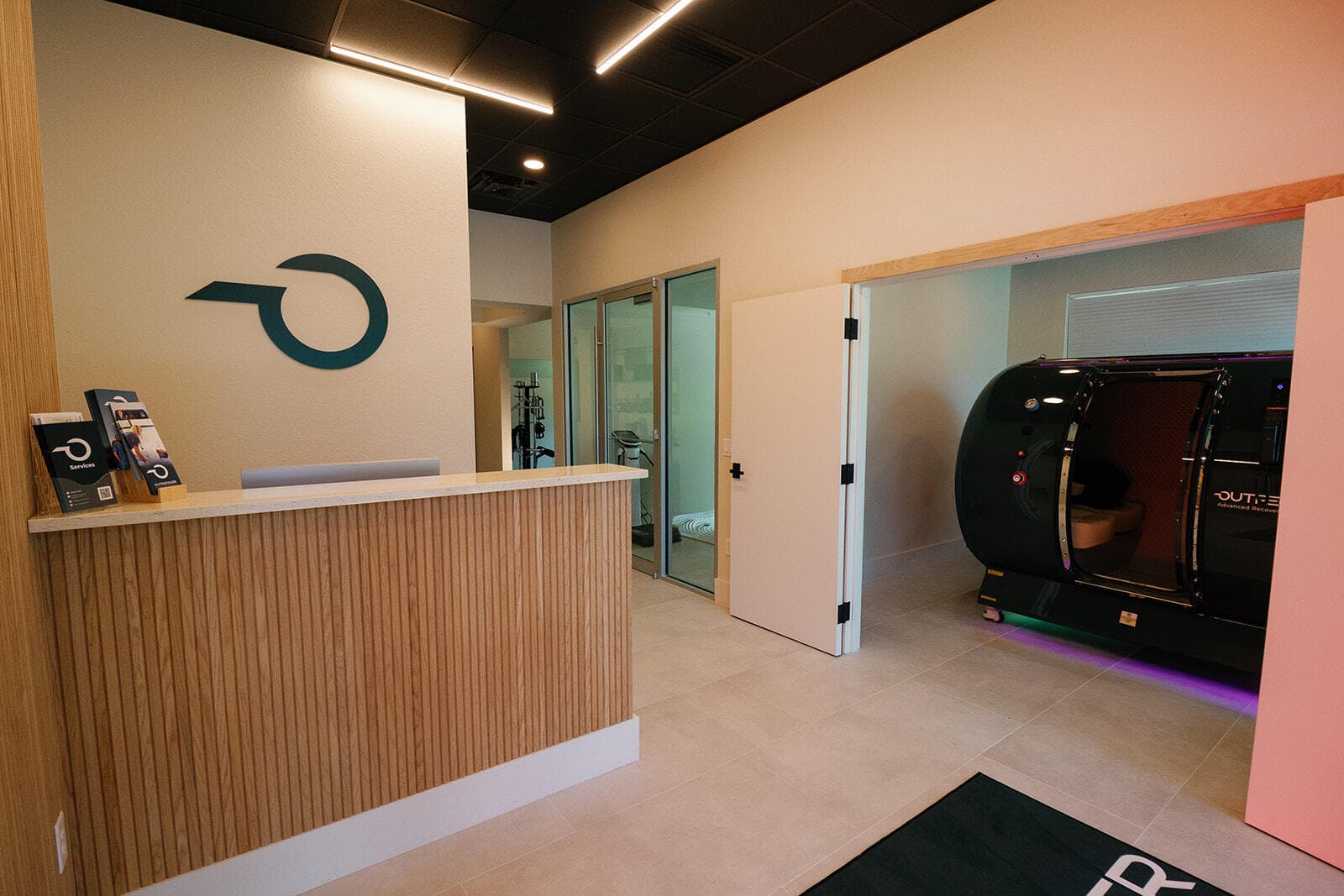
The studio offers several of the methods above, and the research supports them at different strengths. Compression is the best match: compression therapy is a 30-minute passive session, and the trials on boots show a small effect on perceived soreness. A dry cold plunge is listed at 45 to 55 degrees Fahrenheit, but the Cochrane trials tested water immersion. We did not find soreness trials of a dry plunge, so treat those results as indirect. The full evidence is on the cold plunge research page.
The infrared sauna and red light therapy sit in the same routine, but we did not find a review that tests either one for DOMS specifically.
Two packages are built for this kind of week. OutTrain lists runners, tennis, pickleball and golf players, lifters and anyone with post-workout soreness, and includes red light, compression, the sauna, the cold plunge and an InBody scan. OutPerform adds more visits and OutWin IVs (they need medical approval) for people training several times a week or in a race block. These are comfortable, low-effort add-ons to sleep, food and a sensible training load. They are not a treatment for DOMS and the studio's own pages say its services are not meant to diagnose, treat or cure disease.
Your next step
Check the warning signs first. If you have dark urine, severe weakness, swelling or pain that is not easing after about five days, see a clinician before booking anything. If it is ordinary DOMS, sleep, eat protein, move gently, and decide whether one or two sessions of compression or a plunge feel worth it to you. Rate your soreness each morning for two days. Book a session or call the studio to ask which service fits.
Sources
- Cleveland Clinic. Delayed Onset Muscle Soreness (DOMS). Health Library. https://my.clevelandclinic.org/health/diseases/delayed-onset-muscle-soreness
- Cleveland Clinic. Rhabdomyolysis. Health Library. https://my.clevelandclinic.org/health/diseases/21184-rhabdomyolysis
- Mayo Clinic News Network. Variety of causes can be at root of rhabdomyolysis. Mayo Clinic. https://newsnetwork.mayoclinic.org/discussion/variety-of-causes-can-be-at-root-of-rhabdomyolysis
- Dupuy O, Douzi W, Theurot D, Bosquet L, Dugué B. An evidence-based approach for choosing post-exercise recovery techniques to reduce markers of muscle damage, soreness, fatigue, and inflammation: a systematic review with meta-analysis. Frontiers in Physiology, 2018. https://pmc.ncbi.nlm.nih.gov/articles/PMC5932411
- Wiecha S, et al. Physical therapies for delayed-onset muscle soreness: an umbrella and mapping systematic review with meta-meta-analysis. Sports Medicine, 2025. https://pubmed.ncbi.nlm.nih.gov/40120073
- Bleakley C, McDonough S, Gardner E, Baxter GD, Hopkins JT, Davison GW. Cold-water immersion (cryotherapy) for preventing and treating muscle soreness after exercise. Cochrane Database of Systematic Reviews, 2012. https://pmc.ncbi.nlm.nih.gov/articles/PMC6492480
- Herbert RD, de Noronha M, Kamper SJ. Stretching to prevent or reduce muscle soreness after exercise. Cochrane Database of Systematic Reviews, 2011. https://www.cochrane.org/evidence/CD004577_stretching-prevent-or-reduce-muscle-soreness-after-exercise
- Wiśniowski P, et al. The effect of pressotherapy on performance and recovery in the management of delayed onset muscle soreness: a systematic review and meta-analysis. Journal of Clinical Medicine, 2022. https://pmc.ncbi.nlm.nih.gov/articles/PMC9028309
- Pearson AG, Hind K, Macnaughton LS. The impact of dietary protein supplementation on recovery from resistance exercise-induced muscle damage: a systematic review with meta-analysis. European Journal of Clinical Nutrition, 2023. https://pubmed.ncbi.nlm.nih.gov/36513777
- Palsson TS, Rubio-Peirotén A, Doménech-García V. Sleep deprivation increases pain sensitivity following acute muscle soreness. Sleep Medicine, 2023. https://pubmed.ncbi.nlm.nih.gov/37423022
- Advances in non-pharmacological strategies for DOMS: a scoping and critical review of recent evidence. PubMed Central, 2025. https://pmc.ncbi.nlm.nih.gov/articles/PMC12641786
- OutRecover. Compression Therapy, Dry Cold Plunge, Infrared Sauna and Red Light Therapy service pages; OutTrain and OutPerform package pages. https://outrecover.com