Zone 2 training means steady cardio at an easy-to-moderate effort, the second zone in a five-zone model. Regular aerobic training at that kind of effort does improve fitness; a 2026 meta-analysis of randomized trials found a large effect on VO2max in healthy adults. The evidence for zone 2 specifically is limited: we found no trial showing it beats other ways of training, and "zone 2" has no single agreed definition. This guide covers what the research says, where popular claims go further than it does, and how to find your own zone.
What is zone 2 training?
Zone 2 is the second of five intensity zones that many coaches, watches and apps use, and it usually marks the low-to-moderate end of aerobic work. A 2025 study of 50 cyclists describes it as low-intensity training that endurance athletes use for its potential to improve aerobic adaptations and metabolic efficiency (Meixner, 2025). In practice that means long, steady sessions of 30 to 90 minutes on a bike, a walk, a jog, a rower or a swim.
The word "zone" is a convention. Different systems draw the boundaries in different places, which matters more than most people expect.
How is zone 2 defined, and why do the definitions disagree?
There is no single definition, and the choice changes who is training where. The same word can mean a percentage of your maximum heart rate, the point where your breathing first speeds up, the intensity where you burn the most fat, or a blood lactate reading. A 2025 comparison of these markers found coefficients of variation from 6% to 29% across them (Meixner, 2025).
| Way of setting the zone | What it uses | Main weakness |
|---|---|---|
| Fixed percent of max heart rate | An age formula or a tested maximum | Individual differences are wide |
| Effort scale | How hard it feels, 0 to 10 | Subjective; the CDC calls a 5 or 6 "moderate", which is a broader band than zone 2 |
| First ventilatory threshold (VT1) | Breathing gases in a lab or clinic test | Needs equipment and a graded test |
| Lactate threshold | Blood samples during stepped effort | Needs equipment and a skilled tester |
| Maximal fat oxidation (FatMax) | Breathing gases, converted to fuel use | Needs equipment and a graded test |
Two findings from that table are worth holding onto. In the 50-cyclist study, VT1 and FatMax lined up closely, while fixed percentages of heart rate and some lactate thresholds showed wide individual differences (Meixner, 2025). And a 2025 study of 1,691 people on cycle ergometers found that the share of maximum effort at which VT1 falls varies widely, even after sorting people by sex and fitness level (Ventilatory thresholds study, 2025).
The broader exercise-science field agrees. A 2020 review in Sports Medicine concluded that prescribing exercise intensity based on a fixed percentage of these maximal anchors has little merit for eliciting distinct or domain-specific homeostatic perturbations (Jamnick, 2020). It found some evidence that VT, the gas exchange threshold and the first lactate threshold do separate moderate from heavy effort.
What does the research show about zone 2 and other low-intensity training?
Low-intensity endurance training works, and the strongest evidence covers a wide band of easy-to-moderate effort rather than zone 2 alone. A 2026 meta-analysis of 50 randomized trials, with 824 participants in the training groups, found a large effect on VO2max (effect size 0.94) and a moderate effect on VT1 compared with control groups (Nuuttila, 2026). Effects on blood pressure and blood lipids were small but significant.
Three details keep that result honest:
- The band was wide. The review included training below the first threshold, or at 60% of heart rate reserve or less, or at 75% of maximum heart rate or less. That is a range that spans more than one zone.
- Higher was better, within the band. Intensity was associated with VO2max gains, while no minimum intensity showed up for most other outcomes.
- The authors flag the gap. They write that the upper part of the low-intensity range, zone 2, has been suggested to work better than the lower part, but that research evidence supporting this claim remains relatively limited, and a universal definition of such a zone is challenging (Nuuttila, 2026).
So the fair summary is that regular, easy-to-moderate aerobic work raises fitness, and we found no trial showing that a precisely defined zone 2 is the best version of it.
Is zone 2 better than harder training?
For raising VO2max, the trials do not favor staying easy. A 2015 meta-analysis of 28 controlled trials in healthy 18-to-45-year-olds found that both endurance training and interval training produced large VO2max gains, with gains greater after high-intensity interval training than after continuous endurance training (Milanović, 2015). Our guide on how to increase VO2 max covers that side in detail.
For athletes who train a lot, the question is how to mix easy and hard. A 2025 network meta-analysis of 13 studies and 348 endurance athletes found no difference in VO2max or time-trial performance between polarized and pyramidal training (Rosenblat, 2025). Competitive athletes tended to improve more with polarized training and recreational athletes with pyramidal. Both patterns include plenty of easy work, so this does not make zone 2 the star, and it does not make it pointless.
In practice, easy aerobic work is a sound base, harder work adds to it, and the evidence does not support a rule like "keep nearly all your cardio in zone 2" for people who are not racing.
Where do popular zone 2 claims go further than the evidence?
Three claims travel faster than their sources.
"Zone 2 is where you burn the most fat, so it is the fat-loss zone." The research behind the fuel idea is real. A 2018 study compared professional endurance athletes, moderately active people and people with metabolic syndrome, and found that fat oxidation during exercise was higher in the athletes, and that fat oxidation and blood lactate were inversely related (San-Millán and Brooks, 2018). That is a comparison between groups at one point in time. It does not show that training in zone 2 changes body fat or metabolic health.
"Zone 2 is the key to longevity." Fitness itself has strong support. A study of 122,007 adults who had treadmill tests found risk of death was inversely related to fitness, with no upper limit of benefit observed (Mandsager, 2018). It was an observational study that grouped people by their fitness and did not look at how they trained, so it cannot tell you which zone built the fitness.
"Heart-rate formulas find your zone." The 2020 Sports Medicine review and the two 2025 studies above show why this is shaky for any one person. In a small 2015 trial of 36 adults, training prescribed from ventilatory thresholds improved VO2max by 3.93 ml/kg/min against 1.76 for training set by heart rate reserve, and every threshold-trained person gained more than 5.9% in VO2max against 41.7% of the heart-rate-reserve group (Wolpern, 2015). One small trial from 2015 is a snapshot and an open question, but it points the same way as the larger reviews.
How do you find your zone 2?
Pick the method that matches how precise you need to be, and treat any number as a starting point.
- Start with effort. Aim for an effort you could keep up for an hour, around a 5 or 6 on a 0-to-10 scale, which is how the CDC describes relatively moderate-intensity activity (CDC). For most people that is a reasonable place to begin.
- Add heart rate as a cross-check. A watch reading is useful for noticing drift over weeks, with the caveat that fixed percentages vary widely between people.
- Test if the number matters. If you train for an event or want a personal threshold, a gas-exchange test finds VT1 and FatMax directly. A lactate test does the same job with blood samples.
- Re-check after a training block. Thresholds move as fitness changes, so a number from last year may be stale.
If you have a heart condition, take medicines that change your heart rate, are recovering from surgery, or have not exercised in a long time, clear a new program with your doctor first.
How much zone 2 should you do each week?
No trial tells us a single best dose of zone 2. The national guideline covers the whole aerobic category. The Physical Activity Guidelines for Americans advise adults to get at least 150 to 300 minutes of moderate-intensity aerobic activity each week, plus muscle-strengthening activity on at least 2 days (Physical Activity Guidelines, 2nd edition, 2018).
A weekly checklist that fits the evidence:
- Two to four easy steady sessions of 30 to 60 minutes.
- One harder session if your doctor agrees, since intervals raised VO2max more in the trials above.
- Two days of strength work. Muscle matters as you age; see our guide to sarcopenia and muscle loss after 50.
- At least one easy or off day, and attention to the signs in our overtraining syndrome guide if you are stacking sessions.
Where do OutRecover's services fit?
Two services touch this topic, and neither is a zone 2 program.
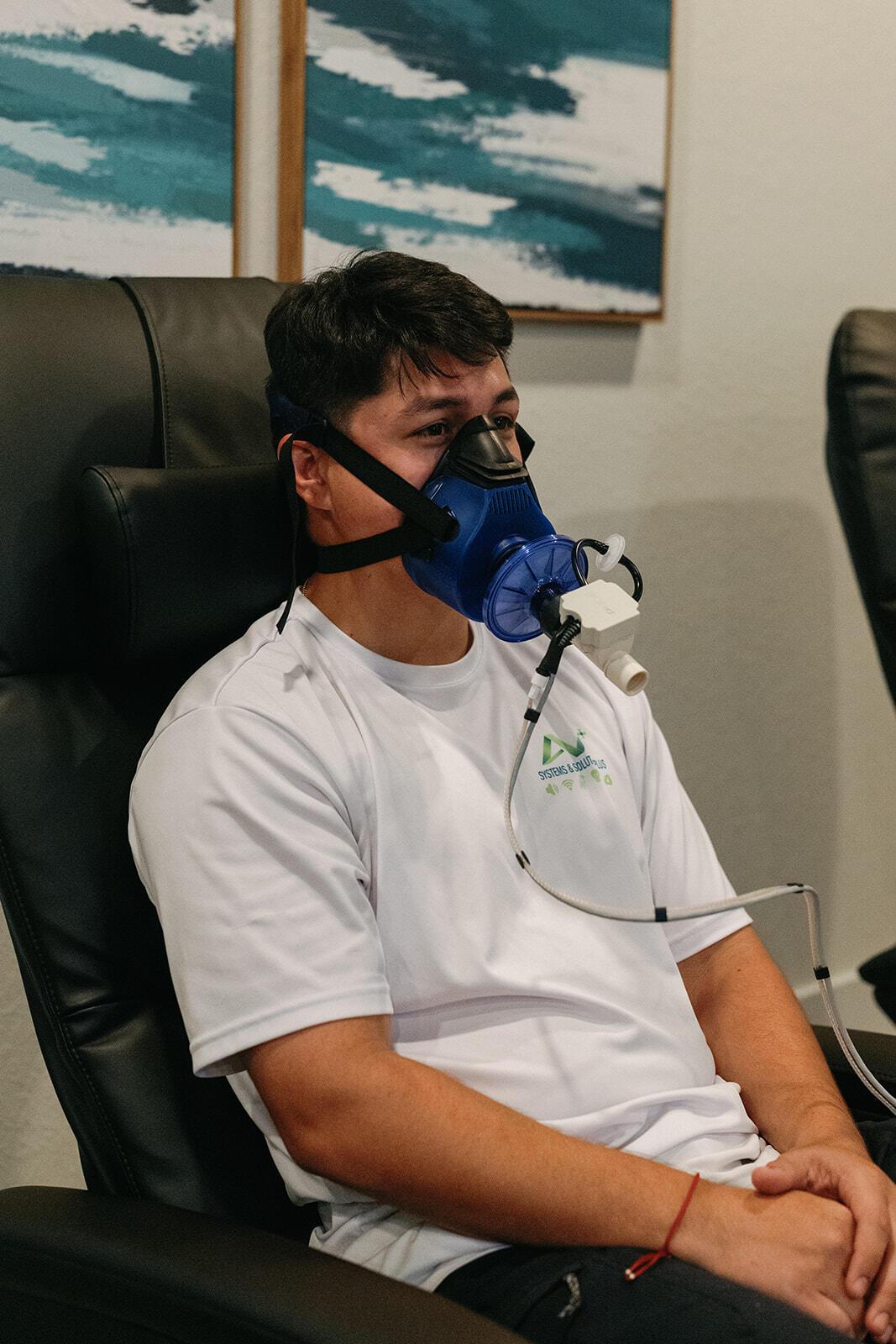
The PNOE metabolic test is a breath analysis. Its page describes a portable analyzer that measures oxygen use and carbon dioxide output, either at rest or during a graded exercise test on a bike or treadmill, and says it shows how your body uses fuel. That is the kind of measurement the research above uses to find VT1 and FatMax. Ask the studio what the report includes and whether it gives you a threshold for training, because we cannot say from the page that it does. The research summary is on our biometric testing science page.
The CAROL AI bike is the opposite end of the intensity range. Its page describes a 9-minute ride with two 20-second sprints. It is built for time-efficient cardio, so it is not a way to do zone 2 and it does not need to be one.
If you train several days a week and want recovery built around it, the OutTrain and OutPerform packages are written for endurance athletes and people training often. They add recovery services around training. Read the research page for each service before you rely on it; the evidence for most recovery services is limited or mixed. Easy sessions also double as recovery days; see active recovery.
What should you do next?
Pick one easy aerobic activity you like, put it on the calendar three times this week, and run it at an effort you could hold for an hour. After a month, notice whether the same effort feels easier. If you want a measured number rather than a guess, book a PNOE test and ask for your first threshold in writing. Your doctor or surgeon comes first if anything about your health is changing.
Sources
- Meixner B, Filipas L, Holmberg H-C, Sperlich B. Zone 2 Intensity: A Critical Comparison of Individual Variability in Different Submaximal Exercise Intensity Boundaries. Translational Sports Medicine, 2025. https://pmc.ncbi.nlm.nih.gov/articles/PMC11986187
- Nuuttila O-P, Matomäki P, Raitanen J, Sievänen H, Vasankari T. Effects of Low-Intensity Endurance Training on Aerobic Fitness and Risk Factors of Cardiometabolic Health in Working-Age Adults: A Systematic Review and Meta-Analysis. Scandinavian Journal of Medicine & Science in Sports, 2026. https://pubmed.ncbi.nlm.nih.gov/41543030 (full text: https://pmc.ncbi.nlm.nih.gov/articles/PMC12810095)
- Jamnick NA, Pettitt RW, Granata C, Pyne DB, Bishop DJ. An Examination and Critique of Current Methods to Determine Exercise Intensity. Sports Medicine, 2020. https://pubmed.ncbi.nlm.nih.gov/32729096
- Ventilatory Thresholds Differences According to Aerobic Fitness Level in 1450 Males and 241 Females on Cycle-Ergometer: A Cross-Sectional Study. European Journal of Sport Science, 2025. https://pmc.ncbi.nlm.nih.gov/articles/PMC12173951
- Milanović Z, Sporiš G, Weston M. Effectiveness of High-Intensity Interval Training (HIT) and Continuous Endurance Training for VO2max Improvements: A Systematic Review and Meta-Analysis of Controlled Trials. Sports Medicine, 2015. https://pubmed.ncbi.nlm.nih.gov/26243014
- Rosenblat MA, et al. Which Training Intensity Distribution Intervention will Produce the Greatest Improvements in Maximal Oxygen Uptake and Time-Trial Performance in Endurance Athletes? A Systematic Review and Network Meta-analysis of Individual Participant Data. Sports Medicine, 2025. https://pubmed.ncbi.nlm.nih.gov/39888556
- San-Millán I, Brooks GA. Assessment of Metabolic Flexibility by Means of Measuring Blood Lactate, Fat, and Carbohydrate Oxidation Responses to Exercise in Professional Endurance Athletes and Less-Fit Individuals. Sports Medicine, 2018. https://pubmed.ncbi.nlm.nih.gov/28623613
- Mandsager K, Harb S, Cremer P, Phelan D, Nissen SE, Jaber W. Association of Cardiorespiratory Fitness With Long-term Mortality Among Adults Undergoing Exercise Treadmill Testing. JAMA Network Open, 2018. https://pubmed.ncbi.nlm.nih.gov/30646252
- Wolpern AE, Burgos DJ, Janot JM, Dalleck LC. Is a threshold-based model a superior method to the relative percent concept for establishing individual exercise intensity? A randomized controlled trial. BMC Sports Science, Medicine and Rehabilitation, 2015. https://pmc.ncbi.nlm.nih.gov/articles/PMC4491229
- Centers for Disease Control and Prevention. How to Measure Physical Activity Intensity. CDC, accessed 2026. https://www.cdc.gov/physical-activity-basics/measuring/index.html
- U.S. Department of Health and Human Services, ODPHP. Top 10 Things to Know About the Second Edition of the Physical Activity Guidelines for Americans. 2018. https://odphp.health.gov/our-work/nutrition-physical-activity/physical-activity-guidelines/current-guidelines/top-10-things-know