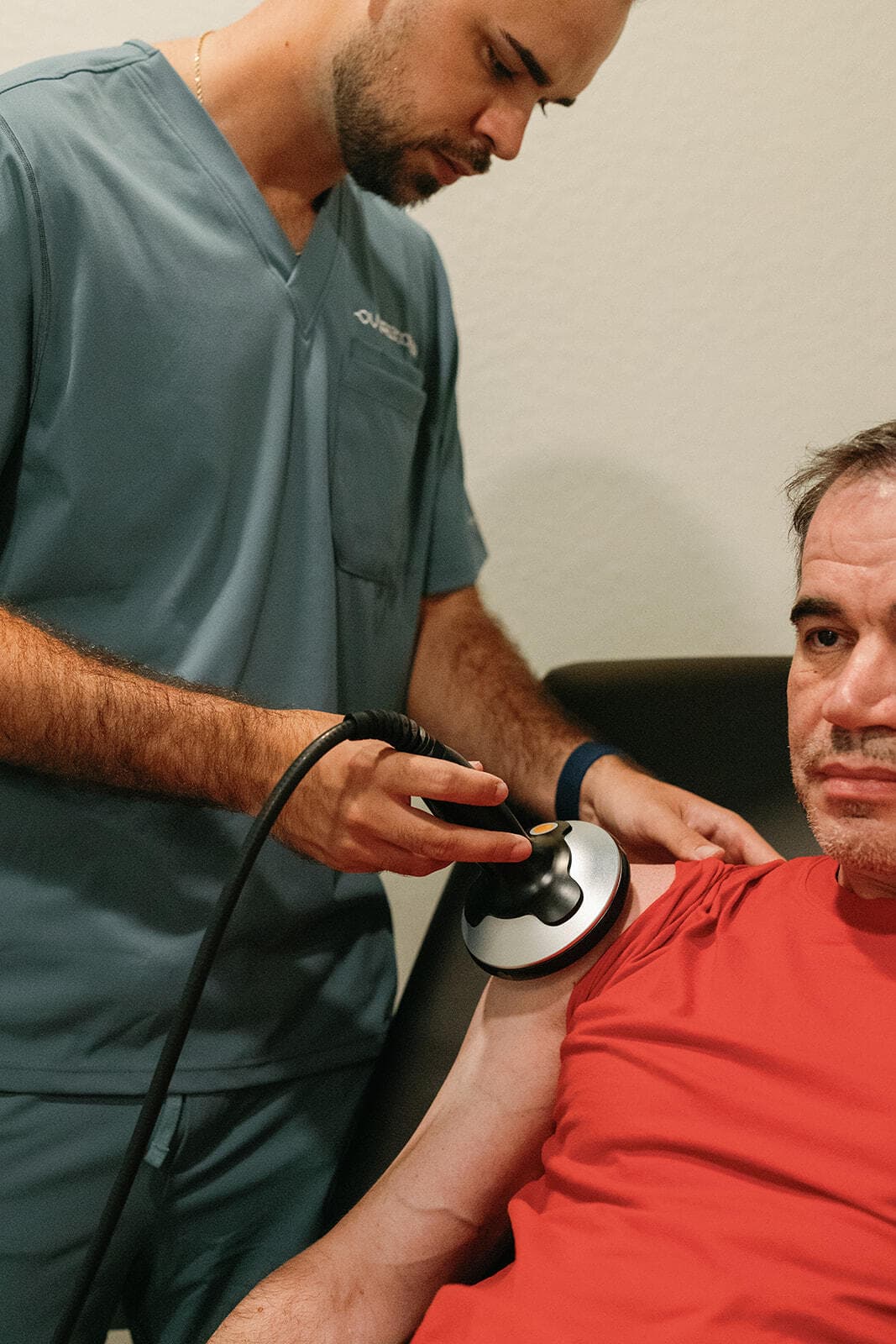
Shoulder bursitis is irritation of the small fluid-filled cushion that sits above your rotator cuff tendons. It rarely travels alone. The overload that inflames the bursa usually irritates a tendon too, so care for bursitis shoulder pain is largely care for the rotator cuff: a progressive exercise program first, with injections, machines and surgery in supporting roles at best. A few look-alikes (a tear, an infection, gout) need a clinician to rule out, and that check is worth doing early.
What is shoulder bursitis, and how does it relate to impingement?
A bursa is a small, fluid-filled sac that cushions the space between a bone and the muscles or tendons moving over it (MedlinePlus, undated). In the shoulder, the subacromial bursa sits in the gap between the top of the upper arm bone and the bony roof of the shoulder, the acromion. The Hospital for Special Surgery lists inflammation of the subacromial bursa or a diseased rotator cuff tendon among the things that narrow that gap (HSS, 2025). The Merck Manual adds that rotator cuff tendinitis can result in subacromial bursitis (Merck Manual, 2025).
That overlap explains the many names on a report. The 2025 clinical practice guideline from the Journal of Orthopaedic and Sports Physical Therapy (JOSPT) treats subacromial pain syndrome, subacromial impingement syndrome and subacromial bursopathy as falling within a rotator cuff tendinopathy diagnosis (Desmeules and colleagues, 2025). A 2025 editorial in the same journal argues that the tendons are not the definitive and sole source of shoulder symptoms (Lewis and colleagues, 2025), which is also why nobody can reliably point to the bursa alone. If you want the tendon and impingement side in full, read our guides on shoulder impingement and rotator cuff tendinitis.
Cleveland Clinic describes the feel: pain that can come on suddenly or build gradually, a dull ache that turns sharp or pinching when you lift your arm overhead, and worse pain when you lie on that shoulder (Cleveland Clinic, 2024). The Merck Manual notes the pain is usually worst between 60 and 120 degrees of lifting and minimal below or above that range.
How is shoulder bursitis diagnosed, and what should be ruled out?
Diagnosis starts with an exam. Merck says diagnosis is usually made by examination, with MRI or arthroscopy for some patients. The JOSPT guideline advises against imaging to confirm the problem at the start, allows it if symptoms have not improved within a maximum of 12 weeks of appropriate nonsurgical care, and says to prioritize ultrasound. It also tells clinicians to screen the neck and to look for red flags: fever or chills, a suspicious deformity, signs pointing to the heart or other organs, or a history or suspicion of cancer.
| Look-alike | What points to it | How it is checked |
|---|---|---|
| Rotator cuff tear | Weakness lifting or rotating the arm, pain at rest and at night; a sudden tear after a fall can bring a snap and immediate weakness (AAOS) | Strength exam, then ultrasound or MRI |
| Frozen shoulder | Limited motion both when you move the arm and when someone else moves it (AAOS) | Active and passive range-of-motion exam |
| Infection (septic bursitis) | Fever or chills with redness, swelling or warmth (Cleveland Clinic, 2024) | Drawing and testing bursa fluid, blood tests |
| Gout or inflammatory arthritis | Cleveland Clinic lists rheumatoid arthritis, gout and psoriatic arthritis among conditions that raise bursitis risk | Fluid test for crystals, X-ray |
| Neck problem | Shoulder pain with neck symptoms (JOSPT, 2025) | Neck screening exam |
Cleveland Clinic says an untreated infected bursa can spread bacteria through the body, and that severe infections can cause sepsis. It calls this rare, and asks you to see a provider right away if you suspect infection. Fever, chills, or a red, swollen, warm shoulder is a same-day call, not something to exercise through. See a provider as well if the shoulder is weak, if pain interferes with your sleep or daily routine, or if home care has not helped.
Bursitis shoulder treatment: what should you try first?
Start with an active exercise program, ideally guided by a physical therapist. The JOSPT guideline gives its top-graded recommendation (Grade A) to an active rehabilitation program, which may include motor control and resistance exercises of various loads, as the initial treatment. Merck agrees that in most cases of tendinitis, bursitis and partial cuff tears, rest, NSAIDs and rotator cuff strengthening are sufficient.
The pieces, in the order most plans use them:
- Understand the problem and adjust activity. The guideline recommends individualized education, activity modification and self-management.
- Calm the flare. Cleveland Clinic suggests an ice pack wrapped in a thin towel for 15 minutes a few times a day. The JOSPT guideline says clinicians may recommend acetaminophen or oral NSAIDs for short-term pain relief. Cleveland Clinic advises against taking over-the-counter NSAIDs or acetaminophen for more than 10 days in a row without talking to your provider.
- Build load gradually. Resistance and motor-control exercise is the center of the plan. Have a physical therapist set the exercises and progression for your shoulder.
- Reassess at about 12 weeks. If symptoms have not improved by then, the guideline suggests imaging and referral to a musculoskeletal specialist.
Evidence here is strong on direction and thin on the single best exercise, so expect the first plan to be adjusted. The same bursitis label on the outer hip has a similar story, covered in our hip bursitis guide.
When does a steroid injection make sense?
When pain is stopping you from doing the exercise, and as a short-term helper. The American Academy of Orthopaedic Surgeons (AAOS) places the steroid shot after rest, medications and physical therapy have not helped. The JOSPT guideline says clinicians may recommend or administer corticosteroid injections for pain and short-term disability, and should not use them as first-line treatment. It suggests ultrasound guidance for a subacromial injection where available.
A 2025 meta-analysis of 15 trials and 1,785 people found that an injection added to physical therapy might give small to moderate short-term improvements in pain and function, that an injection alone seemed no better than physical therapy, and that nothing beat therapy at mid or long term (Lazzarini and colleagues, 2025). The authors rated the evidence moderate to mostly very low certainty. Merck adds a caution: repeat glucocorticoid injections are associated with an increased risk of tendon degeneration, so their use should be limited.
Does surgery for a bursa help?
Rarely, and the best trials say so plainly. The common operation, subacromial decompression, removes bone and bursal tissue to create room. In CSAW, a UK trial with a placebo-surgery arm, surgical groups did better than no treatment, but the difference was not clinically important, and decompression gave no extra benefit over arthroscopy only (Beard and colleagues, 2018). A 2019 BMJ guideline panel concluded that decompression surgery should not be offered to patients with this kind of shoulder pain (Vandvik and colleagues, 2019), and noted frozen shoulder may be more common after surgery.
Merck still lists surgery for chronic bursitis that resists conservative care, and a surgeon may repair a tear during the same procedure. Ask what the operation would add in your shoulder, given those trials.
What do reviews show for shockwave, laser, PEMF and red light?
The research is thinner than for exercise, mostly low in certainty, and on shockwave the 2025 JOSPT guideline takes a clear position. The studio therapies are listed here at the strength the reviews support. Read the table as the state of the research, not a promise for one shoulder.
| Therapy | What the research says | How sure |
|---|---|---|
| Focused shockwave | JOSPT 2025 (Grade C): clinicians should not use it for rotator cuff tendinopathy without calcification, and may use it when a calcific deposit is confirmed by imaging. A 2024 review of 9 trials (543 people) found a small short-term pain edge over sham (SMD -0.28, 95% CI -0.55 to -0.01), no function benefit, and no edge over other treatments | Moderate certainty for that small, short-term pain edge |
| Laser, low-level and high-power | A 2026 review of 23 trials (805 to 1064 nm) found overall pain reduced, but not pain at rest, in movement or at night, and best used as an add-on to rehabilitation. A 2026 low-level laser review found pooled effects that did not reach the minimal clinically important difference | Limited: small trials, inconsistent dosing, short follow-up |
| PEMF | A 2025 review of 4 trials (252 people) found small short-term pain relief (SMD -0.34, 95% CI -0.66 to -0.01), with small samples and varying protocols. The JOSPT guideline found insufficient evidence for PEMF in rotator cuff tendinopathy | Low |
| Red light | A 2025 review of 10 trials of low-level light plus exercise for impingement found pain improved (mean difference -0.89, 95% CI -1.38 to -0.40) and range of motion improved, with no significant gain in function. Those trials used targeted devices; this research turned up no trial of a full-body red light bed for the shoulder | Limited: no function gain, and not tested on the studio's device type |
Sources: JOSPT guideline, 2025; Kamonseki, 2024; Dadkhahfar, 2026; Chen and Wang, 2026; Wang, 2025; Quagliotto, 2025.
Two things follow. If imaging shows no calcium deposit in the tendon, the 2025 guideline's position is that shockwave is not recommended, whatever your shoulder is called. And for laser, PEMF and red light, the honest summary is small, short-term effects at best, as a side dish to rehabilitation. For the full shockwave research, see the shockwave science page; for the others, our guides on laser therapy for pain, PEMF and whether red light works.
Where do studio services fit?
Alongside a rehabilitation plan, after a clinician has ruled out the look-alikes above. The shoulder-relevant packages at the North Naples studio on Piper Boulevard fit different situations, best fit first:
- OutRelief lists shoulder, hip and knee pain and pain that disrupts sleep. It combines PEMF, Class IV laser and red light, with an IV and molecular hydrogen. It is the closest match for a painful bursitis shoulder with no calcium deposit, and the table above sets the expectation: supportive, with modest evidence.
- OutResolve pairs Class IV laser and/or shockwave with PEMF and lists calcific rotator cuff tendinopathy. That is the one shoulder situation where the guideline allows shockwave, so get imaging that confirms a deposit before choosing it.
- OutReach is built for frozen shoulder and checks your range of motion at each visit. It includes shockwave. Choose it only if an exam shows limited motion in both directions; the 2025 guideline covers rotator cuff tendinopathy, so for bursitis alone it is not the match. Our frozen shoulder guide explains that condition.
The studio's pages say shockwave is not recommended over open wounds, infections or tumors, and ask you to tell staff about any clotting disorder. Class IV laser needs protective eyewear, and PEMF is not recommended for people with pacemakers or electrical implants. A shoulder with signs of infection belongs with a doctor first. Nothing here replaces a physical therapist's plan or promises a result.
What should you do this week?
Get the diagnosis, then start loading the shoulder.
- See a doctor or physical therapist for an exam. Ask: could this be a tear, frozen shoulder, gout or an infection?
- Ask for an exercise program with sets, repetitions and a progression, and begin it.
- Track two things: how well you sleep on that side, and how far overhead you can reach without a pinch.
- If there is no clear improvement by about 12 weeks, ask about ultrasound and a specialist opinion.
- Before any injection or operation, ask what the placebo-controlled trials say about your situation, and what it would add to exercise.
Sources
- National Institutes of Health. Bursitis. MedlinePlus (undated). https://medlineplus.gov/bursitis.html
- Hospital for Special Surgery. Shoulder Impingement Syndrome: Symptoms and Treatment. HSS Health Library, 2025. https://www.hss.edu/health-library/conditions-and-treatments/list/shoulder-impingement
- Liebert PL. Rotator Cuff Injury/Subacromial Bursitis. Merck Manual Professional Edition, 2025. https://www.merckmanuals.com/professional/injuries-poisoning/sports-injury/rotator-cuff-injury-subacromial-bursitis
- Cleveland Clinic. Shoulder Bursitis: What It Is, Symptoms and Treatment. Cleveland Clinic Health Library, 2024. https://my.clevelandclinic.org/health/diseases/21530-bursitis-in-shoulder
- Desmeules F, Roy JS, Lafrance S, et al. Rotator Cuff Tendinopathy Diagnosis, Nonsurgical Medical Care, and Rehabilitation: A Clinical Practice Guideline. J Orthop Sports Phys Ther, 2025. https://pubmed.ncbi.nlm.nih.gov/40165544
- Lewis J, Mintken PE, McDevitt AW. What's in a Name? The Case for Using "Rotator Cuff-Related Shoulder Pain" in Clinical Practice. J Orthop Sports Phys Ther, 2025. https://pubmed.ncbi.nlm.nih.gov/40536259
- American Academy of Orthopaedic Surgeons. Rotator Cuff Tears. OrthoInfo (undated). https://orthoinfo.aaos.org/en/diseases--conditions/rotator-cuff-tears/
- American Academy of Orthopaedic Surgeons. Frozen Shoulder. OrthoInfo (undated). https://orthoinfo.aaos.org/en/diseases--conditions/frozen-shoulder/
- American Academy of Orthopaedic Surgeons. Shoulder Impingement/Rotator Cuff Tendinitis. OrthoInfo (undated). https://www.orthoinfo.org/diseases--conditions/shoulder-impingementrotator-cuff-tendinitis
- Lazzarini SG, et al. Effectiveness of Additional or Standalone Corticosteroid Injections Compared to Physical Therapist Interventions in Rotator Cuff Tendinopathy: A Systematic Review and Meta-Analysis of Randomized Controlled Trials. Phys Ther, 2025. https://pubmed.ncbi.nlm.nih.gov/39836429
- Beard DJ, Rees JL, Cook JA, et al. Arthroscopic subacromial decompression for subacromial shoulder pain (CSAW): a multicentre, pragmatic, parallel group, placebo-controlled, three-group, randomised surgical trial. Lancet, 2018. https://pubmed.ncbi.nlm.nih.gov/29169668
- Vandvik PO, Lahdeoja T, Ardern C, et al. Subacromial decompression surgery for adults with shoulder pain: a clinical practice guideline. BMJ, 2019. https://pubmed.ncbi.nlm.nih.gov/30728120
- Kamonseki DH, da Rocha GM, Ferreira VML, et al. Extracorporeal Shockwave Therapy for the Treatment of Noncalcific Rotator Cuff Tendinopathy: A Systematic Review and Meta-analysis. Am J Phys Med Rehabil, 2024. https://pubmed.ncbi.nlm.nih.gov/37903597
- Dadkhahfar S, Abbasian M, Hasanzadeh S, et al. Effectiveness of Low-Level and High-level Laser Therapy for Rotator Cuff-Related Shoulder Disorders: A Systematic Review and Meta-Analysis. J Lasers Med Sci, 2026. https://pmc.ncbi.nlm.nih.gov/articles/PMC13675592
- Chen L, Wang Y. Efficacy of low-level laser therapy for subacromial impingement syndrome: a meta-analysis of randomized controlled trials. Lasers Med Sci, 2026. https://pmc.ncbi.nlm.nih.gov/articles/PMC13572333
- Wang HY, Chen YJ, Huang IC, et al. The effectiveness of pulsed electromagnetic field therapy in patients with shoulder impingement syndrome: a systematic review and meta-analysis of randomized controlled trials. PLoS One, 2025. https://pmc.ncbi.nlm.nih.gov/articles/PMC12088032
- Quagliotto GL, Manchope MP, Hilario R, et al. Photobiomodulation associated with physical exercise in shoulder impingement syndrome: systematic review with meta-analysis. Photochem Photobiol, 2025. https://pubmed.ncbi.nlm.nih.gov/40365684
