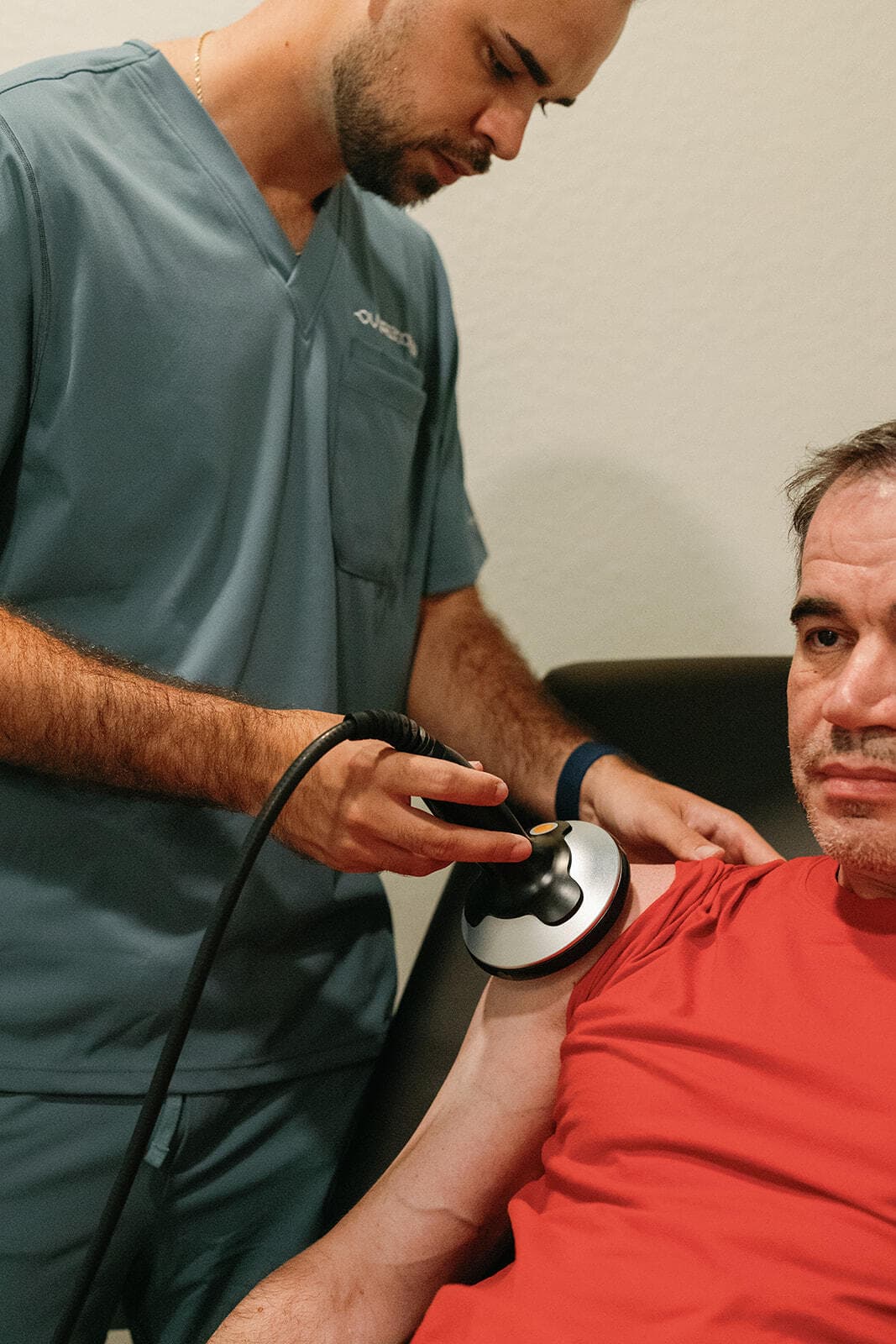
Most frozen shoulders loosen on their own, slowly. The American Academy of Orthopaedic Surgeons (AAOS) says full recovery may take up to 3 years, and physical therapy aimed at flexibility is its primary treatment recommendation. A steroid injection can settle early pain, and in the largest randomized trial, surgery did not beat physical therapy at 12 months. Shockwave has moderate-certainty evidence for short-term pain relief. PEMF and red light have little or none for this condition. Before any of it, a doctor should rule out a rotator cuff tear and arthritis.
What is frozen shoulder, and who gets it?
Frozen shoulder, also called adhesive capsulitis, is a condition in which the tissue around the shoulder joint thickens and tightens, and thick bands called adhesions form. The AAOS says the hallmarks are severe pain and being unable to move the shoulder, either on your own or with someone's help. It most often affects people between 40 and 60 and occurs in women more often than men (AAOS, updated 2023).
The same AAOS page names the main risk factors: diabetes, thyroid disease (hypothyroidism and hyperthyroidism), Parkinson's disease, cardiac disease, and time spent with the shoulder held still after surgery, a fracture or another injury. People with diabetes tend to have more stiffness that lasts longer before it thaws, and StatPearls (NIH's clinician reference, updated March 2025) describes a longer, more severe course with thyroid dysfunction too. One part of that is in your hands: the AAOS says better glucose control, planned with your doctor, can help speed recovery.
What are the three phases, and how long does frozen shoulder last?
There are three phases: freezing (pain builds and motion shrinks), frozen (pain eases but stiffness stays) and thawing (motion slowly returns). The AAOS puts the whole course at up to 3 years. Timing varies, and the two main references differ slightly, so treat the table as a rough map.
| Phase | What you notice | AAOS range | StatPearls range |
|---|---|---|---|
| Freezing | Growing pain, then loss of motion | 6 weeks to 9 months | 2 to 9 months |
| Frozen | Less pain, stiffness stays, daily tasks are hard | 4 to 6 months | 4 to 12 months |
| Thawing | Motion slowly improves | 6 months to 2 years | Not given as a range |
Sources: AAOS, updated 2023; StatPearls, 2025.
"Gets better" does not always mean "back to normal." In a long-term study of 223 people with primary frozen shoulder, followed for an average of 4.4 years from the start of symptoms, 59% had normal or near-normal shoulders and 41% reported some ongoing symptoms, most of them mild (data from 2007; an older snapshot). StatPearls puts residual stiffness and discomfort at 10% to 20% of patients, and the AAOS notes that frozen shoulder, though uncommonly, can come back, especially if a factor like diabetes persists.
How is it diagnosed, and what else could it be?
A doctor diagnoses frozen shoulder from your history and an exam. The giveaway is that both active motion (you lifting your arm) and passive motion (someone else moving it) are limited. An X-ray checks for arthritis and other bone problems. MRI and ultrasound are not needed to diagnose it, but the AAOS says they can help find other soft tissue injuries such as a rotator cuff tear.
StatPearls adds a clinical test: after a numbing injection above the joint, adhesive capsulitis still limits motion, while other pain sources may improve (StatPearls, 2025).
| Possible cause | How a clinician tells it apart |
|---|---|
| Rotator cuff tear | MRI or ultrasound can show it (AAOS) |
| Shoulder arthritis | X-ray (AAOS) |
| Bursitis or rotator cuff tendinopathy | Pain and motion may improve after a numbing injection (StatPearls) |
| Nerve problem | Intact nerve function points to frozen shoulder; new weakness or numbness points elsewhere (StatPearls) |
See a doctor soon if symptoms are getting worse, or if you notice new weakness or numbness in the arm, which StatPearls lists as signs of a different problem.
What is the best frozen shoulder treatment to start with?
Start with physical therapy aimed at restoring motion, gentle stretching at home, and good control of any diabetes or thyroid disease. The AAOS calls physical therapy with a focus on flexibility the primary treatment recommendation, and says sometimes heat is used to loosen the shoulder before stretching. Anti-inflammatory medicines can reduce pain and swelling.
The evidence behind that advice is modest. A 2025 Korean clinical practice guideline rates manual therapy including range-of-motion exercises as a low-evidence, conditional recommendation. A 2022 umbrella review of 14 systematic reviews found non-surgical and rehabilitative care is effective for frozen shoulder, but no good evidence that one approach beats another. So build the plan around what you can do consistently, adjusted by phase.
Which home exercises does the AAOS show?
The AAOS frozen shoulder page shows three stretches, and its rotator cuff conditioning program adds pendulum and stick stretches. Ask your physical therapist for sets and reps, as the AAOS itself advises. The conditioning program adds a rule: you should not feel pain during an exercise.
| Exercise | How the AAOS describes it | Hold |
|---|---|---|
| Doorway external rotation | Stand in a doorway, bend the elbow to 90 degrees, hand on the door jamb, rotate your body | 30 seconds |
| Supine forward flexion | Lie on your back, use the other arm to lift the stiff arm overhead until you feel a gentle stretch | 15 seconds |
| Crossover arm stretch | Gently pull the arm across your chest, just below your chin, as far as comfortable | 30 seconds |
| Pendulum | Lean on a table with one hand, let the other arm hang, swing it forward and back, side to side, then in circles | Not a hold |
| Stick internal rotation | Hold a stick behind your back with both hands and pull it horizontally to a stretch without pain | 30 seconds |
Sources: AAOS frozen shoulder page (first three); AAOS rotator cuff and shoulder conditioning program (last two).
Do steroid injections and hydrodilatation help?
A steroid injection into the joint helps mainly with early pain, and the benefit fades. A 2025 clinical practice guideline says it should be considered to improve pain and function (low evidence, conditional recommendation, 21 randomized trials). A review summarized in a 2022 umbrella review found injections had a greater effect than physical therapy in the short term, with only a small, not statistically significant effect in favor of injections later.
Hydrodilatation is the next step the AAOS lists if other non-surgical care has not relieved symptoms: a large volume of sterile fluid is injected under imaging guidance to stretch the capsule. A 2023 systematic review found it gives at least a transient improvement in disability and passive external rotation compared with a steroid injection alone, and said its clinical relevance remains unclear. The 2025 guideline suggests hydrodilatation with a steroid injection may be considered (low evidence).
Both are procedures done by a physician. A useful question for your doctor: is pain what stops you from stretching?
When is surgery considered?
Surgery is considered when therapy and other conservative care have not worked. The AAOS says it is typically offered in the frozen phase, and the two common options are manipulation under anesthesia (the surgeon moves the shoulder to stretch and tear the tight capsule) and arthroscopic capsular release (cutting through the tight capsule with small instruments).
In UK FROST, the largest randomized trial, 503 adults at 35 hospitals were randomly assigned to manipulation, capsular release or early structured physical therapy with a steroid injection. At 12 months, the shoulder scores (Oxford Shoulder Score, 0 to 48) were 40.3 after capsular release, 38.3 after manipulation and 37.2 after physical therapy. All differences were smaller than the trial's target differences (4 or 5 points), so the authors concluded none of the three was clinically superior. Capsular release had 8 serious adverse events, against 2 with manipulation (published 2020).
The 2026 BMJ review adds a nuance: moderate-certainty evidence that manipulation under anesthesia, with or without a steroid injection, probably improves short-term forward flexion. StatPearls lists humeral fractures and biceps or subscapularis tendon ruptures as possible complications of manipulation, and the AAOS says that even after surgery, some stiffness can remain.
What does the evidence say about shockwave, PEMF, laser and red light?
Shockwave has the strongest evidence of the four, and it is for short-term pain. PEMF and red light have little or none in frozen shoulder. Laser has one small trial of the low-power kind, which is a different class from Class IV. Here is each, as exactly as the sources allow.
| Therapy | What the research says | How sure |
|---|---|---|
| Shockwave | A 2026 BMJ network meta-analysis of 189 trials: probably reduces short-term pain versus usual care (0 to 10 scale, difference 1.97 points). Function and range of motion: low certainty. Mid-term pain: very low certainty | Moderate for short-term pain |
| Laser (low-level) | 2014 Cochrane review: with exercise, pain was 19 points lower on a 0 to 100 scale at 4 weeks in one 63-person trial | Moderate, one trial |
| PEMF | 2014 Cochrane review: unclear whether it works, from one trial of 32 people | Very low |
| Red light | No frozen shoulder trial of a full-body red light bed turned up in the research behind this guide | None found |
Sources: BMJ, 2026; Cochrane, 2014.
Three details matter. First, the BMJ review's authors report that 71% of trials contributing to the pain results were at high risk of bias, and most other effects are uncertain. Second, a 2022 meta-analysis of 20 trials found shockwave added to routine care gave better immediate and short-term pain relief, while long-term pain and range-of-motion results varied widely; it pooled focused and radial devices. Third, in type 2 diabetes, a 2025 review of 7 studies found shockwave improved pain, range of motion and disability versus conservative care, with poor study quality.
The Cochrane laser trials used low-level lasers, a lower-power class than Class IV. The one recent PEMF shoulder review (2025) covered impingement and excluded adhesive capsulitis. The Cochrane evidence is more than three years old, so treat it as a snapshot. Full research: the shockwave science page, the PEMF guide and the laser therapy guide.
Where do studio services fit?
Alongside a physical therapist's plan, not in place of one, and only after a doctor has ruled out a tear. The studio's shoulder-specific package is OutReach, built for frozen shoulder, trouble reaching overhead or behind your back, and shoulder pain that disrupts sleep. Its page lists four weekly visits, about an hour each, combining focused shockwave, PEMF and red light, with a shoulder range-of-motion check at each visit.
Read against the evidence above: shockwave has research behind it, with modest and mostly short-term effects. PEMF and red light are supportive, without frozen shoulder trials behind them. The range-of-motion checks show you whether the shoulder is moving. If you want Class IV laser, OutMove pairs it with PEMF and red light for neck and shoulder stiffness, and the Class IV laser page describes the session.
Safety notes from the studio's own pages: shockwave is not recommended over open wounds, infections or tumors, and you should tell staff about any blood clotting disorder; PEMF is not recommended with pacemakers or electrical implants. Tell your doctor or physical therapist before starting. No service here replaces a doctor's care or promises a result.
What should you do this week?
Get the diagnosis first, then start guided stretching.
- Get a diagnosis: an exam and an X-ray, to rule out arthritis and a rotator cuff tear.
- Ask for physical therapy aimed at flexibility, and get sets and reps from your therapist. Stay below the point of pain.
- If you have diabetes or thyroid disease, ask your doctor how to bring it under better control.
Sources
- American Academy of Orthopaedic Surgeons. Frozen Shoulder. OrthoInfo, updated 2023. https://orthoinfo.aaos.org/en/diseases--conditions/frozen-shoulder/
- American Academy of Orthopaedic Surgeons. Rotator Cuff and Shoulder Conditioning Program. OrthoInfo. https://orthoinfo.aaos.org/en/recovery/rotator-cuff-and-shoulder-conditioning-program/
- Li D, St Angelo JM, Taqi M. Adhesive Capsulitis (Frozen Shoulder). StatPearls, NCBI Bookshelf, last updated March 2025. https://www.ncbi.nlm.nih.gov/books/NBK532955/
- Hand C, Clipsham K, Rees JL, Carr AJ. Long-term outcome of frozen shoulder. J Shoulder Elbow Surg, 2008 (study published 2007 online). https://pubmed.ncbi.nlm.nih.gov/17993282
- Rangan A, Brealey SD, Keding A, et al. Management of adults with primary frozen shoulder in secondary care (UK FROST): a multicentre, pragmatic, three-arm, superiority randomised clinical trial. Lancet, 2020. https://pubmed.ncbi.nlm.nih.gov/33010843
- Zhao SS, Liu W, et al. Interventions for adhesive capsulitis: systematic review and network meta-analysis of randomised controlled trials. BMJ, 2026. https://www.bmj.com/content/395/bmj-2026-101057
- Zhang R, Wang Z, Liu R, et al. Extracorporeal Shockwave Therapy as an Adjunctive Therapy for Frozen Shoulder: A Systematic Review and Meta-analysis. Orthop J Sports Med, 2022. https://pmc.ncbi.nlm.nih.gov/articles/PMC8819773
- Reno C, Swinton PA, Alexander L. Extracorporeal Shock Wave Therapy for Chronic Adhesive Capsulitis in Type 2 Diabetics: A Systematic Review With Meta-Analysis. Phys Ther, 2025. https://pubmed.ncbi.nlm.nih.gov/40401517
- Page MJ, Green S, Kramer S, et al. Electrotherapy modalities for adhesive capsulitis (frozen shoulder). Cochrane Database of Systematic Reviews, 2014. https://www.cochrane.org/evidence/CD011324_electrotherapy-modalities-adhesive-capsulitis-frozen-shoulder
- Wang HY, Chen YJ, Huang IC, et al. The effectiveness of pulsed electromagnetic field therapy in patients with shoulder impingement syndrome: a systematic review and meta-analysis of randomized controlled trials. PLoS One, 2025. https://pmc.ncbi.nlm.nih.gov/articles/PMC12088032
- Poku D, Hassan R, Migliorini F, Maffulli N. Efficacy of hydrodilatation in frozen shoulder: a systematic review and meta-analysis. Br Med Bull, 2023. https://pubmed.ncbi.nlm.nih.gov/37496207
- Lee BC, Kim BS, Lee BJ, et al. Clinical Practice Guidelines for Diagnosis and Non-Surgical Treatment of Primary Frozen Shoulder. Ann Rehabil Med, 2025. https://pmc.ncbi.nlm.nih.gov/articles/PMC12231400
- de Sire A, et al. Non-Surgical and Rehabilitative Interventions in Patients with Frozen Shoulder: Umbrella Review of Systematic Reviews. J Pain Res, 2022. https://pmc.ncbi.nlm.nih.gov/articles/PMC9397530
