Use ice in the first day or two after a sudden injury if you want less pain and swelling, and use warmth for muscle tightness, stiffness and aches that have lingered. That is the standard advice from orthopedic and clinic sources. The part most articles leave out: the evidence for ice is thin, and a 2019 editorial in the British Journal of Sports Medicine questions whether it helps tissue repair and says it may get in the way. This guide gives you the rule of thumb, the doubts behind it, and how to choose when the two disagree.
Ice or heat for injury: which one first?
For a fresh injury, with swelling, bruising or sharp pain, the usual first choice is ice, for pain relief. For tight, achy muscles or stiff joints with no new swelling, the usual choice is warmth. The American Academy of Orthopaedic Surgeons lists ice for acute injuries, inflammation and swelling, and heat for muscle pain or stiffness (AAOS OrthoInfo, undated).
Here is the rule as a quick lookup:
| Your situation | Usual choice | Source |
|---|---|---|
| Rolled ankle, first 48 hours, swollen | Ice, 15 to 20 minutes at a time | Mayo Clinic, sprain first aid |
| Sudden tendon injury | Ice for pain and swelling | Mayo Clinic, tendinitis |
| Ongoing tendon pain (tendinopathy) | Heat may help | Mayo Clinic, tendinitis |
| Tight muscle or stiff joint, no new swelling | Gentle warmth | AAOS OrthoInfo |
| Swollen, bruised or broken skin | No heat | AAOS OrthoInfo |
| Not sure, or you cannot bear weight | Skip both and get it examined | See the last section |
If you have just had surgery, follow your surgeon's instructions for cold or heat, since those can differ from the general rules above.
Does icing slow healing?
Nobody can say for sure. Ice numbs pain, but the research that it speeds repair is weak, and some lab work suggests it may interfere. A systematic review of 22 trials found only marginal evidence that ice combined with exercise works best after an ankle sprain or surgery. The trials scored a mean of 3.4 out of 10 on a quality scale, and no one had established the best way or length of time to apply ice. The review searched studies up to April 2002, so treat it as a snapshot more than 20 years old (Bleakley et al., 2004).
On the other side, an animal study of muscle bruises found that icing delayed the first wave of immune cells and delayed some blood vessel regrowth in the first week. By four weeks, though, it made no substantial difference to capillary density or muscle growth (Singh et al., 2017). That is animal data, and it shows a delay with no lasting difference.
So here is a fair summary. Ice is a reasonable pain tool. It has not been shown to speed healing. It might slow part of the early repair process, and the practical effect in people is unknown.
What do PEACE and LOVE say?
PEACE and LOVE is a framework from a 2019 British Journal of Sports Medicine editorial. It replaces RICE with a plan that covers the whole recovery. The authors question routine ice, writing that there is "no high-quality evidence on the efficacy of ice for treating soft-tissue injuries" (Dubois and Esculier, BJSM, 2019). It is an editorial, which is an expert opinion piece and not a trial.
Here is what the letters stand for:
- Immediately after injury (PEACE): Protect the area for one to three days, Raise it above the heart, Avoid anti-inflammatory modalities (the editorial names medication, and it questions ice too), Compress with tape or a bandage, and Educate yourself on an active recovery.
- After the first days (LOVE): Load the area as symptoms allow, keep an Optimistic outlook, add pain-free cardio for Vascularisation, and do Exercises to restore movement and strength.
Notice what the framework asks for after the first days: movement. The editorial says to put mechanical stress back on early and resume normal activity as soon as symptoms allow. For a rolled ankle specifically, our sprained ankle recovery guide walks through how bracing and early movement fit together.
The editorial's advice on anti-inflammatory pills is its own point of view, and not every clinician agrees. If you take them for another condition, do not stop on the strength of this guide. Ask your doctor.
When is heat the better choice?
Heat suits stiffness and ongoing aches more than fresh injuries. AAOS lists heat for muscle pain or stiffness, with warm temperatures to avoid burns, and says not to apply it to swollen or bruised skin or an open wound (AAOS OrthoInfo). Mayo Clinic says heat may suit ongoing tendon pain because it boosts blood flow and relaxes muscles (Mayo Clinic).
The best-studied case is low back pain. A Cochrane review of nine trials with 1,117 people found moderate evidence that heat wraps give a small, short-term reduction in pain and disability in acute and subacute low back pain, and that adding exercise helped more. For cold, the review found not enough evidence either way (French et al., Cochrane, 2006). The result is a 2006 snapshot, and the benefit it describes is small and brief.
For a sore back that came on suddenly, our lower back pain guide covers what else has evidence.
How do you use ice or heat safely?
Short applications with a barrier between you and the source keep you out of trouble. Mayo Clinic recommends icing 15 to 20 minutes, four to eight times a day, for the first 48 hours or until swelling goes down, with a thin towel between the ice and your skin, because ice on bare skin or for too long can damage tissue (Mayo Clinic).
A checklist you can follow:
- Wrap the ice pack or bag of frozen vegetables in a thin cloth.
- Keep each session to 20 minutes or less.
- Raise the limb above your heart while you ice, if you can.
- Check your skin as you go, and stop if it hurts or the skin changes.
- For heat, aim for warm and stay awake. Do not fall asleep on a heating pad.
- Skip ice if you have poor circulation, and skip heat if a condition dulls your sensation of temperature. AAOS flags both.
- Do not use heat on anything swollen or bruised.
Should you ice after training?
If you lift to build muscle, probably not as a habit. In a 12-week trial, people who sat in cold water for 10 minutes after strength sessions gained less muscle mass and strength than a comparison group (Roberts et al., 2015). A later study found that cold immersion blunted muscle fiber growth but did not reduce strength gains (Fyfe et al., 2019). So the effect of cold on strength is mixed, and the effect on muscle size looks more consistent. These trials used cold water immersion, which is colder and more extensive than an ice pack on one spot, so they do not map neatly onto icing a sore knee.
Where do the studio's cold plunge and sauna fit?
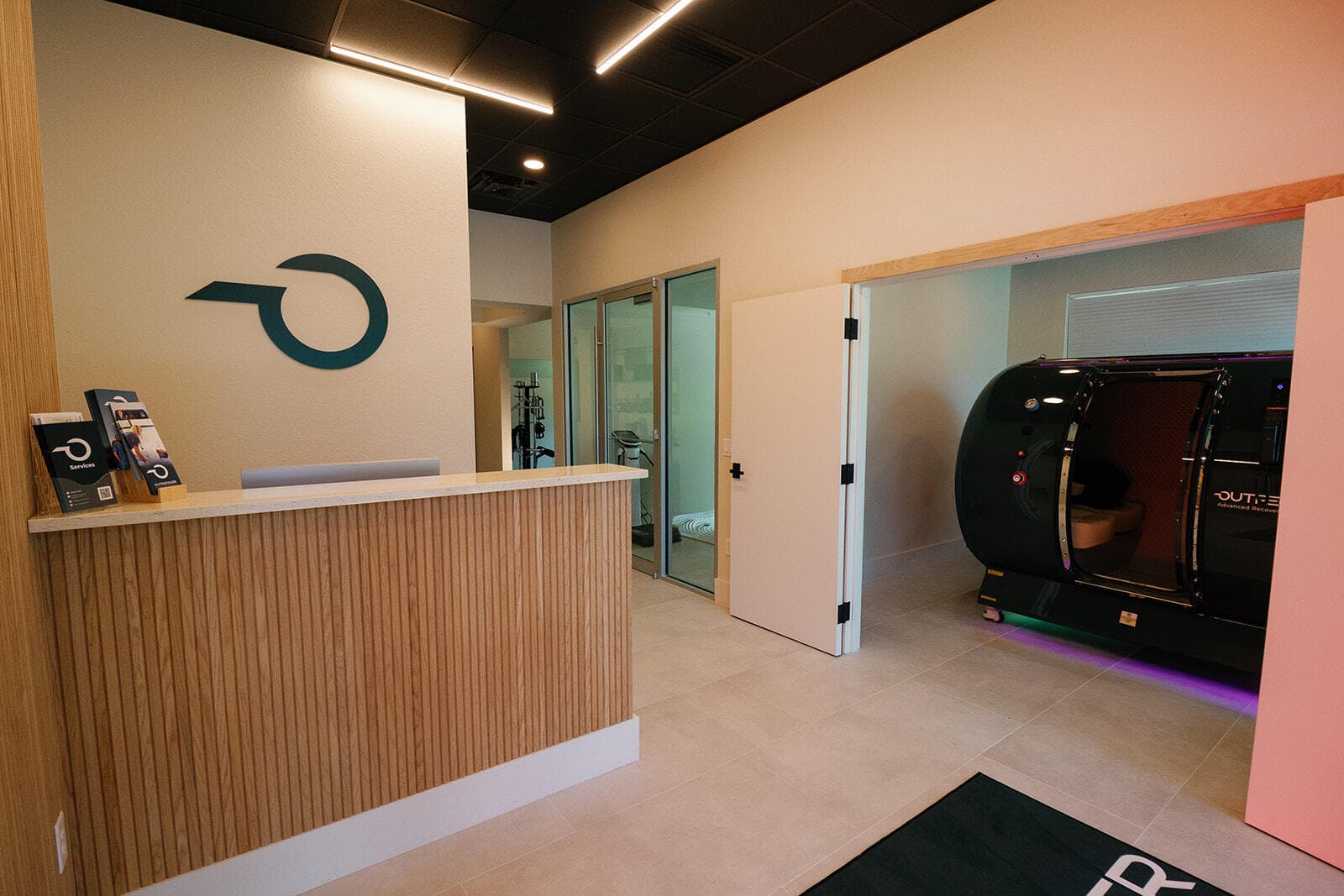
The studio's cold plunge and sauna belong to general recovery. Neither is first aid for a fresh injury. OutRecover's dry cold plunge is held at 45 to 55 degrees F, and the session is about five minutes. Its page lists soreness and training recovery among the reasons people use it, and says it is not suitable for uncontrolled hypertension, Raynaud's syndrome or cold agglutinin disease, and that no one should plunge alone. See the dry cold plunge page and its research summary.
The infrared sauna is a private cabin, typically 120 to 150 degrees F, and its page names muscle relaxation and joint stiffness among its uses. It advises against use during pregnancy or with certain cardiovascular conditions. Our guide to infrared versus traditional saunas compares them, and the sauna research summary covers the clinical evidence.
Two honest limits. First, neither service replaces the first-aid steps above for a new sprain, and a plunge is a poor idea on a freshly injured joint you have not had checked. Second, the research on cold immersion (see the section above) says to think twice before using it right after strength training. For a look at alternating the two, read contrast therapy. If you are recovering from surgery, clear any plunge or sauna with your surgeon first.
If your injury is a sprain, strain or other soft-tissue problem, the studio's injury packages, OutRebuild and OutFlex, are built around it, and OutMove targets back and joint stiffness. Their contents include laser, red light or PEMF and, in OutRebuild, hyperbaric oxygen, not ice or heat; each package page lists its sessions. The evidence for those therapies is limited, and the laser guide and PEMF guide say where it runs thin.
When should you stop self-care and see a clinician?
Get it examined if you cannot put weight on the limb, the joint looks misshapen, the pain is severe, or numbness or tingling appears. Mayo Clinic also notes that the greater the pain and swelling, the worse a sprain tends to be (Mayo Clinic). A broken bone needs an X-ray before anything else, and the same goes for pain that does not improve after a few days.
Your next step
Decide which situation you are in. Fresh and swollen: ice for pain in short sessions, protect the area, and plan to start moving it within days. Stiff or achy with no swelling: warmth, then gentle movement. Not sure what you injured: get it looked at. If you want help with a recovery plan, see our injury packages or book a consult.
Sources
- Dubois B, Esculier J-F. Soft-tissue injuries simply need PEACE and LOVE. British Journal of Sports Medicine, 2019 (print 2020;54:72-73). https://bjsm.bmj.com/content/bjsports/54/2/72.full.pdf
- American Academy of Orthopaedic Surgeons. Heat or Ice for Your Pain? OrthoInfo, undated. https://www.orthoinfo.org/globalassets/pdfs/heat-or-ice-for-your-pain-infographic_final.pdf
- Bleakley C, McDonough S, MacAuley D. The use of ice in the treatment of acute soft-tissue injury: a systematic review of randomized controlled trials. American Journal of Sports Medicine, 2004. https://pubmed.ncbi.nlm.nih.gov/14754753
- Singh DP, et al. Effects of topical icing on inflammation, angiogenesis, revascularization, and myofiber regeneration in skeletal muscle following contusion injury. Frontiers in Physiology, 2017. https://pubmed.ncbi.nlm.nih.gov/28326040
- Mayo Clinic. Sprain: First aid. Mayo Clinic, current page. https://www.mayoclinic.org/first-aid/first-aid-sprain/basics/art-20056622
- Mayo Clinic. Tendinitis pain: Should I apply ice or heat? Mayo Clinic, current page. https://www.mayoclinic.org/diseases-conditions/tendinitis/expert-answers/tendinitis/faq-20057872
- French SD, Cameron M, Walker BF, Reggars JW, Esterman AJ. Superficial heat or cold for low back pain. Cochrane Database of Systematic Reviews, 2006. https://pmc.ncbi.nlm.nih.gov/articles/PMC8846312
- Roberts LA, et al. Post-exercise cold water immersion attenuates acute anabolic signalling and long-term adaptations in muscle to strength training. The Journal of Physiology, 2015. https://pmc.ncbi.nlm.nih.gov/articles/PMC4594298
- Fyfe JJ, et al. Cold water immersion attenuates anabolic signaling and skeletal muscle fiber hypertrophy, but not strength gain, following whole-body resistance training. Journal of Applied Physiology, 2019. https://pubmed.ncbi.nlm.nih.gov/31513450