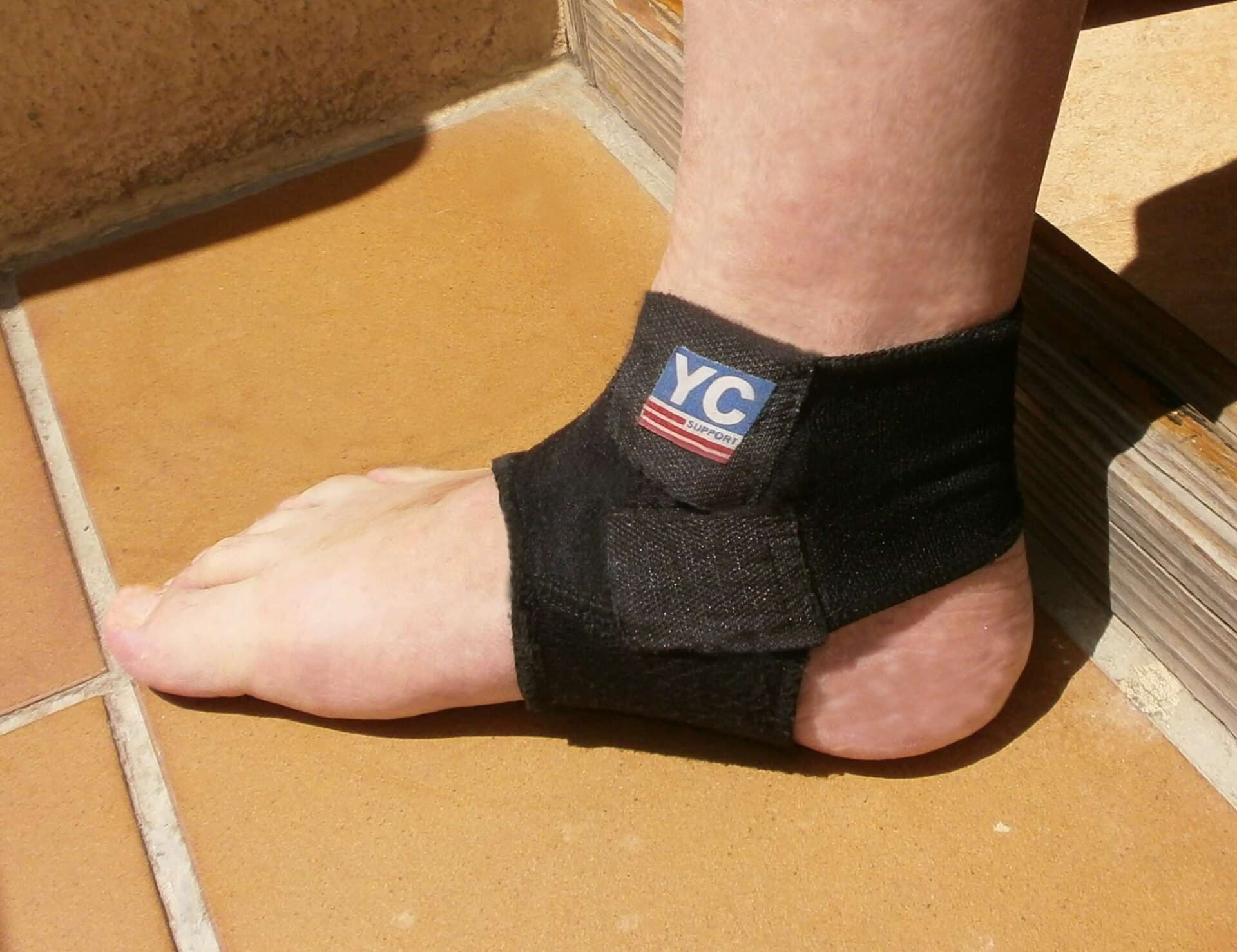
Most rolled ankles are ligament sprains that get better with a brace or support, early movement and a short exercise program, and a few are broken bones that need an X-ray first. So the order is: rule out a fracture, protect the ankle for a few days, then start moving it. This guide is for a pickleball player, golfer or walker in Naples who has just rolled an ankle, with what the research supports and where it runs thin.
When does a rolled ankle need an X-ray?
A clinician uses the Ottawa ankle rules to decide. An ankle X-ray is warranted if you have pain near the ankle bones plus either tenderness on the back edge or tip of the bone on either side of the ankle, or you could not take four steps right after the injury and again at the exam (AAFP, 2012). For the foot, the same logic applies to pain in the midfoot with tenderness at the base of the fifth metatarsal or the navicular bone.
You cannot run the exam on yourself, because the tenderness check means pressing on specific bony points. Use this as a screen for whether to book one:
- You could not walk four steps right after you rolled it.
- It is hard to put weight on it now.
- The bones of the ankle or midfoot are tender to the touch.
- It is still swollen or painful after several weeks of care (AAOS).
Mayo Clinic says to contact a clinician for pain and swelling after a suspected sprain, since the cause may be a torn ligament or a broken bone. AAOS adds that a severe sprain can look like a fracture. How reliable is the rule? A 2022 meta-analysis of 15 studies and 8,560 adults pooled sensitivity at 91% and specificity at 25%, with large differences between studies, and it cites an older pooled sensitivity of 97.3%. In plain terms, the rule rarely misses a fracture, and it sends many normal ankles for pictures.
Do sprain grades change what you do?
Less than you would think. Doctors grade sprains from 1 to 3 by how much of the ligament is torn, and the grade guides the plan, but AAFP notes that clinical grading is somewhat subjective and does not change initial treatment. About 90% of sprains come from the foot turning inward and hurting the ligaments on the outside of the ankle (AAOS).
- Grade 1: slight stretching and microscopic tearing. Mild tenderness, bruising and swelling, typically no pain with weight, no looseness on exam.
- Grade 2: partial tear. Moderate swelling and bruising, mild pain with weight, slight looseness compared with the other ankle.
- Grade 3: complete tear. Significant swelling and bruising, severe pain with weight, a lot of looseness.
An exam a few days after the injury is the more reliable one: the Dutch multidisciplinary guideline says severity is assessed most reliably by physical examination 4 to 5 days after the injury. If you have not been seen yet, that is a sensible time to book.
What do you do in the first days: RICE or PEACE and LOVE?
For the first two to three days, protect the ankle, compress it and keep it raised. The sources disagree on ice and anti-inflammatory medicine. Mayo Clinic recommends RICE (rest, ice, compression, raising the leg) for those days, while a 2020 British Journal of Sports Medicine editorial proposes PEACE for the first days and LOVE after (Dubois and Esculier, 2020).
| RICE and a family-medicine review | PEACE and LOVE | |
|---|---|---|
| Rest | Rest the ankle (AAOS) | Protect for 1 to 3 days, then load early |
| Ice | Cold for the first three to seven days, grade B evidence (AAFP, 2012) | Questions it: no high-quality evidence of benefit (BJSM, 2020) |
| Compression | Bandage, lace-up support or air stirrup brace | Supports it; swelling and quality of life seem better after a sprain |
| Raising the leg | Above heart level, first 48 hours | Raise it; evidence weak, risk low |
| Medicine | NSAIDs or acetaminophen for pain | Avoid anti-inflammatories; they may hinder healing |
Two things to keep straight. PEACE and LOVE is two clinicians' proposal rather than a trial. And a 2017 overview of systematic reviews (46 papers) found strong evidence for NSAIDs and early mobilisation for pain, swelling and function after a sprain, while the 2018 guideline says NSAIDs may be used but can suppress natural healing, so use them with care. Ask your clinician or pharmacist what suits you, especially if you take other medicine. For lingering puffiness, see our swollen ankles guide. If you sprained it on court, our pickleball injuries guide covers footwear and ramp-up.
Should you rest it in a boot or keep it moving?
Keep it moving, in a brace. The 2018 guideline's summary is direct: even though a short time of immobilisation may relieve pain and swelling, "the patient with an acute lateral ankle ligament rupture benefits most from use of tape or a brace in combination with an exercise programme" (Vuurberg et al., 2018). Its recommendation is functional support for 4 to 6 weeks over immobilisation, and if immobilisation is used for pain or swelling, no more than 10 days. In the guideline's comparison, an ankle brace showed the greatest effect among types of functional support.
The International Ankle Consortium statement on assessment (Delahunt et al., 2018; Doherty is a co-author) builds on the same idea: look for mechanical and sensorimotor problems early, because they drive long-term trouble. Where guidance differs is at the severe end. AAOS says a grade 3 sprain may need a short leg cast or cast-brace for 10 to 14 days, with early weight-bearing as tolerated for most. A clinician makes that call after examining you.
What does sprained ankle recovery look like?
AAOS describes a three-phase program that "may take just 2 weeks to complete for minor sprains, or up to 6 to 12 weeks for more severe injuries." No source we read gives a safe date to return to pickleball or golf, because it depends on the grade, your strength and balance, and what your clinician finds. These milestones come from AAOS:
| Stage | What the source says |
|---|---|
| First 2 to 3 days | Swelling and pain usually peak; walking may be hard, and crutches can help |
| Phase 1 | Brief protection, ice and rest; early weight-bearing as tolerated |
| Phase 2 | Range of motion, isometric strengthening and balance retraining, started early |
| Phase 3 | Advanced strengthening and balance, then a gradual return, starting with activity that has no turning or twisting and adding cutting sports later; taping or bracing may help |
| Still hurting at 4 to 6 weeks | Possible chronic sprain; see a clinician |
| Symptoms past 6 to 8 weeks | Doctors may order an MRI |
AAOS also says incomplete rehabilitation is the most common cause of chronic ankle instability after a sprain.
How do you keep it from happening again?
Train balance, and think about a brace for the first sports season back. A 2017 overview of systematic reviews found strong evidence for bracing and moderate evidence for neuromuscular training in preventing a repeat sprain. The 2018 guideline reports that brace or tape cut the risk of a recurrent sprain (risk ratio 0.30, 95% CI 0.21 to 0.43), especially in sports. And a 2022 meta-analysis found exercise-based rehabilitation lowered reinjury at 12 months versus usual care (odds ratio 0.60, 95% CI 0.36 to 0.99), though the optimal exercise content remains unknown.
Here is a balance progression to try, an illustration built from AAOS's examples rather than a tested protocol. Stay pain-free, stand next to a counter, and ask a physical therapist to adjust it.
- Stand on the injured leg with the other foot raised, holding the counter if needed.
- Let go of the counter.
- Close your eyes (AAOS's own example of a balance exercise).
- Move to a cushion or balance board, which AAOS says are often used at this stage.
- Add figure-8 jogging in progressively smaller loops, which AAOS calls excellent for agility and calf and ankle strength, once you are pain-free.
AAOS also lists risk factors you can fix: poor balance, shoes without enough support or with slippery soles, and walking or exercising on uneven ground.
What is chronic ankle instability, and when do you need a specialist?
Chronic ankle instability is an ankle that keeps giving way. The International Ankle Consortium's 2016 position paper states that the majority of people with a past ankle sprain will have at least one more, and many develop lasting "giving-way" and limits on activity. AAOS says repeat sprains can lead to chronic pain, arthritis and instability.
Get it looked at if the ankle keeps rolling, feels loose, or still hurts after 4 to 6 weeks. Surgery is rare, and AAOS reserves it for injuries that do not respond to nonsurgical care and for people with instability and pain after months of rehabilitation. The 2018 guideline likewise says surgery should follow thorough exercise-based treatment.
Where do studio services fit?
The guideline recommends supervised exercise over "passive modalities" for the ankle (Vuurberg et al., 2018), and most studio services are passive. So your brace, your balance work and your clinician's plan come first, and a fracture or a tear gets a doctor first. These are wellness services and do not replace a diagnosis. Here is what we found for each therapy in sprains:
- Class IV laser. A randomized trial of 217 people (1998, a snapshot) tested low-level laser added to brace therapy and home exercise for acute ankle sprains and concluded neither dose was effective. That laser is a lower-powered class than the studio's Class IV device, so it does not test it, and we found no sprain trial of Class IV. See the laser research page and laser service page.
- PEMF. A 2026 systematic review of four trials in foot and ankle soft-tissue injuries found low-to-moderate certainty evidence of short-term pain relief and uncertain effects on function. The one ankle sprain trial in it used a different, high-frequency device. Read our PEMF guide and the PEMF page; it is not for people with pacemakers or electrical implants.
- Hyperbaric oxygen. A Cochrane review (2005, so a long-ago snapshot) found one sham-controlled trial in ankle sprain, 32 people, with no difference in time to recovery, function, pain or swelling, and called the evidence insufficient. See our hyperbaric guide for safety and cost questions.
- Red light. We found no sprain trial in the sources we read. Our red light guide gives the general picture.
Two packages list injuries like this. OutRebuild names ankle and knee sprains and sports soft-tissue injuries, and pairs hyperbaric oxygen, red light (swappable for PEMF), Class IV laser, an IV through partner OutInfuse that needs medical approval, and vitamin D light, alongside physical therapy. OutFlex is built for muscle strains such as calf, hamstring and hip flexor, with PEMF, Class IV laser and red light, so it is a closer match if a muscle strain came with the roll. Given the evidence above, we cannot say either package speeds an ankle sprain, so treat them as support around the exercise plan.
Your next step
If you cannot walk four steps, or the bones are tender, get an exam and an X-ray first. If you can walk, get the ankle examined within about 4 to 5 days anyway, wear a brace, and start the balance work as soon as pain allows. If you have had a surgeon involved, clear anything new with them.
Sources
- Gomes YE, Chau M, Banwell HA, et al. Diagnostic accuracy of the Ottawa ankle rule to exclude fractures in acute ankle injuries in adults: a systematic review and meta-analysis. BMC Musculoskeletal Disorders, 2022. https://pmc.ncbi.nlm.nih.gov/articles/PMC9502997
- Tiemstra JD. Update on acute ankle sprains. American Family Physician, 2012. https://www.aafp.org/pubs/afp/issues/2012/0615/p1170.html
- American Academy of Orthopaedic Surgeons. Sprained ankle. OrthoInfo, updated 2026. https://orthoinfo.aaos.org/en/diseases--conditions/sprained-ankle/
- Mayo Clinic. Sprained ankle: symptoms and causes; diagnosis and treatment. https://www.mayoclinic.org/diseases-conditions/sprained-ankle/symptoms-causes/syc-20353225
- Vuurberg G, Hoorntje A, Wink LM, et al. Diagnosis, treatment and prevention of ankle sprains: update of an evidence-based clinical guideline. British Journal of Sports Medicine, 2018. https://pubmed.ncbi.nlm.nih.gov/29514819/
- Doherty C, Bleakley C, Delahunt E, Holden S. Treatment and prevention of acute and recurrent ankle sprain: an overview of systematic reviews with meta-analysis. British Journal of Sports Medicine, 2017. https://pubmed.ncbi.nlm.nih.gov/28053200
- Delahunt E, Bleakley CM, Bossard DS, et al. Clinical assessment of acute lateral ankle sprain injuries (ROAST): 2019 consensus statement and recommendations of the International Ankle Consortium. British Journal of Sports Medicine, 2018. https://pubmed.ncbi.nlm.nih.gov/29886432
- Dubois B, Esculier JF. Soft-tissue injuries simply need PEACE and LOVE. British Journal of Sports Medicine, 2020. https://pubmed.ncbi.nlm.nih.gov/31377722
- Gribble PA, Bleakley CM, Caulfield BM, et al. 2016 consensus statement of the International Ankle Consortium: prevalence, impact and long-term consequences of lateral ankle sprains. British Journal of Sports Medicine, 2016. https://bpb-us-w2.wpmucdn.com/sites.udel.edu/dist/d/3615/files/2016/06/Br-J-Sports-Med-2016-Gribble_IAC-Consensus-Statement-1i4jkta.pdf
- Wagemans J, Bleakley C, Taeymans J, et al. Exercise-based rehabilitation reduces reinjury following acute lateral ankle sprain: a systematic review update with meta-analysis. PLoS One, 2022. https://pubmed.ncbi.nlm.nih.gov/35134061
- de Bie RA, de Vet HC, Lenssen TF, et al. Low-level laser therapy in ankle sprains: a randomized clinical trial. Archives of Physical Medicine and Rehabilitation, 1998. https://pubmed.ncbi.nlm.nih.gov/9821903
- Chia CSM, Fu SC, Ko VM, et al. The effects of pulsed electromagnetic field therapy on pain and physical functions in patients with soft tissue injuries: a systematic review of randomised controlled trials. Frontiers in Sports and Active Living, 2026. https://pmc.ncbi.nlm.nih.gov/articles/PMC12916110
- Bennett M, Best TM, Babul S, et al. Hyperbaric oxygen therapy for delayed onset muscle soreness and closed soft tissue injury. Cochrane Database of Systematic Reviews, 2005. https://pubmed.ncbi.nlm.nih.gov/16235376
