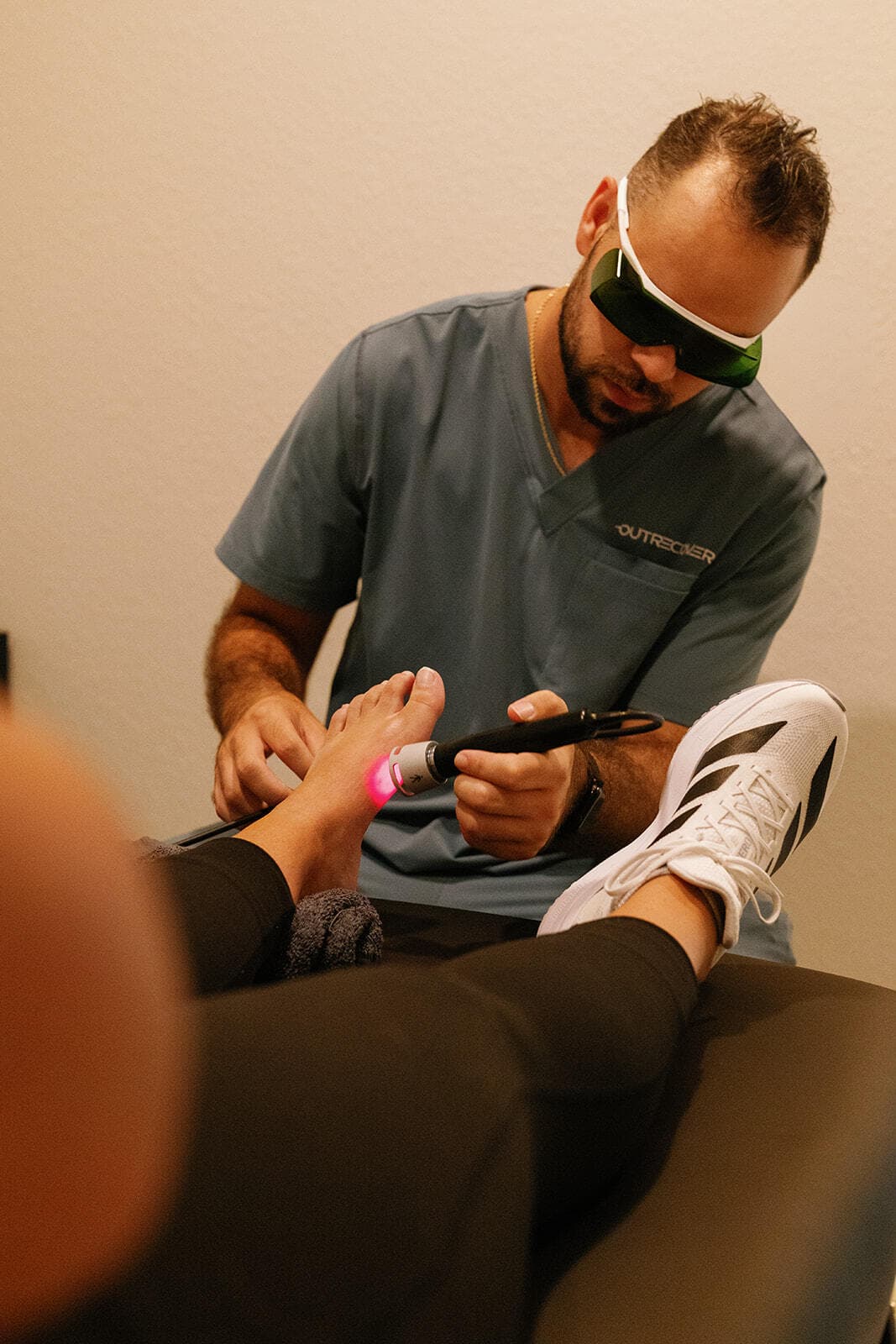
Laser therapy for pain means a clinician passes a red or near-infrared laser over a sore joint, tendon or muscle, usually for several visits over a few weeks. The reviews lean positive on short-term pain and weaker on function, and almost every one of them warns that the certainty is low. That makes laser a reasonable thing to try for a stubborn musculoskeletal problem, as long as you set a stopping point and keep doing the exercise that goes with it.
Cold laser vs Class 4 laser: what is the difference?
Power is the difference. Research papers call lasers under 0.5 W (500 mW) low-level laser therapy, the "cold" kind (the 2009 Lancet review calls it non-thermal), and lasers above 0.5 W high-intensity laser therapy, or HILT (de la Barra Ortiz et al., 2026). HILT is the group the market sells as Class 4, and OutRecover's research page uses the two names interchangeably.
The "class" itself is a safety label. The FDA ranks lasers by hazard: a Class IV laser is an immediate skin and eye hazard from the direct or reflected beam and can be a fire hazard (FDA, laser hazard classes, page current as of 2024). A higher class tells you how carefully the device must be handled. It says nothing about how well it works.
What the extra power is meant to buy is depth and warmth. The studio's service page describes the beam reaching muscle, fascia, joints and bone. None of the reviews below measured tissue depth in patients; they measured pain and function, so treat any depth figure as the provider's description rather than a finding.
Does laser therapy for pain work?
For short-term pain, the pooled results lean yes, with modest effects. A 2023 meta-analysis of 48 randomized trials found pain about 1.3 cm lower on a visual analog scale after HILT than in comparison groups, with low-certainty evidence for pain and moderate for function, and it cautioned about a high risk of bias in the trials (Arroyo-Fernández et al., 2023). The gap was larger against no treatment than against other conservative treatments, which is the comparison a patient cares about most.
By problem, the picture looks like this:
| Problem | What the reviews found | How strong |
|---|---|---|
| Low back pain (low-level laser) | 2008 Cochrane review: statistically significant but clinically unimportant pain relief, and too little data for firm conclusions (Cochrane, 2008). A 2015 meta-analysis of 7 trials (394 people): about 14 mm lower pain scores than placebo, no effect on disability or range of motion (Huang et al., 2015) | Small trials, older data |
| Back and neck pain (high-intensity) | 2018 meta-analysis of 12 studies: pain improved by about 1 point against controls, disability also improved (Song et al., 2018) | Moderate risk of bias, high heterogeneity |
| Neck pain (low-level) | 2009 Lancet review: 11 trials showed about 20 mm lower pain scores, and in chronic neck pain the relief lasted up to 22 weeks after treatment (Chow et al., 2009) | A snapshot, 17 years old |
| Knee osteoarthritis (low-level) | 2019 meta-analysis of 22 placebo-controlled trials (1,063 people): about 14 mm lower pain than placebo (Stausholm et al., 2019) | Risk of bias judged insignificant; a 2015 meta-analysis of 9 trials found no benefit (Huang et al., 2015), so results conflict |
| Tendinopathy (high-intensity) | 2026 meta-analysis of 15 trials (629 people): lower pain and disability than comparison groups (Hong et al., 2026) | Moderate quality; blinding and allocation concealment weak |
Two patterns stand out. Pain results are steadier than function results: the 2015 back pain review found no effect on disability, and the 2026 comparison below found function and range of motion "insufficient" to judge. And knee osteoarthritis shows why guidelines stay cautious. The American Academy of Orthopaedic Surgeons guideline says FDA-approved laser treatment "may be used" to improve pain and function in knee osteoarthritis, at a "Limited" strength of recommendation (AAOS, 2021).
Tendon problems are the most relevant for racquet and club sports. Lateral epicondylitis (tennis elbow) made up 53% of the patients in the tendinopathy review, and the review found effects that built up over time, peaking at 16 weeks in its analysis. Our pickleball elbow guide covers the rest of the plan around it, and our golfer's elbow guide does the same for the inside of the elbow.
Is Class 4 laser better than the cold kind?
Possibly by a small margin, and nobody can say so with confidence. A 2026 network meta-analysis of 22 trials (1,353 people) found HILT beat low-level laser on pain in some comparisons, by roughly 0.6 to 1.4 points, but the differences were generally modest and often below the minimal clinically important difference. The certainty of evidence was mostly very low, and 54.5% of the trials had methodological problems (de la Barra Ortiz et al., 2026).
In knee osteoarthritis, a 2024 network meta-analysis found both laser types plus exercise beat placebo plus exercise at weeks 4 and 8, with high-intensity laser plus exercise ahead of low-level laser plus exercise at week 8 (Khalilizad et al., 2024). The authors of the 2026 review concluded that both types may be considered for pain, inside a broader rehabilitation plan.
Is Class 4 laser therapy safe? Heat, eyes and who should skip it
The trials report very little harm. The Cochrane review reported no side effects and the knee osteoarthritis meta-analysis reported no adverse events. Those trials are short and small, so read that as "no signal found," not "nothing can happen."
Two risks are practical rather than theoretical:
- Eyes. Class IV light can injure the eye from a direct or reflected beam (FDA). Everyone in the room should wear eyewear matched to the laser, you included, and the beam should never go near your eyes. OutRecover's service page states that protective eyewear is required and that the laser is not applied over the eyes.
- Heat. The laser warms tissue. In a 2025 cohort of people treated with a dual-wavelength low-power laser, those with self-reported dark skin had about three times the risk of heating or thermal injury, and nearly 12 times the risk of a visible burn (de Brito et al., 2025). That was a low-power device in a retrospective study, so it is a reason to tell the technician your skin tone and to speak up the moment it feels hot. It is a caution about heat, and says little about Class IV itself.
Who should skip it or ask a doctor first, per two recent reviews (Kurhaluk et al., 2026; Hassan et al., 2025):
- Anyone with a cancer in the treatment area
- Pregnant patients, especially for any exposure over the abdomen or pelvis
- People with a known photosensitivity disorder, or who take photosensitizing medication
- People with active bleeding
- People with epilepsy, because some wavelengths could in theory trigger photic seizures
The 2025 review adds that the evidence behind some of these precautions is theoretical rather than based on documented harm. They are still the standard ones, and a good provider asks about every one. If you are recovering from surgery, clear laser with your surgeon first, especially in the early weeks.
What does a session feel like, and how many do studies use?
Most people feel gentle warmth. The service page describes a certified technician applying the handpiece to the targeted area, with sessions that are brief and precise; the length is on that page.
Studies run longer than one visit. In the 2026 comparison, treatment frequency ranged from 1 to 5 sessions a week, averaging 2 to 3, over 2 to 12 weeks (de la Barra Ortiz et al., 2026). A single session is not the dose the research tested. A rule of thumb of ours, which no study set: if you have followed a plan in that range, plus your exercises, and your pain has not moved, stop and go back to the person who diagnosed you.
When is laser a fair thing to try?
Use this as a decision rule, then check it with your clinician:
- A clinician has looked at the problem. Laser is aimed at musculoskeletal pain, such as a tendon, joint or muscle. New numbness, weakness, or pain that wakes you or comes with fever or weight loss needs a doctor first. Our golf back pain guide lists the signs for the back.
- You will pair it with movement. The knee trials ran laser alongside exercise, and the review authors place laser inside a wider plan.
- You pass the skip list above.
- You can name what "better" means. For example, walking the dog without the knee flaring, or finishing a set of pickleball. Set it before session one.
If you have heel pain, our plantar fasciitis guide lays out the options around it.
How do you judge a laser provider?
Ask these before you book:
- Who runs the device, and what training do they have?
- Is eyewear provided for you and for them?
- What is the plan: how many sessions, how often, and when do we reassess?
- Which tissues and conditions do you use it for, and which do you decline?
- Do you ask about pregnancy, cancer, photosensitizing medication, skin tone and recent surgery?
- Do you say what laser cannot do?
A provider who promises a result, or cannot say what the plan is after the first block, has told you something useful.
Where does laser fit at OutRecover?
OutRecover's Class IV laser service is a technician-applied handpiece session, available on its own with no package, and its page names back, knee and shoulder discomfort, tendinitis and sports injuries among the uses. The full research summary is on the Science page.
Five packages pair laser with other services; these fit this guide's reader best:
- OutResolve is built for chronic tendon pain, such as tennis and golfer's elbow, with laser and/or shockwave plus PEMF.
- OutRelief covers lower back and neck pain, shoulder, hip and knee pain, and arthritis stiffness.
- OutMove is for back and joint stiffness over a few weeks.
- OutReset is for a sudden back flare, and OutFlex is for muscle strains.
One honest caveat: the reviews above mostly tested laser alone or with exercise. A package that adds PEMF, red light or other services has its own evidence, which is thinner than laser's, and the studies cannot tell you which part helped. Studio wellness services are not a substitute for a physical therapist's or surgeon's plan.
Your next step
Find your problem in the table, and read the skip list. If nothing on it applies and your clinician is comfortable with it, a single session on its own is a low-commitment way to learn how you feel about it, though remember the research tested several weeks of visits. Write down your pain score and one everyday task before you start, and look again after a few visits.
Sources
- de la Barra Ortiz HA, Parizotto NA, Liebano RE. Comparison of the effectiveness of high-intensity laser therapy versus low-level laser therapy in musculoskeletal disorders: a systematic review and network meta-analysis. Lasers in Medical Science, 2026. https://pubmed.ncbi.nlm.nih.gov/41697446
- U.S. Food and Drug Administration. Laser Products and Instruments (hazard classes). FDA, content current as of November 2024. https://www.fda.gov/radiation-emitting-products/home-business-and-entertainment-products/laser-products-and-instruments
- Arroyo-Fernández R, et al. High-Intensity Laser Therapy for Musculoskeletal Disorders: A Systematic Review and Meta-Analysis of Randomized Clinical Trials. Journal of Clinical Medicine, 2023. https://pubmed.ncbi.nlm.nih.gov/36836014
- Yousefi-Nooraie R, et al. Low level laser therapy for nonspecific low-back pain. Cochrane Database of Systematic Reviews, 2008. https://pubmed.ncbi.nlm.nih.gov/18425909
- Huang Z, et al. The effectiveness of low-level laser therapy for nonspecific chronic low back pain: a systematic review and meta-analysis. Arthritis Research & Therapy, 2015. https://pubmed.ncbi.nlm.nih.gov/26667480
- Song HJ, et al. Effectiveness of high-intensity laser therapy in the treatment of musculoskeletal disorders: a systematic review and meta-analysis of randomized controlled trials. Medicine (Baltimore), 2018. https://pubmed.ncbi.nlm.nih.gov/30572425
- Chow RT, Johnson MI, Lopes-Martins RAB, Bjordal JM. Efficacy of low-level laser therapy in the management of neck pain: a systematic review and meta-analysis. The Lancet, 2009. https://pubmed.ncbi.nlm.nih.gov/19913903
- Stausholm MB, et al. Efficacy of low-level laser therapy on pain and disability in knee osteoarthritis: systematic review and meta-analysis of randomised placebo-controlled trials. BMJ Open, 2019. https://pubmed.ncbi.nlm.nih.gov/31662383
- Hong R, et al. Effectiveness of high-intensity laser therapy for tendinopathy: a systematic review and meta-analysis of randomised controlled trials. Lasers in Medical Science, 2026. https://pubmed.ncbi.nlm.nih.gov/41964853
- American Academy of Orthopaedic Surgeons. Clinical Practice Guideline for the Management of Osteoarthritis of the Knee (Non-Arthroplasty), 3rd edition. AAOS, 2021. https://www.aaos.org/globalassets/quality-and-practice-resources/osteoarthritis-of-the-knee/oak3cpg.pdf
- Khalilizad M, Hosseinzade D, Marzban Abbas Abadi M. Efficacy of High-Intensity and Low-Level Laser Therapy Combined With Exercise Therapy on Pain and Function in Knee Osteoarthritis: A Systematic Review and Network Meta-analysis. Journal of Lasers in Medical Sciences, 2024. https://pubmed.ncbi.nlm.nih.gov/39193110
- de Brito CBT, et al. Photosensitivity Episodes Related to Skin Color in People Treated With Dual-Wavelength Low Power Laser Therapy: A Retrospective Cohort Study. Photodermatology, Photoimmunology & Photomedicine, 2025. https://pmc.ncbi.nlm.nih.gov/articles/PMC12336633
- Kurhaluk N, Tomin V, Kołodziejska R, Tkaczenko H. Photobiomodulation and Low-Level Laser Therapy as Complementary Strategies in Diabetes Treatment. International Journal of Molecular Sciences, 2026. https://pmc.ncbi.nlm.nih.gov/articles/PMC12940873
- Hassan M, et al. Physiological action of Photobiomodulation using 650 nm diode laser for treating frozen shoulder: a comprehensive review. Lasers in Medical Science, 2025. https://pmc.ncbi.nlm.nih.gov/articles/PMC12698824
- Huang Z, Chen J, Ma J, Shen B, Pei F, Kraus VB. Effectiveness of low-level laser therapy in patients with knee osteoarthritis: a systematic review and meta-analysis. Osteoarthritis and Cartilage, 2015. https://pubmed.ncbi.nlm.nih.gov/25914044
