Most plantar fasciitis gets better with simple care and time. The American Academy of Orthopaedic Surgeons says more than 90% of patients improve within 10 months of starting basic treatment. The care with the strongest backing is stretching, taping and a night splint. If you have stretched and tried insoles and the first steps out of bed still stab, you are in the group the research on shockwave and injections was built for, and this guide sets out what that research does and does not show.
What is plantar fasciitis, and how is it diagnosed?
Plantar fasciitis is pain in the plantar fascia, the band of tissue that runs from your heel bone to the front of your foot. It typically hurts at the bottom of the heel with the first steps after waking or after a long sit, then eases within minutes of walking (AAOS, undated page). A clinician diagnoses it from your history and a foot exam. A scan is rarely needed at the start.
The 2023 physical therapy guideline describes the pattern as pain on the inner side of the heel, tender at the spot where the fascia attaches, and worst with the first weight-bearing of the day. It accounts for about 15% of foot problems and is most common between ages 40 and 60 (APTA Orthopaedic Section, 2023). Imaging is usually held back until conservative care has failed, and an X-ray comes first. A heel spur on that X-ray is not the cause: most people with spurs have no heel pain.
The guideline also tells clinicians to look for something else when symptoms do not fit the pattern or are not resolving. Here is where a clinician presses to sort it out:
| Where it is tender | What it can point to |
|---|---|
| Inner front of the heel, at the fascia attachment | Plantar fasciitis |
| Body of the heel bone | Heel stress fracture |
| Fleshy pad under the heel | Fat pad problem |
| Back of the heel | Achilles tendon at its insertion |
| Middle of the arch | Plantar fibroma (a lump in the fascia) |
| Burning or tingling more than tenderness | Nerve irritation, such as tarsal tunnel |
Source: examination outline in the 2023 APTA guideline and the AAOS differential list.
What is the best plantar fasciitis treatment to start with?
Start with plantar fascia and calf stretching, then add taping, a night splint and supportive shoes. The 2023 guideline recommends stretching, taping and night splints, and treats insoles as one part of a combined plan rather than a stand-alone fix (APTA Orthopaedic Section, 2023).
| Step | What the guideline says |
|---|---|
| Plantar fascia and calf stretching | Reduces pain and improves function short and long term |
| Taping | Short-term (one to six weeks) help, alongside other care |
| Night splint | A one to three month program if the first step each morning hurts |
| Foot orthoses (insoles) | Used alongside other care, not as the only step |
| Foot and ankle strengthening | Include resistance training |
| Ultrasound | Does not add to stretching |
Source: APTA Orthopaedic Section, 2023.
The AAOS adds practical points: do the plantar fascia stretch before you stand in the morning, hold each stretch for 10 seconds and repeat 20 times, wear cushioned shoes and replace worn-out athletic pairs, and swap running for cycling or swimming while the heel calms down. It says to check with your doctor before using anti-inflammatory pills for more than a month. For walkers, golfers and pickleball players, that usually means trimming hard-surface volume rather than stopping everything. Our pickleball injuries guide covers the rest of the lower body.
How long does plantar fasciitis take to go away?
Plan on months. The AAOS puts the figure at more than 90% improving within 10 months of simple treatment. A 2026 network meta-analysis of 63 trials describes chronic plantar fasciitis as symptoms lasting beyond six months, in up to 10% of cases. The physical therapy guideline notes that people often wait more than a year before seeking care.
Those figures describe groups. Your heel may settle sooner or later, and a plateau after several months of consistent stretching and splinting is the usual signal to ask about the next step. The AAOS places injections and shockwave after "several months" of basic care.
Do cortisone and PRP injections help?
Cortisone gives a small, short-lived gain and brings a risk of rupture. A Cochrane review of 39 trials (searches through 2017, so a snapshot) found a possible short-term benefit under one month, about 6 points on a 100-point pain scale, and no difference at one to six months. The evidence was low to very low quality. The AAOS warns that steroid injections can weaken the fascia and lead to a tear.
Platelet-rich plasma (PRP) is made from your own blood. A systematic review of nine trials, published in 2020, found it gave more pain and function improvement than steroid from about one month through a year. Those trials compared PRP with steroid. None of them used a placebo. The AAOS says PRP can be expensive and needs more research.
Does shockwave therapy for plantar fasciitis work?
Shockwave may help in chronic cases, and the expert sources disagree on how much. A 2023 meta-analysis rated ESWT (extracorporeal shockwave therapy) a large effect with high-certainty evidence for pain and function in plantar fasciitis, short, mid and long term. The AAOS patient page calls the results mixed and says it is not clear the treatment helps. It adds that, because the risk is low, ESWT is sometimes tried before surgery.
The best single trial is a 2015 sham-controlled study of focused shockwave in chronic plantar fasciitis. Twelve weeks after the last treatment, heel pain on a composite score fell 69.2% with shockwave and 34.5% with placebo, with success rates of 50% to 65%. The protocol in that trial, per the 2023 meta-analysis, was three sessions of 2,000 pulses over three weeks. Note that the placebo group improved too.
Focused versus radial. Focused devices concentrate energy deeper; radial devices spread it across a wider, shallower area. A 2024 meta-analysis found both cut pain scores by about three points (focused 2.8, radial 3.0). A 2026 review of shockwave for tendinopathies found no clear winner, with low-certainty evidence, though it was not limited to the heel.
Sessions and dose. Trials typically run 800 to 3,000 pulses a session, often three weekly sessions. In that meta-regression, higher pulse counts and energy tracked with more pain relief and also with more dropouts. Treatment is tolerable, though it can hurt.
Side effects. Reported ones are minor: temporary redness, pain during treatment, bruising in 2 of 115 people in one trial, swelling in 1, and one fainting episode in another (2024 meta-analysis). Expect a delayed payoff: the main trial measured results 12 weeks after the last session.
What about laser therapy for plantar fasciitis?
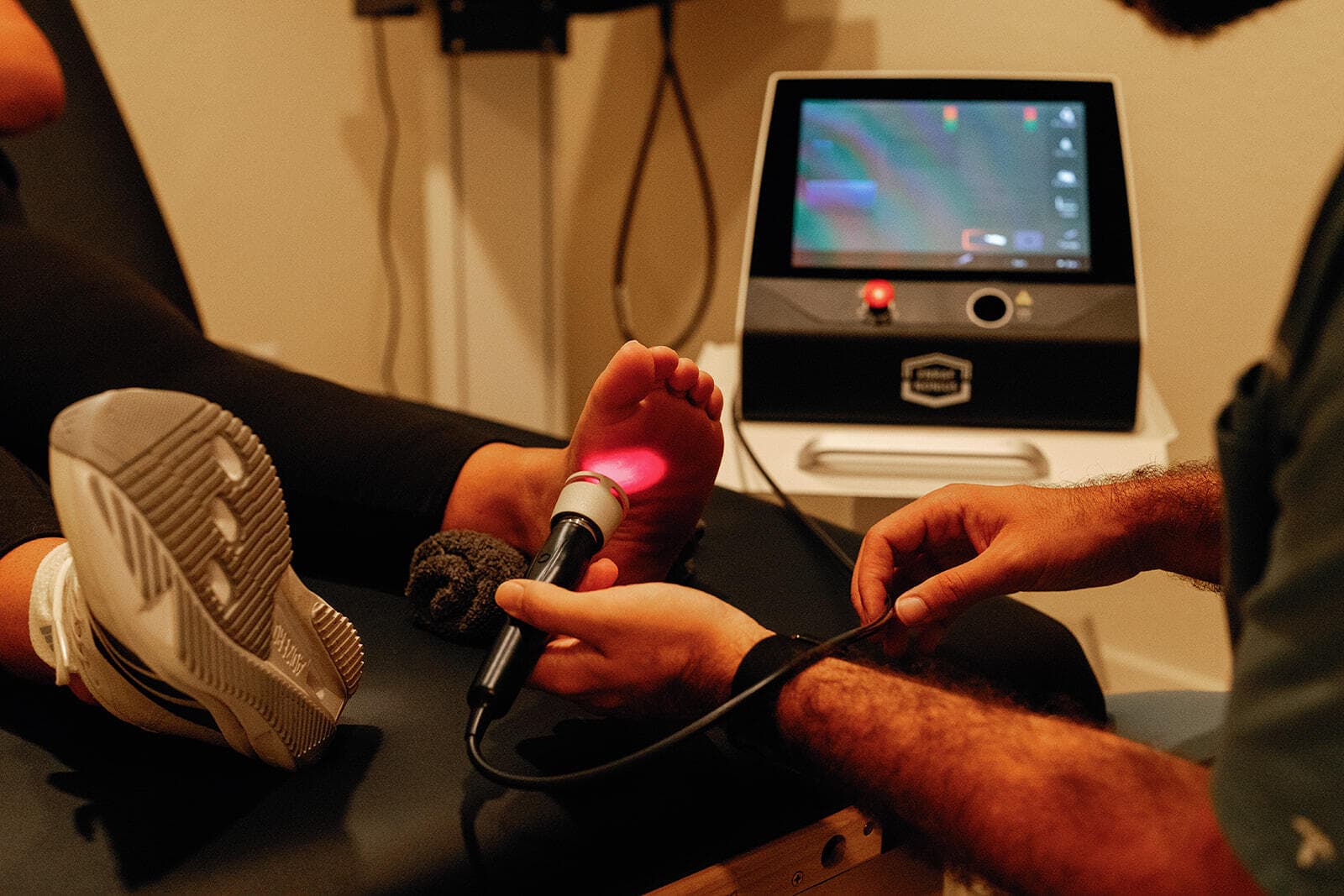
The guideline backs low-level laser as an add-on to a rehab program for short-term pain relief. A pooled analysis inside it found about a 2-point drop on the pain scale at one to six weeks, with no significant difference from shockwave over that span. A 2026 review comparing high-intensity laser with shockwave found no difference in pain, a small edge for shockwave on foot function, and called the evidence insufficient for firm conclusions.
OutRecover's laser page describes its Class IV laser as higher intensity than a standard cold laser, so the high-intensity research is the closer match. Neither source tested that device. For the wider picture, see our laser therapy guide.
When is surgery considered?
Surgery is for heels that have not improved after about 12 months of consistent nonsurgical care. The AAOS says it is generally saved for that group and offers two operations: a partial release of the plantar fascia, or lengthening of a calf muscle when tight calves persist despite stretching. It also warns that surgery can leave chronic pain and dissatisfaction, so it follows everything else.
Where do studio services fit?
Studio services fit after the first-line steps, as an add-on. Your foundation is stretching, a splint, shoes and a sensible load. If those have run for months, ask your doctor whether shockwave is reasonable, and rule out the other causes in the table first.
OutRecover's focused shockwave page lists plantar fasciitis among the uses. It describes a handheld device that delivers pulses felt as a tapping sensation, with some tenderness, and says it is not recommended over open wounds, infections or tumors; tell staff about any blood clotting disorder. The full research summary is on our shockwave evidence page. Studio services are wellness services and do not replace your doctor's or physical therapist's plan.
If the studio's package fits your case, OutResolve is built for chronic tendon pain and lists plantar fasciitis among the problems it is for. It pairs Class IV laser and/or shockwave with PEMF. OutPrime wraps oxygen, laser and shockwave around PRP, so it fits only if your doctor has already recommended PRP.
What should you do this week?
Get the diagnosis confirmed, run the first-line plan consistently, and decide about add-ons with a clinician. In order:
- See a clinician if you have not been examined, so stress fracture, nerve and fat pad causes are ruled out.
- Do the stretch before your first step each morning, plus calf stretches, daily.
- Ask about taping and a night splint if the first step is your worst.
- Swap one high-impact session for cycling or swimming.
- After several months with no change, ask about shockwave, injections or a specialist. Bring this guide's sources.
Sources
- American Academy of Orthopaedic Surgeons. Plantar Fasciitis and Bone Spurs. OrthoInfo, undated page, read 2026. https://orthoinfo.aaos.org/en/diseases--conditions/plantar-fasciitis-and-bone-spurs/
- Koc TA Jr, Bise CG, Neville C, Carreira D, Martin RL, McDonough CM. Heel Pain - Plantar Fasciitis: Revision 2023. J Orthop Sports Phys Ther (APTA Academy of Orthopaedic Physical Therapy), 2023. https://www.orthopt.org/content/s/heel-pain-plantar-fasciitis-revision-2023
- Gollwitzer H, Saxena A, DiDomenico LA, et al. Clinically relevant effectiveness of focused extracorporeal shock wave therapy in the treatment of chronic plantar fasciitis: a randomized, controlled multicenter study. J Bone Joint Surg Am, 2015. https://pubmed.ncbi.nlm.nih.gov/25948515
- Charles R, Fang L, Zhu R, Wang J. The effectiveness of shockwave therapy on patellar tendinopathy, Achilles tendinopathy, and plantar fasciitis: a systematic review and meta-analysis. Front Immunol, 2023. https://pmc.ncbi.nlm.nih.gov/articles/PMC10468604
- Efficacy and tolerability of extracorporeal shock wave therapy in patients with plantar fasciopathy: a systematic review with meta-analysis and meta-regression. Eur J Phys Rehabil Med, 2024. https://pmc.ncbi.nlm.nih.gov/articles/PMC11561739
- Efficacy of radial and focused shockwave therapy for tendinopathy: a systematic review and meta-analysis. Sci Rep, 2026. https://pmc.ncbi.nlm.nih.gov/articles/PMC12936064
- David JA, Sankarapandian V, Christopher PRH, Chatterjee A, Macaden AS. Injected corticosteroids for treating plantar heel pain in adults. Cochrane Database Syst Rev, 2017. https://pmc.ncbi.nlm.nih.gov/articles/PMC6481652
- Hurley ET, Shimozono Y, Hannon CP, Smyth NA, Murawski CD, Kennedy JG. Platelet-Rich Plasma Versus Corticosteroids for Plantar Fasciitis: A Systematic Review of Randomized Controlled Trials. Orthop J Sports Med, 2020. https://pmc.ncbi.nlm.nih.gov/articles/PMC7222276
- Comparative effectiveness of minimally invasive therapies for plantar fasciitis: a systematic review and network meta-analysis. Sci Rep, 2026. https://pmc.ncbi.nlm.nih.gov/articles/PMC12992864
- Wu PC, Liu DH, Cheng YS, Lin CS, Yang FA. High-Intensity Laser Therapy Versus Extracorporeal Shockwave Therapy for Plantar Fasciitis: A Systematic Review and Meta-Analysis. Bioengineering, 2026. https://pmc.ncbi.nlm.nih.gov/articles/PMC12838031
