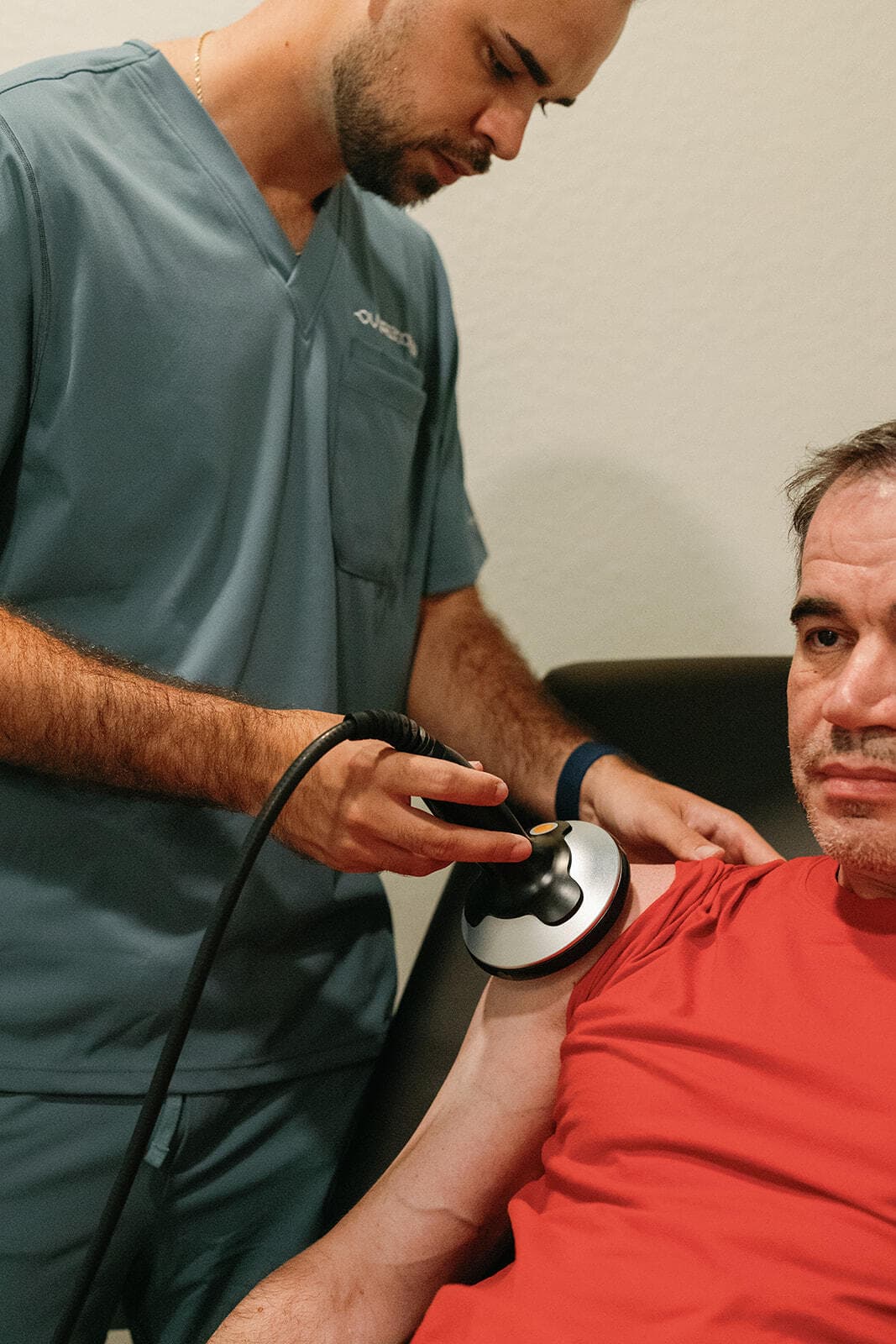
If lifting your arm hurts, especially overhead, the usual answer is a progressive exercise program, not an injection, a machine or an operation. The 2025 clinical practice guideline for this problem gives active exercise its top grade as the first treatment. A steroid injection helps with pain for a while at best. Two placebo-controlled trials found that shaving bone off the shoulder did no better than a fake version of the operation. Shockwave, laser and PEMF have thinner and more mixed evidence, and the guideline advises against shockwave when there is no calcium deposit in the tendon. Before any of it, a clinician should rule out a rotator cuff tear and a frozen shoulder.
What is shoulder impingement, and why do some doctors avoid the term?
Shoulder impingement is the name for pain at the top or front of the shoulder when you raise your arm. The American Academy of Orthopaedic Surgeons (AAOS) describes the space under the bony roof of the shoulder (the acromion) narrowing as you lift, so the rotator cuff tendons and the bursa above them get rubbed and irritated. Symptoms include pain reaching overhead, pain bringing the arm down, and pain that is usually worst at night. Swimmers, tennis and volleyball players, and people who paint or build overhead are named as being at risk.
The term itself is debated. A 2009 paper in the British Journal of Sports Medicine argued that these labels reflect a clinical hypothesis more than proof of what is damaged. The Dutch Orthopaedic Association said in 2014 that the rubbing explanation is not sufficient to cover the pathology and preferred "subacromial pain syndrome." A 2025 editorial in the Journal of Orthopaedic and Sports Physical Therapy argues for "rotator cuff-related shoulder pain," because the tendons are not the definitive and sole source of symptoms. You will hear all of these names. They describe the same group of patients, and the 2025 guideline folds subacromial pain syndrome and impingement under rotator cuff tendinopathy.
If you are a pickleball player, golfer or swimmer, the practical point is that the label matters less than the plan: load the shoulder gradually and get a doctor to rule out the look-alikes below.
How do you know it is shoulder impingement and not a tear or a frozen shoulder?
A clinician sorts this out with a history and an exam, and imaging is usually not the first step. In the 2025 guideline, the painful arc test is the one suggested to confirm the diagnosis and the Hawkins-Kennedy test the one to rule it out. The same guideline advises against imaging to confirm it at the start, and says imaging may be considered if symptoms have not improved within a maximum of 12 weeks of appropriate care. AAOS notes that X-rays of a painful rotator cuff are usually normal or show a small bone spur.
| Look-alike | What points to it | How it is checked |
|---|---|---|
| Rotator cuff tear | Weakness lifting or rotating the arm, pain at rest and at night, sometimes a snap after a fall or heavy lift | Strength testing, then MRI or ultrasound (AAOS) |
| Frozen shoulder | Motion is limited both when you move the arm and when someone else moves it | Range-of-motion exam, X-ray to rule out arthritis (AAOS) |
| Neck or nerve problem | A pinched nerve in the neck can cause shoulder pain | Neck exam by the doctor (AAOS) |
| Arthritis | Joint changes the tendons do not explain | X-ray (AAOS) |
The guideline also tells clinicians to screen for red flags: fever or chills, an obvious deformity, symptoms pointing to the heart or other organs, or a history of cancer. If any of those fit, or if pain started with a fall and the arm suddenly feels weak, see a doctor promptly. Our guides on rotator cuff tendinitis and frozen shoulder treatment go further on the two most common look-alikes.
What is the best first treatment for shoulder impingement?
Start with an active exercise program guided by a physical therapist. The 2025 guideline gives its Grade A recommendation to active rehabilitation, which may include motor control and resistance training, as the initial treatment. AAOS describes the sequence: physical therapy first to restore motion with stretching, then, once pain is improving, a strengthening program for the rotator cuff and work on posture. Short-term anti-inflammatory medicine is an option (a Grade B recommendation in the guideline). AAOS says many patients improve gradually, but full recovery can take several weeks to months.
The evidence is better for exercise as a plan than for any single exercise. A 2026 review of eight trials (417 people) found no clear overall pain difference between exercise therapy and control treatments, with wide variation between studies, so treat exercise as the best-supported starting point rather than a guaranteed fix. The AAOS shoulder conditioning program shows example stretches and strengthening moves, and says to check with your doctor or physical therapist before trying them.
When does a steroid injection make sense?
When exercise is stalled by pain, and as a short-term helper. AAOS lists a steroid injection into the bursa after rest, medication and physical therapy have not helped. The 2025 guideline says injections may be used to reduce pain and short-term disability, but should not be the first-line treatment. A 2025 meta-analysis of 15 trials (1,785 people) found an injection added to physical therapy might give small to moderate short-term improvement, an injection alone looked no better than physical therapy, and nothing beat therapy at mid or long term. Its authors rated the evidence moderate to mostly very low certainty.
A 2026 Dutch guideline update lands in the same place: consider an injection to enable exercise in people whose pain keeps them from doing it, because exercise therapy remains essential for the long term.
Does decompression surgery work?
In the best trials, the bone-shaving operation did no better than a placebo operation. Subacromial decompression removes part of the acromion and bursa so the tendons have more room. In CSAW, a UK trial, 313 people with shoulder pain for at least 3 months, who had already tried exercise and at least one injection, were randomized to decompression, a diagnostic arthroscopy without the key step, or no treatment. At six months the Oxford Shoulder Score (0 to 48) averaged 32.7 after decompression and 34.2 after placebo arthroscopy. Both surgical groups beat no treatment by a small margin of uncertain clinical importance.
The Finnish FIMPACT trial randomized 210 people to decompression, placebo arthroscopy or exercise therapy. At 24 months decompression gave no benefit over placebo, and a 2025 report on the 10-year results again found no significant difference between decompression and placebo surgery, or between decompression and exercise, on a pain scale where 15 points counted as meaningful. A 2019 Cochrane review of eight trials, restricted to its two placebo-controlled trials for this comparison, found pain at one year differed by 0.26 points on a 0 to 10 scale between decompression and placebo surgery, with the interval running from a little better to a little worse. The same year a BMJ guideline panel made a strong recommendation against surgery for this kind of shoulder pain.
Two caveats. AAOS still describes decompression as an option when nonsurgical care has not worked, and a surgeon may also repair a tear or treat other findings during the same operation. Ask what the operation would add in your shoulder, given these trials.
What do reviews show for shockwave, laser and PEMF?
The evidence is thinner and more mixed than for exercise, and the guideline is blunt about shockwave. Read the table as the strength of the research, not a promise for any one person.
| Therapy | What the research says | How sure |
|---|---|---|
| Focused shockwave | 2025 guideline: should not be used for rotator cuff tendinopathy without calcification (Grade C); may be used when a calcium deposit is confirmed. A 2024 review of 9 trials (543 people) found a small short-term pain edge over sham (SMD -0.28), no function benefit, and no edge over other treatments | Moderate for the small short-term pain edge; the guideline's call is conditional |
| Laser, including high-power | A 2026 review of 23 trials of low- and high-level lasers (805 to 1064 nm) found a modest pain benefit and selective motion gains, best as an add-on to exercise rather than alone. A 2026 review of low-level laser found effects under the minimal clinically important difference | Low to very low for the low-level laser review; the 23-trial review cites inconsistent dosing and short follow-up |
| PEMF | 2025 review of 4 trials (252 people): small short-term pain reduction (SMD -0.34, with a confidence interval that barely excludes zero). The 2025 guideline found insufficient evidence for PEMF in rotator cuff tendinopathy | Low, from few small trials with varying protocols |
| Red light | No trial of a full-body red light bed for shoulder impingement turned up in the research behind this guide | None found |
Sources: JOSPT guideline, 2025; Kamonseki, 2024; Dadkhahfar, 2026; Chen and Wang, 2026; Wang, 2025.
A larger 2024 review of 16 trials found shockwave relieved pain and improved function in rotator cuff tendinopathy, but it pooled calcific and non-calcific cases and its authors called the evidence limited. For the full shockwave research, see the shockwave science page, and for laser and PEMF, the laser therapy guide and the PEMF guide.
Where do studio services fit?
Next to a physical therapist's plan, after a doctor has ruled out a tear, and with realistic expectations. The shoulder-related packages at the Naples studio at 675 Piper Boulevard in North Naples match different situations:
- OutPrep lists rotator cuff injuries and shoulder tendinopathy among its uses. It combines PEMF, Class IV laser and hyperbaric oxygen and is built around PRP injections, so it fits mainly if your doctor is planning one. The guideline says PRP may be used but not as a first-line treatment. See what to expect after a PRP injection.
- OutResolve pairs Class IV laser and/or shockwave with PEMF and lists calcific rotator cuff tendinopathy. That matches the one shoulder situation where the guideline allows shockwave, so confirm with imaging that you have a calcium deposit first.
- OutMove combines PEMF, Class IV laser and red light for neck and shoulder stiffness. It is a supportive option, with no impingement-specific trial behind the red light part.
- OutReach is for frozen shoulder. Choose it only if a doctor has found limited motion in both directions.
The studio's shockwave page says not to use it over open wounds, infections or tumors and asks you to tell staff about any clotting disorder. Class IV laser requires protective eyewear. Tell your doctor or physical therapist before adding any of these, and nothing here replaces a rehab program or promises a result.
What should you do this week?
Get the diagnosis, then start loading the shoulder with guidance.
- See a doctor or physical therapist for an exam. Ask whether a tear or frozen shoulder is in play.
- Ask for an exercise program with sets, reps and a progression. Start it, and track whether night pain and overhead reach are improving.
- If there is no clear improvement by about 12 weeks, ask for imaging and a specialist opinion, as the guideline suggests.
- Before any injection or surgery, ask: what do the placebo-controlled trials say about my situation, and what would this add to exercise?
Sources
- American Academy of Orthopaedic Surgeons. Shoulder Impingement/Rotator Cuff Tendinitis. OrthoInfo (page undated). https://www.orthoinfo.org/diseases--conditions/shoulder-impingementrotator-cuff-tendinitis
- American Academy of Orthopaedic Surgeons. Rotator Cuff Tears. OrthoInfo. https://orthoinfo.aaos.org/en/diseases--conditions/rotator-cuff-tears/
- American Academy of Orthopaedic Surgeons. Frozen Shoulder. OrthoInfo. https://orthoinfo.aaos.org/en/diseases--conditions/frozen-shoulder/
- American Academy of Orthopaedic Surgeons. Rotator Cuff and Shoulder Conditioning Program. OrthoInfo. https://www.orthoinfo.org/recovery/rotator-cuff-and-shoulder-conditioning-program
- Desmeules F, Roy JS, Lafrance S, et al. Rotator Cuff Tendinopathy Diagnosis, Nonsurgical Medical Care, and Rehabilitation: A Clinical Practice Guideline. J Orthop Sports Phys Ther, 2025. https://pubmed.ncbi.nlm.nih.gov/40165544
- Lewis J, Mintken PE, McDevitt AW. What's in a Name? The Case for Using "Rotator Cuff-Related Shoulder Pain" in Clinical Practice. J Orthop Sports Phys Ther, 2025. https://pubmed.ncbi.nlm.nih.gov/40536259
- Lewis JS. Rotator cuff tendinopathy/subacromial impingement syndrome: is it time for a new method of assessment? Br J Sports Med, 2009. https://pubmed.ncbi.nlm.nih.gov/18838403
- Diercks R, Bron C, Dorrestijn O, et al. Guideline for diagnosis and treatment of subacromial pain syndrome. Acta Orthop, 2014. https://pmc.ncbi.nlm.nih.gov/articles/PMC4062801
- Lambers Heerspink FO, Veen EJD, Dorrestijn O, et al. Update of guideline for diagnosis and treatment of subacromial pain syndrome, Part 1. Acta Orthop, 2026. https://pubmed.ncbi.nlm.nih.gov/41718640
- Wu J, Zheng Y, Cai W, et al. Exercise therapy for rotator cuff-related shoulder pain: a systematic review and meta-analysis, subgroup analysis of racquet sport athletes. Front Bioeng Biotechnol, 2026. https://pmc.ncbi.nlm.nih.gov/articles/PMC13275474
- Lazzarini SG, et al. Effectiveness of Additional or Standalone Corticosteroid Injections Compared to Physical Therapist Interventions in Rotator Cuff Tendinopathy: A Systematic Review and Meta-Analysis of Randomized Controlled Trials. Phys Ther, 2025. https://pubmed.ncbi.nlm.nih.gov/39836429
- Beard DJ, Rees JL, Cook JA, et al. Arthroscopic subacromial decompression for subacromial shoulder pain (CSAW). Lancet, 2018. https://pubmed.ncbi.nlm.nih.gov/29169668
- Paavola M, Malmivaara A, Taimela S, et al. Subacromial decompression versus diagnostic arthroscopy for shoulder impingement: randomised, placebo surgery controlled clinical trial (FIMPACT). BMJ, 2018. https://pubmed.ncbi.nlm.nih.gov/30026230
- Kanto K, Back M, Ibounig T, et al. Arthroscopic subacromial decompression versus placebo surgery for subacromial pain syndrome: 10 year follow-up of the FIMPACT trial. BMJ, 2025. https://pubmed.ncbi.nlm.nih.gov/41330610
- Karjalainen TV, Jain NB, Page CM, et al. Subacromial decompression surgery for rotator cuff disease. Cochrane Database Syst Rev, 2019. https://pmc.ncbi.nlm.nih.gov/articles/PMC6357907
- Vandvik PO, Lahdeoja T, Ardern C, et al. Subacromial decompression surgery for adults with shoulder pain: a clinical practice guideline. BMJ, 2019. https://pubmed.ncbi.nlm.nih.gov/30728120
- Kamonseki DH, da Rocha GM, Ferreira VML, et al. Extracorporeal Shockwave Therapy for the Treatment of Noncalcific Rotator Cuff Tendinopathy: A Systematic Review and Meta-analysis. Am J Phys Med Rehabil, 2024. https://pubmed.ncbi.nlm.nih.gov/37903597
- Xue X, Song Q, Yang X, et al. Effect of extracorporeal shockwave therapy for rotator cuff tendinopathy: a systematic review and meta-analysis. BMC Musculoskelet Disord, 2024. https://pubmed.ncbi.nlm.nih.gov/38704572
- Dadkhahfar S, Abbasian M, Hasanzadeh S, et al. Effectiveness of Low-Level and High-level Laser Therapy for Rotator Cuff-Related Shoulder Disorders: A Systematic Review and Meta-Analysis. J Lasers Med Sci, 2026. https://pmc.ncbi.nlm.nih.gov/articles/PMC13675592
- Chen L, Wang Y. Efficacy of low-level laser therapy for subacromial impingement syndrome: a meta-analysis of randomized controlled trials. Lasers Med Sci, 2026. https://pmc.ncbi.nlm.nih.gov/articles/PMC13572333
- Wang HY, Chen YJ, Huang IC, et al. The effectiveness of pulsed electromagnetic field therapy in patients with shoulder impingement syndrome: a systematic review and meta-analysis of randomized controlled trials. PLoS One, 2025. https://pmc.ncbi.nlm.nih.gov/articles/PMC12088032
