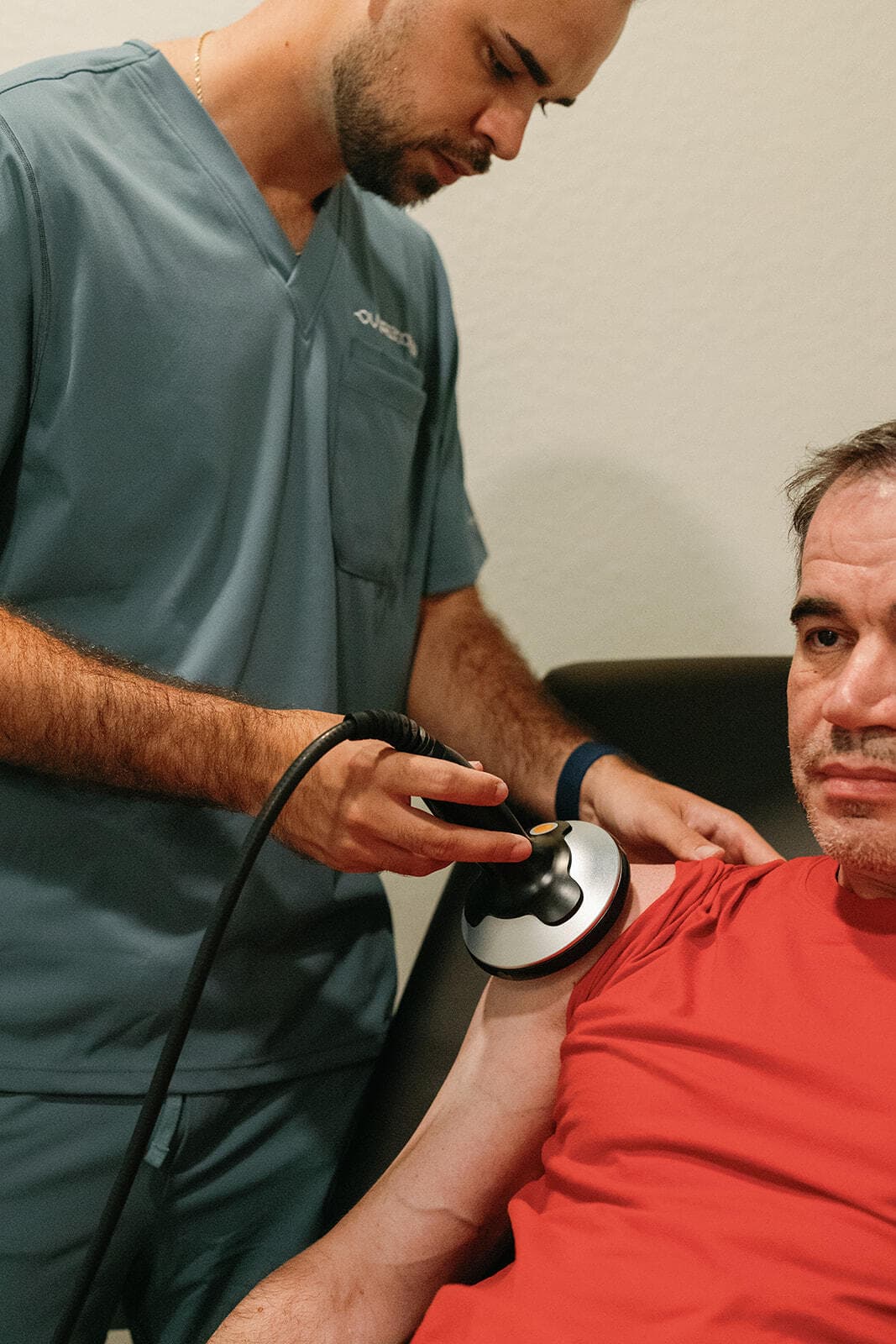
Rotator cuff tendinitis is irritation of the tendons that lift and rotate your arm, and most cases settle with time, load management and a progressive exercise program. The American Academy of Orthopaedic Surgeons (AAOS) says initial treatment is nonsurgical and that many people improve gradually over several weeks to months. Surgery for this kind of shoulder pain has not beaten placebo surgery in the best trials. Shockwave has its strongest evidence in one specific form, calcific tendinitis. Laser and PEMF have thinner support.
What is rotator cuff tendinitis, and how is it different from a tear or impingement?
The rotator cuff is four muscles whose tendons wrap the top of the upper arm bone. AAOS lists three overlapping sources of rotator cuff pain: tendinitis (inflamed tendons), bursitis (an inflamed gliding sac above the tendons) and impingement (the tendon rubbing under the bony roof of the shoulder). A tear is a different finding: the tendon has frayed or detached from the bone, partly or fully (AAOS, rotator cuff tears, 2024).
The labels blur in research. A 2026 Dutch orthopedic guideline groups tendon degeneration, calcific tendinitis and degenerative supraspinatus tears under one heading, subacromial pain syndrome, and the Cochrane reviews use "rotator cuff disease." For you the useful split is practical: is the arm weak, or just painful? AAOS lists weakness as a tear symptom, so it is the finding to mention first. Our guide to shoulder impingement covers the mechanical side in more depth.
A rough field guide, using AAOS's descriptions:
- Tendinitis or impingement: pain and stiffness lifting the arm overhead and bringing it down, tenderness at the front or side of the shoulder, worst at night. X-rays are usually normal or show a small bone spur.
- Tear: the same pain, plus weakness lifting or rotating the arm, and sometimes a crackling sensation. Some tears cause no pain at all. MRI or ultrasound is how a tear is confirmed.
- Calcific tendinitis: a calcium deposit inside the tendon, found on imaging. It is covered in its own section below.
What does it feel like, and who gets it?
AAOS describes pain and tenderness at the front or side of the shoulder, trouble lifting the arm to reach overhead, and pain that is typically worst at night. As it progresses, it can disturb sleep and make dressing, a seatbelt or brushing your hair hard. Swimming, tennis, volleyball and baseball put athletes at risk, as does repetitive overhead work (AAOS).
Over 40, the odds shift. AAOS says most tears come from wear that builds slowly with age, and some are painless. A scan that shows a tear does not by itself explain your pain, which is one reason treatment starts with how the shoulder works, not just what the picture shows. If you play pickleball, our pickleball injuries guide covers where shoulders fit in.
How is a sore rotator cuff diagnosed?
A clinician examines tenderness, range of motion and strength, and checks your neck to rule out a pinched nerve and other causes such as arthritis. AAOS says X-rays cannot show the tendons but help exclude other problems. MRI or ultrasound shows the tendons themselves, and AAOS notes that ultrasound accuracy depends on the technician.
The 2026 Dutch guideline recommends a cluster of physical tests, ultrasound when a partial tear is suspected, and MRI if ultrasound is unavailable or inconclusive (Acta Orthopaedica, 2026). Imaging is for a specific question, such as a suspected tear or a calcium deposit. It is not always needed on day one.
What is the first-line treatment for rotator cuff tendinitis?
First-line care is activity modification (cut the overhead movements that provoke pain, not all movement) plus a progressive exercise program, usually through a physical therapist. AAOS lists rest, activity change, anti-inflammatory medication and physical therapy before injections or surgery. In AAOS's description, therapy first restores motion, then adds rotator cuff strengthening once pain is improving.
The evidence behind exercise is modest, and worth stating plainly:
- A 2017 systematic review in the British Journal of Sports Medicine found exercise beat non-exercise controls for pain, and specific exercises beat generic ones, but graded the evidence very low quality (Steuri, 2017).
- A Cochrane review found one high-quality trial comparing manual therapy plus exercise with placebo, with no clinically important difference at 22 weeks. It found low-quality evidence that therapy performs similarly to an injection or to surgery (Cochrane, 2016).
- The 2026 Dutch guideline still recommends exercise therapy and gradual return to sport and work, and says the evidence on the best protocol is lacking.
Read that as: exercise is the safest, cheapest place to start and no better-proven option exists. Which exercises, and how hard, is a call for someone who has examined your shoulder.
Do steroid injections help?
For some people, briefly. A 2018 systematic review of 13 trials found a corticosteroid injection beat a numbing-only injection for up to 8 weeks, with no evidence of benefit beyond 8 weeks (Cook, 2018). AAOS gives a more generous average, pain relief for about two-thirds of patients for at least 3 months, and warns of risks from repeated long-term injections.
The Dutch guideline's framing is the practical one: consider an injection when pain is so severe that it stops you doing the exercise program, and tell patients the relief is temporary.
Rotator cuff tendinitis with calcium: where does shockwave work?
Calcific tendinitis, a calcium deposit within the tendon, is the form of shoulder tendon pain where shockwave has its strongest evidence, and the evidence is specific to high-energy treatment. The 2025 JOSPT clinical practice guideline goes further: it advises clinicians not to use shockwave to reduce pain and disability in rotator cuff tendinopathy without calcification (Grade C), and allows it when a calcium deposit is confirmed (Desmeules, 2025).
Here is what the reviews say, exactly:
- Strongest. A 2014 Annals of Internal Medicine review of 28 trials concluded that high-energy shockwave was better than placebo for pain, function and resorption of calcium in calcific tendinitis, with no significant difference in non-calcific tendinitis. Its authors called the trials heterogeneous and few.
- Dose matters. A 2014 meta-analysis of five trials (359 people) found high-energy treatment beat low-energy: a 9.9-point better Constant-Murley (shoulder function) score at 3 months, and three times the odds of complete resorption of the deposit. Its introduction notes that high-energy treatment is more painful, more expensive and usually done in an inpatient setting.
- The cooler read. The 2020 Cochrane review pooled 32 trials and judged the evidence low to moderate certainty. Against placebo, pain at 3 months was 0.78 points better on a 10-point scale (the review's threshold for an important change was 1.5), and function was 7.9 points better (threshold 10). More adverse events occurred with shockwave (41 of 156 people vs 10 of 139 with placebo), and it found no pain or function difference between people with and without calcium (Cochrane, 2020).
- Alongside other options. A 2023 review of 27 trials found shockwave and ultrasound-guided needling both brought clinically meaningful gains, and called it reasonable to try them before surgery. The 2026 Dutch guideline suggests considering barbotage (needle lavage of the deposit) for symptomatic calcific tendinosis.
The studio's focused shockwave service page does not state the energy level of its device, and the studio's Science page has the full research summary. Before you book, ask what energy the device delivers and whether it matches what the trials tested. Calcific tendinitis needs an X-ray or ultrasound first, so you know a deposit exists.
What do the reviews say about laser and PEMF?
The reviews are thin. Cochrane's 2016 electrotherapy review found low-quality evidence that low-level laser may help short-term compared with placebo, and that PEMF may not provide clinically relevant benefits over placebo. It also found that laser, ultrasound and PEMF may not add anything when combined with other physical therapy.
A 2026 meta-analysis of laser trials pooled effect sizes of about 0.7 for pain and for disability, and found high-intensity laser outperformed low-level laser, which showed limited effect on its own. It noted that dosing is not standardized and long-term outcomes need study (Disability and Rehabilitation, 2026). The studio describes its Class IV laser as higher-intensity than standard cold lasers; ask any provider which type they use and how many sessions they run. Our laser therapy for pain and what is PEMF therapy guides go deeper on each.
When should you see a surgeon?
See an orthopedic doctor soon if you fell on an outstretched arm, felt a snap, and cannot lift the arm. AAOS says sudden tears usually cause intense pain with immediate weakness. Also go if pain wakes you nightly for weeks despite care, if weakness is growing, or if symptoms pass 6 to 12 months. AAOS lists those as signs surgery may be worth discussing, along with a large tear (over 3 cm) in good tissue.
Surgery for plain tendinitis or impingement has weak support. A 2019 Cochrane review found high-certainty evidence that subacromial decompression gives no better pain, function or quality of life than placebo surgery at one year. A 2020 British Journal of Sports Medicine review found no important benefit over placebo or exercise and about six serious harms per 1,000 patients (BJSM, 2020).
Tears are a closer call. A Cochrane review of rotator cuff repair for full-thickness tears said it remains uncertain whether surgery helps more than exercise, with or without injections (2019), in trials of mostly small degenerative supraspinatus tears. In one trial, small non-traumatic tears in people over 55 had no better outcomes with surgery at about 6 years (2021). Those findings may not apply to traumatic tears, large tears or younger people.
Questions to ask the surgeon
- Is this a tear, and if so how large, and is it from injury or wear?
- What is the cost of waiting 3 months with a structured exercise program?
- If I try an injection, what is it meant to let me do?
- What would make you recommend surgery for me?
Where do studio services fit?
Studio sessions sit alongside the exercise and medical care above and do not replace them. If you are heading toward a surgeon's plan, clear anything new with them first.
For persistent tendon pain that is not responding, three packages match this condition. OutPrep lists rotator cuff injuries and shoulder tendinopathy under who it is for, and is built to support the tissue around PRP injections, with PEMF, Class IV laser and hyperbaric oxygen. OutPrime lists chronic rotator cuff tendinopathy and adds focused shockwave to laser and hyperbaric oxygen. If your imaging shows a calcium deposit, OutResolve lists calcific rotator cuff tendinopathy and centers on laser and/or shockwave with PEMF.
On the evidence: PRP is a separate question from the studio's sessions. A 2021 meta-analysis of eight trials called PRP injection safe and effective for long-term pain and function, while noting the trials varied in technique and controls. We did not review hyperbaric oxygen for rotator cuff disease here, so check its Science page for what the research covers, and ask your doctor.
Your next step
Book a shoulder exam with a physician or physical therapist if you have not had one, ask for a specific exercise plan, and decide with them whether imaging is needed. If you already have a plan, or a calcium deposit on imaging, call the studio, share your diagnosis, and ask what each session in a package would do for your shoulder.
Sources
- American Academy of Orthopaedic Surgeons (OrthoInfo). Shoulder Impingement/Rotator Cuff Tendinitis. AAOS, undated page, accessed 2026-11-05. https://orthoinfo.aaos.org/en/diseases--conditions/shoulder-impingementrotator-cuff-tendinitis/
- American Academy of Orthopaedic Surgeons (OrthoInfo). Rotator Cuff Tears. AAOS, updated 2024. https://orthoinfo.aaos.org/en/diseases--conditions/rotator-cuff-tears/
- Lambers Heerspink FO, et al. Update of guideline for diagnosis and treatment of subacromial pain syndrome, Part 1. Acta Orthopaedica, 2026. https://pubmed.ncbi.nlm.nih.gov/41718640/
- Steuri R, et al. Effectiveness of conservative interventions including exercise, manual therapy and medical management in adults with shoulder impingement. British Journal of Sports Medicine, 2017. https://pubmed.ncbi.nlm.nih.gov/28630217/
- Page MJ, et al. Manual therapy and exercise for rotator cuff disease. Cochrane Database of Systematic Reviews, 2016. https://pubmed.ncbi.nlm.nih.gov/27283590/
- Cook T, et al. Are corticosteroid injections more beneficial than anaesthetic injections alone in the management of rotator cuff-related shoulder pain? British Journal of Sports Medicine, 2018. https://pubmed.ncbi.nlm.nih.gov/29305377/
- Bannuru RR, et al. High-energy extracorporeal shock-wave therapy for treating chronic calcific tendinitis of the shoulder: a systematic review. Annals of Internal Medicine, 2014. https://pubmed.ncbi.nlm.nih.gov/24733195/
- Verstraelen FU, et al. High-energy versus low-energy extracorporeal shock wave therapy for calcifying tendinitis of the shoulder. Clinical Orthopaedics and Related Research, 2014. https://pubmed.ncbi.nlm.nih.gov/24872197/
- Surace SJ, et al. Shock wave therapy for rotator cuff disease with or without calcification. Cochrane Database of Systematic Reviews, 2020. https://pubmed.ncbi.nlm.nih.gov/32128761/
- Angileri HS, et al. Chronic calcific tendonitis of the rotator cuff: a systematic review and meta-analysis of randomized controlled trials comparing operative and nonoperative interventions. Journal of Shoulder and Elbow Surgery, 2023. https://pubmed.ncbi.nlm.nih.gov/37080421/
- Page MJ, et al. Electrotherapy modalities for rotator cuff disease. Cochrane Database of Systematic Reviews, 2016. https://pubmed.ncbi.nlm.nih.gov/27283591/
- Lin LH, et al. Systematic review and meta-analysis of laser physical agent for pain and disability in rotator cuff tendinopathy. Disability and Rehabilitation, 2026. https://pubmed.ncbi.nlm.nih.gov/41718549/
- Karjalainen TV, et al. Subacromial decompression surgery for rotator cuff disease. Cochrane Database of Systematic Reviews, 2019. https://pubmed.ncbi.nlm.nih.gov/30707445/
- Lähdeoja T, et al. Subacromial decompression surgery for adults with shoulder pain: a systematic review with meta-analysis. British Journal of Sports Medicine, 2020. https://pubmed.ncbi.nlm.nih.gov/30647053/
- Karjalainen TV, et al. Surgery for rotator cuff tears. Cochrane Database of Systematic Reviews, 2019. https://pubmed.ncbi.nlm.nih.gov/31813166/
- Kukkonen J, et al. Operative versus conservative treatment of small, nontraumatic supraspinatus tears in patients older than 55 years: over 5-year follow-up of a randomized controlled trial. Journal of Shoulder and Elbow Surgery, 2021. https://pubmed.ncbi.nlm.nih.gov/33774172/
- A Hamid MS, et al. Platelet-rich plasma for rotator cuff tendinopathy: a systematic review and meta-analysis. PLoS One, 2021. https://pubmed.ncbi.nlm.nih.gov/33970936/
- Desmeules F, Roy JS, Lafrance S, et al. Rotator Cuff Tendinopathy Diagnosis, Nonsurgical Medical Care, and Rehabilitation: A Clinical Practice Guideline. J Orthop Sports Phys Ther, 2025. https://pubmed.ncbi.nlm.nih.gov/40165544
