After a PRP injection, expect the treated spot to be sore and a little swollen, often for a day or two and sometimes for a week or two, before any benefit shows up. Many doctors also ask you to skip anti-inflammatory pills and go easy on the area for a while. Your own doctor's instructions come first. What follows is the usual course, what the research says about whether PRP works for your condition, and the warning signs that mean a call.
What is PRP and how is it made?
PRP stands for platelet-rich plasma. A clinician draws a small amount of your blood, spins it in a centrifuge to separate the platelets from the other blood cells, and injects the concentrated platelets into the injured area. The American Academy of Orthopaedic Surgeons says the platelet concentration can be 5 to 10 times higher than in ordinary blood, and that platelets contain growth factors involved in healing (AAOS OrthoInfo, PRP). The AAOS also says it is not exactly clear how PRP works. The theory is lab-based; the clinical results are what count, and they vary.
OutRecover does not give PRP injections. Your own doctor does. The studio's PRP packages are built to go around an injection you have arranged elsewhere, which the last sections cover.
Does PRP work? It depends on the condition
The honest answer is mixed, and it changes by body part.
Knee osteoarthritis. The strongest recent test is the 2021 RESTORE trial in JAMA: 288 adults aged 50 or older with mild to moderate knee osteoarthritis got three weekly PRP injections or three saline injections. At 12 months, pain fell 2.1 points with PRP and 1.8 with saline, a difference that was not statistically significant, and cartilage volume did not differ either. The authors wrote that the findings "do not support use of PRP for the management of knee OA" (Bennell et al., JAMA, 2021). The 2019 American College of Rheumatology and Arthritis Foundation guideline strongly recommended against PRP for knee and hip osteoarthritis (ACR/AF guideline, 2019). That guideline is now seven years old, so ask your doctor what the current guidance says.
Other reviews are kinder. A 2019 meta-analysis of 78 randomized trials found low to moderate quality evidence that PRP reduces pain in knee osteoarthritis and in tennis elbow at one year, while noting that evidence for clinically important benefit is limited (Sports Health meta-analysis, 2019). A 2025 review of six trials found short- to mid-term gains in pain and function, with one large trial showing no benefit over placebo (Cureus meta-analysis, 2025). If you are searching "prp knee," this split is the picture: some trials favor PRP, the large placebo-controlled one did not.
Tendons. For tennis elbow, the AAOS says research supports PRP for chronic cases. For Achilles and patellar tendinopathy it calls PRP promising but says it is hard to claim it beats traditional treatment (AAOS OrthoInfo, PRP). The Achilles trials are less encouraging. In a 2010 JAMA trial, PRP and saline injections both improved scores alongside eccentric exercise, with no difference between them (de Vos et al., JAMA, 2010). A 2021 JAMA trial of 240 people compared PRP with a sham injection at 6 months and also found no difference, concluding the results "do not support" PRP for chronic midportion Achilles tendinopathy (Kearney et al., JAMA, 2021).
A useful frame: PRP may help some people with some conditions, and nobody can promise you will be one of them. That is worth knowing before you spend money and plan time off.
What to expect after a PRP injection: the usual course
Plan for soreness first. Cleveland Clinic says PRP typically causes some swelling and pain at first, because it stimulates a healing process similar to what happens after an injury, and that this may last a day or two (Cleveland Clinic, PRP injection). The AAOS describes a longer tail for tendon injections: pain at the site may increase for the first week or two, and it may be several weeks before a benefit is felt (AAOS OrthoInfo, PRP).
| When | What people commonly report | Source |
|---|---|---|
| First day or two | Soreness and swelling at the site | Cleveland Clinic |
| First week or two | Pain may be worse than before the injection (tendons) | AAOS |
| Several weeks | Earliest point a benefit may show | AAOS |
| 4 to 6 weeks | Most common point protocols allow full activity | PM&R review, 2020 |
The last row comes from a review of 84 studies of PRP for tendinopathy. Return to play or full activity was named in 42 percent of protocols, most often at 4 to 6 weeks, and the authors found that no study compared different after-injection protocols, so the rationale for any rule is limited (Post-PRP protocols review, PM&R, 2020). That means your doctor's rule beats any table, including this one.
How much should you rest after PRP?
Rest the area for a short, guided period, then load it gradually. In that same review, stretching typically began 2 to 7 days after injection and strengthening within 2 to 3 weeks, and weight-bearing limits were rare (12 percent of protocols). Hospital for Special Surgery notes that for PRP or stem cell injections the wait before resuming activity can stretch to two weeks to protect the injection's effect (HSS, injections for hip pain), which is guidance written about the hip, so treat it as an example.
Bring these questions to the doctor who injects you:
- How long do I protect the area, and what counts as protecting it?
- When do stretching and strengthening start?
- When can I run, swing, lift or play?
- Which pain medicine is safe for me?
- Is it fine to book other therapies on or near the injected area, and from what day?
Should you avoid NSAIDs around a PRP injection?
Many doctors say yes, though the proof is thin. The reasoning: NSAIDs such as ibuprofen and naproxen can reduce platelet function, and platelets are what PRP delivers. A 2022 systematic review concluded that aspirin and non-selective NSAIDs should be considered for suspension before a PRP injection, and that COX-2-selective NSAIDs and statins did not need to be withheld (Orthopaedic Journal of Sports Medicine, 2022). HSS likewise advises against NSAIDs before or after the injection (HSS, injections for hip pain). In the tendinopathy review above, 56 percent of protocols restricted NSAIDs after injection, often for more than two weeks.
Two cautions. First, sources disagree on acetaminophen: the 2022 review suggested suspending it, while a 2024 review in Cureus found it does not inhibit platelet aggregation and needs no deferral (Cureus review, 2024). Second, no trial shows that avoiding NSAIDs improves PRP results. Do not stop a medication that a doctor prescribed for another reason, and do not guess. Ask which pain relief you may use, and follow that answer.
Warning signs after a PRP injection
Most after-injection soreness fades. Infection is uncommon: the AAOS says infection, tissue damage and nerve injury appear no more common than with cortisone injections (AAOS OrthoInfo, PRP). Still, call the injecting office the same day if you notice:
- Fever or chills
- Redness or warmth spreading from the site
- Intense joint pain that grows rather than eases, especially with movement
- Swelling that keeps increasing after the first few days
- New numbness or weakness in the limb (the AAOS lists nerve injury among the rare risks)
MedlinePlus lists intense joint pain, redness, swelling and fever as the symptoms of a joint infection (septic arthritis), and says to contact a provider right away for joint pain and swelling with a fever (MedlinePlus, septic arthritis; MedlinePlus, joint swelling).
Is PRP covered by insurance?
Often not. The AAOS tells patients to check eligibility with their carrier because few insurance plans, workers' compensation included, provide even partial reimbursement (AAOS OrthoInfo, PRP). Cleveland Clinic notes PRP is relatively expensive because of how it is made, and that people with a chronic condition weigh the cost of repeat treatment against the benefit (Cleveland Clinic, PRP injection). Ask for the full price and the number of injections in writing before you book. Coverage rules change, so confirm with your carrier.
Where studio services fit around PRP
A recovery studio does not replace your injecting doctor, your physical therapist or the exercise program that follows the injection. The 2010 Achilles trial above was run alongside eccentric exercise, and most PRP protocols include a stretching and strengthening phase. What a studio can offer is a place to add supportive sessions while you wait out the soreness-to-benefit gap.
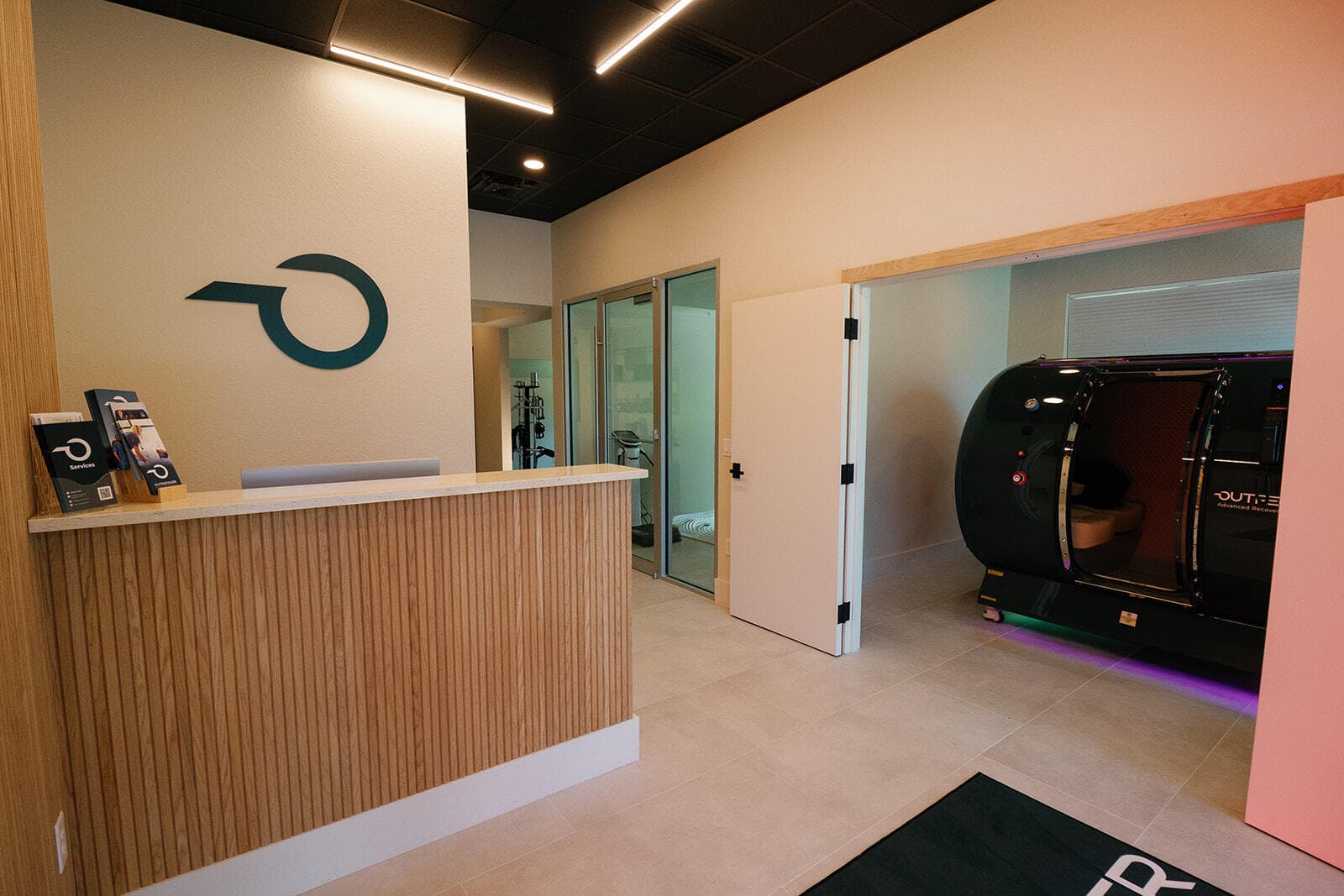
Two OutRecover packages are built for that. OutPrep pairs PEMF therapy, Class IV laser therapy and hyperbaric oxygen therapy, and its page describes it as support for the tissue around your PRP injections. OutPrime pairs hyperbaric oxygen, Class IV laser and focused shockwave therapy for stubborn tendon conditions such as chronic rotator cuff tendinopathy, tennis and golfer's elbow, and Achilles and patellar tendinopathy. Neither page says which visit falls before or after your injection; your clinician sets the plan for each visit, so tell them your injection date and your doctor's instructions.
The evidence needs stating plainly. We found one small randomized trial pairing PRP with shockwave: 33 athletes with patellar tendinopathy had PRP plus a sham treatment or PRP plus one shockwave session a week later. The shockwave group had faster pain relief at one month, and both groups improved over 12 months (Knee Surgery & Related Research, 2024). We did not find controlled trials of laser, PEMF or hyperbaric oxygen added to PRP, so for those the case rests on each therapy's own, mixed evidence, summarized on the research pages for laser, PEMF, hyperbaric oxygen and shockwave. For background, read laser therapy for pain and what PEMF therapy is. Services are wellness-based, results vary, and none of them is a medical treatment for your injury.
Your next step
Before the injection, write down your doctor's answers to the five questions above, and ask about the pain medicine first. If a package looks useful, share those instructions with the studio before booking so the plan fits them. If your problem is the Achilles tendon, the Achilles tendinitis guide covers first-line care.
Sources
- American Academy of Orthopaedic Surgeons. Platelet-Rich Plasma (PRP). OrthoInfo. Updated by Alaia and Kelly. https://orthoinfo.aaos.org/en/treatment/platelet-rich-plasma-prp/
- Bennell KL et al. Effect of Intra-articular Platelet-Rich Plasma vs Placebo Injection on Pain and Medial Tibial Cartilage Volume in Patients With Knee Osteoarthritis: The RESTORE Randomized Clinical Trial. JAMA, 2021. https://pubmed.ncbi.nlm.nih.gov/34812863/
- Kolasinski SL et al. 2019 American College of Rheumatology/Arthritis Foundation Guideline for the Management of Osteoarthritis of the Hand, Hip, and Knee. Arthritis Care & Research, 2020. https://pmc.ncbi.nlm.nih.gov/articles/PMC10518852
- Impact of Platelet-Rich Plasma Use on Pain in Orthopaedic Surgery: A Systematic Review and Meta-analysis. Sports Health, 2019. https://pubmed.ncbi.nlm.nih.gov/31136726/
- Efficacy of Platelet-Rich Plasma Injections in Knee Osteoarthritis: A Systematic Review and Meta-Analysis. Cureus, 2025. https://pmc.ncbi.nlm.nih.gov/articles/PMC12596915
- de Vos RJ et al. Platelet-rich plasma injection for chronic Achilles tendinopathy: a randomized controlled trial. JAMA, 2010. https://pubmed.ncbi.nlm.nih.gov/20068208/
- Kearney RS et al. Effect of Platelet-Rich Plasma Injection vs Sham Injection on Tendon Dysfunction in Patients With Chronic Midportion Achilles Tendinopathy: A Randomized Clinical Trial. JAMA, 2021. https://pubmed.ncbi.nlm.nih.gov/34255009/
- Cleveland Clinic. Platelet-Rich Plasma (PRP Injection): What It Is & Uses. https://my.clevelandclinic.org/health/treatments/platelet-rich-plasma-prp-injection
- Post-Procedure Protocols Following Platelet-Rich Plasma Injections for Tendinopathy: A Systematic Review. PM&R, 2020. https://pubmed.ncbi.nlm.nih.gov/32103599
- Hospital for Special Surgery. Injections for Hip Pain: Cortisone Shots, PRP and More. https://www.hss.edu/health-library/move-better/injections-for-hip-pain
- A Systematic Review on the Effect of Common Medications on Platelet Count and Function: Which Medications Should Be Stopped Before Getting a Platelet-Rich Plasma Injection? Orthopaedic Journal of Sports Medicine, 2022. https://pubmed.ncbi.nlm.nih.gov/35434168
- A Review of Platelet-Rich Plasma Use in Patients Taking Non-steroidal Anti-inflammatory Drugs for Guideline Development. Cureus, 2024. https://pmc.ncbi.nlm.nih.gov/articles/PMC11568791
- MedlinePlus. Septic arthritis. https://medlineplus.gov/ency/article/000430.htm
- MedlinePlus. Joint swelling. https://medlineplus.gov/ency/article/003262.htm
- A comparative analysis of platelet-rich plasma alone versus combined with extracorporeal shockwave therapy in athletes with patellar tendinopathy and knee pain: a randomized controlled trial. Knee Surgery & Related Research, 2024. https://pubmed.ncbi.nlm.nih.gov/39690426