Most Achilles tendinitis (also spelled tendonitis) gets better with progressive calf strengthening, and it takes longer than people expect: plan on about 12 weeks of steady work, sometimes more. The guideline found exercise better than a wait-and-see approach or passive treatments alone, and the AAOS notes anti-inflammatory pills do not reduce tendon thickening. Before any of that, make sure it is not a tear. A sudden pop and an inability to push off is a same-day call to a doctor, not a stretching problem.
What is Achilles tendinitis, and are there two kinds?
Achilles tendinitis is pain in the large tendon that joins your calf muscles to your heel bone. There are two types. Noninsertional means the middle of the tendon is affected. Insertional means the pain sits where the tendon attaches to the heel bone, and bone spurs often form there. The American Academy of Orthopaedic Surgeons (AAOS) says the two can occur together.
The AAOS notes that "tendinitis," "tendinosis" and "tendinopathy" all refer to essentially the same problem. This guide uses both words, because both are what you will hear.
Typical symptoms, per the AAOS: pain and stiffness along the tendon in the morning, pain at the back of the heel that worsens with activity, severe pain the day after exercise, thickening of the tendon, and pain when shoes press on the back of the heel. Middle-of-the-tendon pain more often affects younger, active people and runners.
Who gets it, and what raises the risk?
Overload is the common thread. The AAOS lists a sudden jump in exercise amount or intensity, a change of shoes, tight calf muscles and Haglund's deformity (an enlarged bone at the back of the heel that rubs the tendon).
The physical therapy guideline adds a research view. A review it cites found nine risk factors for midportion Achilles tendinopathy, including a prior lower limb tendinopathy or fracture, use of quinolone antibiotics, moderate alcohol use, training in cold weather and weaker calf strength (guideline text, 2024). The same review found 26 commonly suspected factors, including being overweight and abnormal foot posture, were not associated with it. The guideline itself says risk factors remain understudied and the cause is likely a mix of factors that overload the tendon.
How is it diagnosed, and what should be ruled out?
A clinician diagnoses it from your history and a hands-on exam: swelling along the tendon, tenderness in the middle or near the heel, heel pain when stretching the calf, and limited ability to point your toes down (AAOS). Scans are not required. The 2024 guideline recommends ultrasound, X-ray or MRI when the diagnosis is uncertain, recovery is delayed, symptoms get worse during care, or a procedure is being considered.
The condition to rule out first is a tear.
| Tendinitis or tendinopathy | Rupture (tear) | |
|---|---|---|
| Onset | Builds over days to weeks | Sudden, often with a pop |
| Pain | Morning stiffness, worse with activity | Severe pain and swelling near the heel |
| Walking and push-off | Painful but possible | May not be able to walk on it or stand on your toes |
| Exam | Tender tendon, thickening | Thompson test: your doctor squeezes the calf and your foot does not move |
| Next step | Start a loading plan | See a doctor now |
Sources: AAOS, Achilles tendinitis and AAOS, Achilles tendon rupture.
The AAOS links corticosteroid injections and the antibiotics ciprofloxacin and levofloxacin to a higher risk of tendon tearing. If you took either recently and your heel now hurts, tell your doctor.
What is the best Achilles tendinitis treatment?
Progressive loading: strengthening exercises for the calf that start easy and add weight and difficulty over time. The 2024 APTA guideline (JOSPT), which restates its 2018 recommendation, recommends mechanical loading, either eccentric or heavy-load slow-speed exercise, to reduce pain and improve function in midportion tendinopathy. It adds that patients should exercise at least twice a week within their pain tolerance.
Two programs have the best trial support.
- Eccentric (Alfredson) protocol. A 2015 systematic review found strong evidence for the 12-week version: 3 sets of 15 slow repetitions, twice a day, with the knee straight and again with it bent, adding load when the exercise is pain-free. The original 1998 study was small: 15 recreational athletes, 12 weeks, all back to full running, while a comparison group on conventional care all ended up in surgery.
- Heavy slow resistance. A 2015 randomized trial of 58 people compared the two for 12 weeks. Both improved and held the gains at 52 weeks. Training sessions were completed more often with heavy slow resistance (92% vs 78%), and satisfaction at 12 weeks leaned that way (100% vs 80%) without reaching statistical significance.
The guideline's synthesis says clinicians do not need to pick only eccentric work: exercise frequency, session count and duration of care did not clearly change outcomes, and the most common harm was temporary symptom flare-up.
Insertional pain needs a different plan. The AAOS says heel-drop exercises are for noninsertional tendinitis only, and not for insertional. In a 2008 pilot study, only 32% of people with insertional pain had good results from the standard painful eccentric regimen, and a modified version satisfied 67% at about four months (34 tendons, no control group). Ask a physical therapist to set the range of motion for you.
How long does Achilles tendinitis take to heal?
Expect about 12 weeks to see a clear change, and months before the tendon fully settles. The guideline reports improvement as early as 2 weeks and gains of 18 to 21 points on the VISA-A scale (a 100-point tendon score) by 12 weeks. The AAOS says even with early treatment pain may last longer than 3 months.
| Stage | What to expect |
|---|---|
| Weeks 1 to 2 | Cut the activity that flares it. Start loading within pain tolerance. |
| Weeks 2 to 12 | Add weight and difficulty gradually. Morning stiffness eases. |
| Month 3 and on | Gains hold in the trials that followed people to 52 weeks. |
| After about 6 months with no gain | The AAOS says surgery may be considered. |
Sources: APTA guideline, 2024; Beyer et al., 2015; AAOS. The stage descriptions summarize these sources and are not a prescription.
What should you avoid?
Avoid steroid injections into the tendon. The AAOS says cortisone injections into the Achilles are not recommended because they can cause the tendon to rupture, and that research showed significantly decreased tendon strength after one. Also keep in mind:
- Anti-inflammatory pills can ease pain enough to exercise, but they do not reduce the thickening of the tendon. The AAOS says to check with your doctor before using them past a month.
- A walking boot is for a short rest only. The AAOS discourages extended use because it can weaken the calf.
- Total rest is not required. In a randomized trial of 38 people, continuing running and jumping under a pain-monitoring model did not do worse than stopping for six weeks (2007; both groups improved).
Does shockwave therapy work for Achilles tendinitis?
Shockwave may help as an add-on to loading exercises for midportion pain, and the evidence is mixed. A 2022 systematic review found moderate evidence for shockwave added to a loading program in midportion tendinopathy, and found evidence for insertional pain lacking. A 2023 meta-analysis was less enthusiastic: low to moderate certainty and a negligible effect for Achilles, with no clear advantage over exercise.
One insertional trial points the other way. In a 2008 randomized trial of 50 people, four-month VISA-A scores rose from 53 to 80 with low-energy shockwave and from 53 to 63 with eccentric loading, and 64% vs 28% reported being completely recovered or much improved. A single trial does not settle the question.
The AAOS puts it this way: recent research has found improvement in pain and function, especially when combined with other nonsurgical treatments such as eccentric exercises, but more information is needed before strong recommendations. It adds that shockwave is low risk with few complications. The APTA guideline does not grade shockwave, because it excludes it from scope, so there is no guideline rating to quote.
What about PRP and laser?
PRP (platelet-rich plasma, made from your own blood) has been tested against placebo twice in major trials, and both came out flat. A 2010 JAMA trial of 54 people found no extra benefit over saline. A 2021 JAMA trial of 240 people found no difference at 6 months (VISA-A 54.4 with PRP vs 53.4 with a sham needle) and concluded the findings do not support PRP for chronic midportion Achilles tendinopathy. The AAOS says more information is needed on how effective PRP truly is.
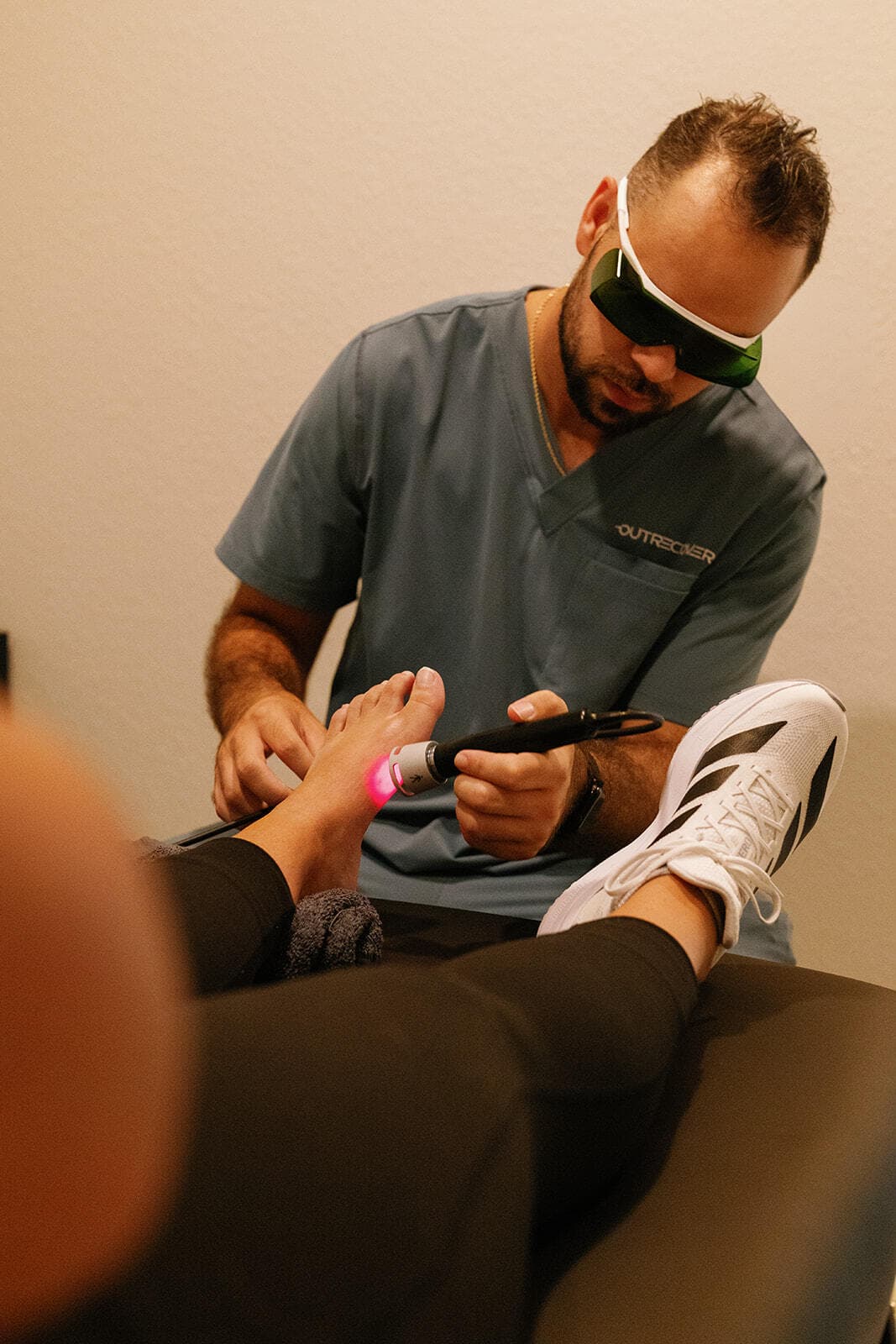
For low-level laser, a 2020 systematic review pooled four trials (119 people) and rated the evidence low to very low certainty, insufficient to support routine use. Those trials used low-level lasers. We did not find a review of Class IV laser for Achilles specifically, so there is no direct evidence either way for that device. For the wider laser picture, see our laser therapy guide.
When can you get back to running, tennis or pickleball?
When everyday life is nearly pain-free and the tendon tolerates the loading plan. There is no single agreed standard. A 2018 review of return-to-sport criteria found the lack of a clear definition and criteria hampers the decision, and that choices should be made individually.
One approach with trial support is a pain-monitoring model, used in the 2007 trial above, where people kept running and jumping while tracking their pain and the load on the tendon was not allowed to climb from week to week. The review adds that this decision should be individual and depends on symptom level. Morning pain and stiffness are the symptoms the AAOS lists first, so if they increase after a session, ask your clinician to adjust the plan.
Ask your physical therapist to set the order for returning to running, cutting and jumping. If your lower body takes a beating from pickleball, our pickleball injuries guide covers the rest of the legs. Heel pain on the bottom of the foot instead of the back? See plantar fasciitis.
Where do studio services fit?
After the loading plan, as an add-on, and only once a clinician has ruled out a tear. Strengthening is the foundation. The studio's services do not replace it, and they do not replace a doctor's or physical therapist's plan.
OutRecover's focused shockwave page lists tendonitis and overuse injuries among its uses and describes pulses you feel as a tapping sensation, with some tenderness. It is not recommended over open wounds, infections or tumors, and you should tell staff about any clotting disorder. The Class IV laser page lists tendinitis and sports injuries and describes gentle warmth. Neither has strong Achilles-specific evidence, as above. The research summary is on the shockwave science page.
If you want a plan, OutResolve is built for chronic tendon pain and lists Achilles tendinopathy among its uses; it pairs Class IV laser and/or shockwave with PEMF. OutPrime wraps oxygen, laser and shockwave around PRP, so consider it only if your doctor has already recommended PRP, and weigh the PRP trial results above.
What should you do this week?
Get the diagnosis confirmed, start a loading plan you can repeat, and add extras only with a clinician. In order:
- Rule out a tear: a pop, or being unable to rise on your toes, means see a doctor today.
- Get the type confirmed (middle or insertional), because the exercises differ.
- Start a loading program you can repeat: eccentric or heavy slow, at least twice a week.
- Swap one running or court session for cycling, the elliptical or swimming, as the AAOS suggests, while the tendon calms down.
- Do not take or accept a steroid injection into the tendon.
- If nothing has changed after about 12 weeks of steady work, ask about imaging and add-ons with a clinician.
Sources
- American Academy of Orthopaedic Surgeons. Achilles Tendinitis. OrthoInfo, updated 2024, peer reviewed 2025. https://orthoinfo.aaos.org/en/diseases--conditions/achilles-tendinitis/
- American Academy of Orthopaedic Surgeons. Achilles Tendon Rupture (Tear). OrthoInfo, read 2026. https://orthoinfo.aaos.org/en/diseases--conditions/achilles-tendon-rupture-tear/
- Chimenti RL, Neville C, Houck J, Cuddeford T, Carreira D, Martin RL. Achilles Pain, Stiffness, and Muscle Power Deficits: Midportion Achilles Tendinopathy Revision 2024. J Orthop Sports Phys Ther, 2024. https://www.orthopt.org/uploads/content_files/files/Achilles_Pain_revision_2024.pdf
- Martin RL, Chimenti R, Cuddeford T, et al. Achilles Pain, Stiffness, and Muscle Power Deficits: Midportion Achilles Tendinopathy Revision 2018. J Orthop Sports Phys Ther, 2018. https://pubmed.ncbi.nlm.nih.gov/29712543
- Habets B, van Cingel RE. Eccentric exercise training in chronic mid-portion Achilles tendinopathy: a systematic review on different protocols. Scand J Med Sci Sports, 2015. https://pubmed.ncbi.nlm.nih.gov/24650048
- Alfredson H, Pietilä T, Jonsson P, Lorentzon R. Heavy-load eccentric calf muscle training for the treatment of chronic Achilles tendinosis. Am J Sports Med, 1998. https://pubmed.ncbi.nlm.nih.gov/9617396
- Beyer R, Kongsgaard M, Hougs Kjær B, Øhlenschlæger T, Kjær M, Magnusson SP. Heavy Slow Resistance Versus Eccentric Training as Treatment for Achilles Tendinopathy: A Randomized Controlled Trial. Am J Sports Med, 2015. https://pubmed.ncbi.nlm.nih.gov/26018970
- Jonsson P, Alfredson H, Sunding K, Fahlström M, Cook J. New regimen for eccentric calf-muscle training in patients with chronic insertional Achilles tendinopathy: results of a pilot study. Br J Sports Med, 2008. https://pubmed.ncbi.nlm.nih.gov/18184750
- Silbernagel KG, Thomeé R, Eriksson BI, Karlsson J. Continued sports activity, using a pain-monitoring model, during rehabilitation in patients with Achilles tendinopathy: a randomized controlled study. Am J Sports Med, 2007. https://pubmed.ncbi.nlm.nih.gov/17307888
- Paantjens MA, Helmhout PH, Backx FJG, van Etten-Jamaludin FS, Bakker EWP. Extracorporeal Shockwave Therapy for Mid-portion and Insertional Achilles Tendinopathy: A Systematic Review of Randomized Controlled Trials. Sports Med Open, 2022. https://pmc.ncbi.nlm.nih.gov/articles/PMC9106789
- Charles R, Fang L, Zhu R, Wang J. The effectiveness of shockwave therapy on patellar tendinopathy, Achilles tendinopathy, and plantar fasciitis: a systematic review and meta-analysis. Front Immunol, 2023. https://pmc.ncbi.nlm.nih.gov/articles/PMC10468604
- Rompe JD, Furia J, Maffulli N. Eccentric loading compared with shock wave treatment for chronic insertional Achilles tendinopathy. A randomized, controlled trial. J Bone Joint Surg Am, 2008. https://pubmed.ncbi.nlm.nih.gov/18171957
- de Vos RJ, Weir A, van Schie HT, et al. Platelet-rich plasma injection for chronic Achilles tendinopathy: a randomized controlled trial. JAMA, 2010. https://pubmed.ncbi.nlm.nih.gov/20068208
- Kearney RS, Ji C, Warwick J, et al. Effect of Platelet-Rich Plasma Injection vs Sham Injection on Tendon Dysfunction in Patients With Chronic Midportion Achilles Tendinopathy: A Randomized Clinical Trial. JAMA, 2021. https://pubmed.ncbi.nlm.nih.gov/34255009
- Martimbianco ALC, Ferreira RES, Latorraca COC, Bussadori SK, Pacheco RL, Riera R. Photobiomodulation with low-level laser therapy for treating Achilles tendinopathy: a systematic review and meta-analysis. Clin Rehabil, 2020. https://pubmed.ncbi.nlm.nih.gov/32204620
- Habets B, van den Broek AG, Huisstede BMA, Backx FJG, van Cingel REH. Return to Sport in Athletes with Midportion Achilles Tendinopathy: A Qualitative Systematic Review Regarding Definitions and Criteria. Sports Med, 2018. https://pmc.ncbi.nlm.nih.gov/articles/PMC5808052
