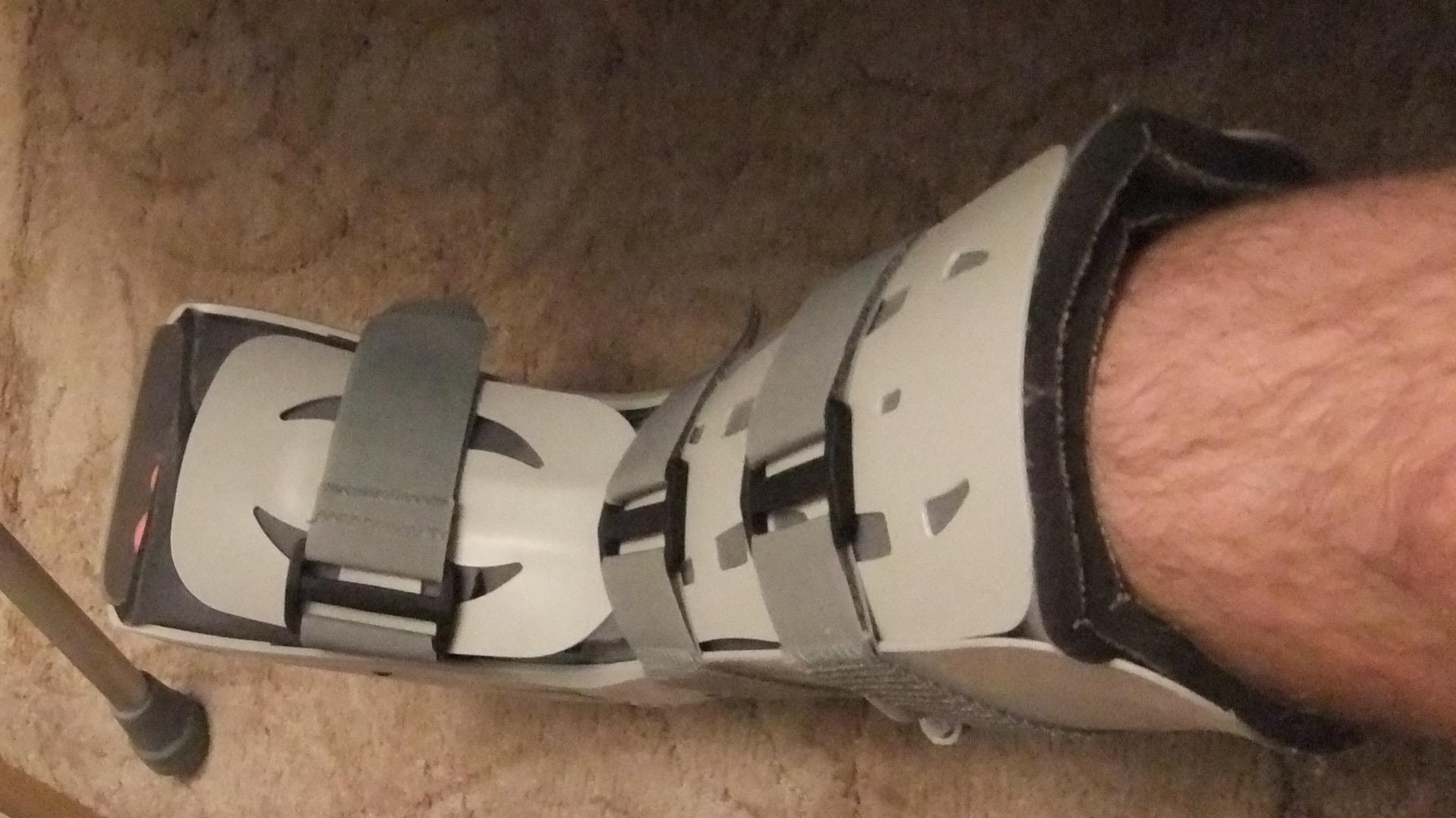
If you ruptured your Achilles tendon on a pickleball court, a tennis court or a run, you have two paths: surgical repair, or a structured rehab program with no operation. A large 2022 trial found similar results at 12 months either way, and the trade is small: surgery lowers the chance of a second tear, and also brings more wound and nerve problems. Either path is slow. Plan on a boot for roughly two to three months and a return to sport measured in many months.
Achilles rupture recovery: surgery or no surgery?
The best recent evidence says the choice is closer than most people expect. In the 2022 NEJM trial by Myhrvold and colleagues, 554 adults with an acute rupture were randomly assigned to nonoperative care, open repair or minimally invasive repair. At 12 months the change in the Achilles Total Rupture Score (a 0 to 100 patient-reported scale) was about the same in all three groups: a drop of 17.0 points without surgery, 16.0 after open repair and 14.7 after minimally invasive repair (P = 0.57). The authors concluded surgery was not associated with better outcomes at 12 months.
The differences sat elsewhere. In the same trial, rerupture happened in 6.2% of the nonoperative group and 0.6% of each surgical group. Nerve injury happened in 5.2% of the minimally invasive group, 2.8% of the open-repair group and 0.6% of the nonoperative group.
What do the meta-analyses add?
A 2019 BMJ meta-analysis of 29 studies found rerupture in 2.3% of surgical patients and 3.9% of nonoperative patients, a gap of 1.6 percentage points. Other complications ran 4.9% with surgery against 1.6% without, mostly infection (2.8% of surgical patients). When nonoperative care used accelerated rehab with early ankle movement, the rerupture difference was not statistically significant. The authors said the decision should rest on patient factors and shared decision making.
A 2025 meta-analysis tipped slightly toward surgery: lower rerupture and a higher return-to-sport rate, with more infection and nerve injury. An older RCT, Willits and colleagues in 2010, found no meaningful difference in strength or range of motion when both groups used early weight-bearing and motion. That trial ran 144 patients, so it is small by today's standards, and it is more than 15 years old.
Use this as a decision rule, then take it to your surgeon:
- If a second tear would end your season or your job, the lower rerupture rate after surgery counts for more.
- If you worry about infection, a scarred wound or nerve irritation, the nonoperative path avoids those.
- If you cannot commit to a supervised, step-by-step rehab, say so. The nonoperative results in the trials came from structured protocols.
- If you have diabetes, smoke or take medicines that affect healing, your surgeon weighs those first.
What does Achilles surgery recovery look like, stage by stage?
Protocols differ by surgeon, so treat this as a typical shape and ask for your own schedule. It draws on Hospital for Special Surgery and the American Academy of Orthopaedic Surgeons.
| Stage | What happens | Source's timing |
|---|---|---|
| Splint | Splint with the foot pointed down, crutches, leg raised. No weight on the foot. | Splint for 2 to 3 weeks until the first follow-up (HSS) |
| First visit | Incisions checked, stitches out, lighter removable boot fitted, physical therapy prescribed. | About 2 to 3 weeks (HSS) |
| Boot with heel wedges | Weight-bearing begins in the boot. Wedges come out a layer at a time, lowering the foot toward neutral. | Weight-bearing from about week 4; wedge changes weekly for 4 to 6 weeks (HSS) |
| Out of the boot | Back into regular sneakers. Range of motion work, then strengthening for push-off. | Usually 10 to 12 weeks (HSS); AAOS says to expect roughly 6 weeks of immobilization |
| Return to sport | Running, jumping and racquet sports. | About 6 to 9 months for all activities (HSS); about 12 months for complete recovery, up to 2 years for some (AAOS) |
The ranges are wide for a reason. Mayo Clinic says most people return to their former level of activity within 18 to 24 months of the injury, after either treatment. Cleared for a jog and back to match play are different milestones.
Nonoperative care follows a similar arc. HSS describes casting for 2 to 6 weeks, then a boot with heel lifts and 4 to 6 months of physical therapy. A 2014 trial of nonoperative care found that allowing full weight-bearing from day one gave the same 12-month results as six weeks without weight on the foot.
How likely is a rerupture, and what does it feel like?
Across the NEJM trial and the BMJ review, rerupture after surgery runs from under 1% to a couple of percent, and without surgery from about 4% to 6%, depending on the study and the rehab protocol. Those are averages from groups that were closely followed, not a forecast for you.
A rupture usually announces itself. Mayo describes a pop followed by sharp pain in the back of the ankle and lower leg, with walking made hard. If you feel that again in the boot or after it comes off, call your surgeon the same day.
What warning signs need a call to your surgeon?
Two problems matter most in the first weeks, and neither is rare enough to ignore.
Infection. AAOS lists infection among surgical risks, and the BMJ review found it was the main extra complication after surgery. MedlinePlus says most wound infections show up within 30 days and lists pus or drainage, a bad smell, fever or chills, heat, redness and pain. Call your surgeon if you see any of these.
Blood clot. AAOS names blood clots as a risk, and the BMJ review counted deep vein thrombosis in about 1% of surgical patients and 1.2% of nonoperative patients. MedlinePlus lists redness, warmth, swelling and pain or tenderness in the leg. The CDC says about half of people with a clot have no symptoms, and that a clot reaching the lungs can be life-threatening and needs help immediately. A swollen, sore calf in a boot is easy to blame on the injury, so mention any change to your surgeon. If you are weighing calf pain from the tear against a pulled muscle, calf strain recovery covers how the two differ and why a clot comes first on the checklist.
Will your calf be as strong as before?
Probably not fully, and nobody should promise otherwise. In Heikkinen and colleagues' 2017 follow-up of 52 patients about 14 years after surgery, calf muscle volumes were 11% to 13% lower on the repaired side and plantar flexion strength was 12% to 18% lower. Brorsson and colleagues' 2018 study of 66 patients (34 surgical, 32 nonsurgical) found calf endurance and strength deficits still present at 7 years, with little gain after year 2. Their patient-reported scores were high (median 96 of 100), which shows how well people adapt even with measurable weakness.
For a racquet or running athlete this matters most in push-off: the first step toward a drop shot, the last stride of a sprint. A 2025 narrative review of return-to-play after rupture reports rates of 70% to 90% after repair and 65% to 85% after nonoperative care, with most athletes in the nonoperative studies back at 8 to 12 months. It also notes that performance often dips even among those who return. Ask your physical therapist for a single-leg heel-raise test, compared side to side, before you clear yourself for sport.
Where studio services fit after surgeon clearance
Your surgeon and physical therapist run the plan: the boot schedule, the wedges, the loading. Studio services sit beside it, and only once your surgeon says so. The honest evidence picture is thin. A search of PubMed and PMC for this guide turned up no randomized trial of hyperbaric oxygen, red light or compression boots for recovery after Achilles repair, so none of them is a proven way to speed healing, shrink the strength deficit or lower rerupture risk.
What a studio can offer is structure and comfort in the long middle of recovery. OutRecover's OutHeal is its signature pre- and post-surgery program, and its page lists tendon repairs among the procedures it is built for, with sessions scheduled around your surgery date and your surgeon's clearance. OutRepair is a shorter five-visit plan, written for minor and minimally invasive procedures, so it fits a smaller procedure better than a full open repair. Both include hyperbaric oxygen and red light therapy; the research summaries are at the science page for hyperbaric oxygen and the science page for red light, including where the evidence runs out. Compression is part of OutHeal. Given the clot risk above, ask your surgeon before putting compression on a leg that is swollen or sore. For swelling questions in general, see how to reduce swelling after surgery.
Your next step
Before your surgeon visit, write down three questions: how many weeks in the boot and when weight-bearing starts, which warning signs to call about, and what test you must pass before running or playing. If you are still in the stage of working out whether this is a rupture at all, a tendon that is sore but intact calls for different care, covered in Achilles tendinitis treatment. If you are cleared for added support and want to see where OutRecover fits, bring your surgeon's note and call the studio.
Sources
- Myhrvold SB, Brouwer EF, Andresen TKM, et al. Nonoperative or Surgical Treatment of Acute Achilles' Tendon Rupture. New England Journal of Medicine, 2022. https://pubmed.ncbi.nlm.nih.gov/35417636
- Ochen Y, Beks RB, van Heijl M, et al. Operative treatment versus nonoperative treatment of Achilles tendon ruptures: systematic review and meta-analysis. BMJ, 2019. https://www.bmj.com/content/364/bmj.k5120
- Yang Z, Ge Z, Zheng J, Zhang L, Yang Z. Surgical treatment versus conservative management for acute Achilles tendon rupture: a systematic review and meta-analysis. Journal of Orthopaedic Surgery and Research, 2025. https://pmc.ncbi.nlm.nih.gov/articles/PMC12235936
- Willits K, Amendola A, Bryant D, et al. Operative versus nonoperative treatment of acute Achilles tendon ruptures: a multicenter randomized trial using accelerated functional rehabilitation. Journal of Bone and Joint Surgery, 2010. https://pubmed.ncbi.nlm.nih.gov/21037028
- Barfod KW, Bencke J, Lauridsen HB, et al. Nonoperative dynamic treatment of acute Achilles tendon rupture: the influence of early weight-bearing on clinical outcome. Journal of Bone and Joint Surgery, 2014. https://pubmed.ncbi.nlm.nih.gov/25232073
- Hospital for Special Surgery. Achilles Tendon Rupture: Symptoms, Treatment, Recovery. HSS Health Library. https://www.hss.edu/health-library/conditions-and-treatments/achilles-tendon-rupture
- American Academy of Orthopaedic Surgeons. Achilles Tendon Rupture (Tear). OrthoInfo. https://orthoinfo.aaos.org/en/diseases--conditions/achilles-tendon-rupture-tear
- Mayo Clinic. Achilles tendon rupture: diagnosis and treatment. https://www.mayoclinic.org/diseases-conditions/achilles-tendon-rupture/diagnosis-treatment/drc-20353239
- MedlinePlus. Surgical wound infection - treatment. National Library of Medicine. https://medlineplus.gov/ency/article/007645.htm
- MedlinePlus. Deep vein thrombosis. National Library of Medicine. https://medlineplus.gov/ency/article/000156.htm
- Centers for Disease Control and Prevention. About Venous Thromboembolism (Blood Clots). https://www.cdc.gov/blood-clots/about/index.html
- Heikkinen J, Lantto I, Piilonen J, et al. Tendon Length, Calf Muscle Atrophy, and Strength Deficit After Acute Achilles Tendon Rupture: Long-Term Follow-up. Journal of Bone and Joint Surgery, 2017. https://pubmed.ncbi.nlm.nih.gov/28926379
- Brorsson A, Grävare Silbernagel K, Olsson N, Nilsson Helander K. Calf Muscle Performance Deficits Remain 7 Years After an Achilles Tendon Rupture. American Journal of Sports Medicine, 2018. https://pubmed.ncbi.nlm.nih.gov/29068725
- Fada L, Mazzorana A, Grand ZA, Jacobs G. Return to Play After Achilles Tendon Rupture: Comparing Operative and Nonoperative Approaches in Athletes. Cureus, 2025. https://pmc.ncbi.nlm.nih.gov/articles/PMC12701767
