Most sciatica gets better on its own. The American Academy of Orthopaedic Surgeons says 80 to 90% of people improve without surgery, typically within several weeks when a herniated disc is the cause. What helps in the meantime is mostly unglamorous: staying active, heat, and exercise. What the evidence does not support is just as useful to know, because several common treatments for sciatica, including popular nerve-pain pills, have trial results that look like placebo. This guide covers what to do first, the signs that mean you should not wait, and an honest read on where recovery-studio therapies fit.
What causes sciatic nerve pain?
Sciatica is pain from a squeezed or irritated nerve root in the lower spine, felt along the path of the sciatic nerve from the buttock down the back of the leg. The cause is usually a herniated disc or a bony overgrowth pressing on the nerve root, and more rarely a tumor (Mayo Clinic). The AAOS stresses that sciatica is a description of nerve pain and never a diagnosis in itself; the diagnosis is the thing pressing on the nerve. In many cases, no cause is found (MedlinePlus).
What it feels like, according to Mayo Clinic: pain from a mild ache to a sharp, burning jolt, usually on one side, often worse with coughing, sneezing or long sitting. Some people also have numbness, tingling or weakness in the leg or foot. Doctors call a pinched root in the lumbar spine lumbar radiculopathy, and you will see that word in the research below.
How long does sciatica last?
For a herniated disc, expect weeks to a few months. The AAOS puts it at several weeks for most people, and Mayo Clinic says disc-related sciatica can clear up in a few weeks to months. Cleveland Clinic says it often does not last longer than six weeks. If the cause is bone spurs or spinal stenosis, the AAOS says treatment without surgery works less often, though improvement is still likely.
Call your primary care clinician if self-care has not eased things, or if the pain lasts longer than a week, is severe, or is getting worse (Mayo Clinic). Pain that disables you after three months or more of non-surgical care is the point where the AAOS says surgery can come up.
When is sciatica an emergency?
Go to an emergency room the same day for sciatica with new loss of bladder or bowel control, difficulty urinating, numbness in the groin, genital or buttock area, or leg weakness that is getting worse. These can signal cauda equina syndrome, a compressed bundle of nerve roots at the base of the spine. Cleveland Clinic calls it a medical emergency, and says quick surgical treatment may prevent permanent complications.
Check yourself against this list:
- Numbness or odd sensation between the legs, around the back passage or genitals (Worcestershire Acute Hospitals NHS Trust leaflet, undated)
- Trouble starting to urinate, not being able to stop, or not feeling when you pass urine
- New bowel changes, or loss of control
- Weakness in one or both legs that is spreading or worsening
- Leg or back pain that is severe and escalating, with any of the above
Mayo Clinic adds that serious leg weakness or bowel or bladder changes are what can lead to surgery in severe sciatica. Cauda equina is rare. Back and leg pain alone, with none of these signs, is the usual picture.
What is the best sciatica treatment to start with?
Keep moving, within what your pain allows. A Cochrane review of 11 trials found that for people with sciatica advice to rest in bed made little or no difference compared with advice to stay active, and for acute low back pain, bed rest was slightly worse (Hagen, 2004, so an older review). Mayo Clinic agrees: resting for a day or so may help, but staying inactive makes symptoms worse.
A first-line plan, in the order most guidelines point:
- Stay active. NICE's guideline on low back pain and sciatica tells clinicians to encourage continuing normal activities (NG59, 2016, amended 2020; the page shows changes as recently as July 2026).
- Use heat. The American College of Physicians' 2017 guideline recommends superficial heat for acute and subacute low back pain, on moderate-quality evidence. That guideline covers back pain broadly and was not written for sciatica alone. Cleveland Clinic suggests ice in the first few days, then heat, 20 minutes at a time.
- Exercise and physical therapy. NICE says to consider a group exercise program for a flare-up of low back pain with or without sciatica. For sciatica on its own, a 2023 review of physiotherapy trials found the evidence inadequate to recommend any one intervention, because the trials were mixed and mostly high risk of bias. Read that as "no specific technique is proven," not "exercise does not work." A physical therapist can tailor it to your leg symptoms.
Do medicines give sciatica pain relief?
Less than most people expect. The evidence on common drugs for sciatica is weak, and in some cases points to harm. This is about what trials show. It is not dosing advice; ask your clinician before starting, changing or stopping any medicine.
| Medicine type | What the evidence says |
|---|---|
| Anti-inflammatory pills (NSAIDs) | A 2017 Cochrane review of 10 trials found very low-quality evidence that they relieve sciatica pain no better than placebo, low-quality evidence of better overall improvement, and more side effects (Rasmussen-Barr, 2017) |
| Pregabalin | A 2017 New England Journal of Medicine trial found no significant reduction in leg pain versus placebo over 8 weeks, with more side effects |
| Gabapentin and pregabalin together | A 2021 review of 8 trials (747 people) concluded there was a lack of effectiveness for sciatica |
NICE goes further: it says not to offer gabapentinoids, other antiepileptics, oral corticosteroids or benzodiazepines for sciatica, because there is no overall evidence of benefit and there is evidence of harm. It also says to be aware of the risk of harm and limited evidence of benefit from NSAIDs in sciatica, and not to offer opioids for chronic sciatica. If you already take one of these, do not stop on your own; NICE recommends a clinician-led conversation about the risks and about withdrawal.
When do injections or surgery come up?
When pain is severe early on, or when it will not settle. NICE says to consider an epidural steroid injection for acute and severe sciatica and spinal decompression surgery when non-surgical care has not helped and imaging matches your symptoms. A 2024 meta-analysis found epidural steroids gave short- and medium-term pain relief, with limited long-term effect. A 2021 meta-analysis rated the evidence low to moderate quality, with benefits that did not reach a clinically important threshold (Verheijen, 2021).
Surgery follows a similar pattern. A systematic review found that early surgery for sciatica of 6 to 12 weeks gave faster pain relief, with no difference after one and two years (Jacobs, 2011). A 2026 meta-analysis reports the same shape: surgery is better at 6 to 8 weeks, a small gap remains at 6 months, and by 12 months no important difference in acute sciatica. For persistent leg pain, the AAOS says surgery is usually very successful when most of the pain is in the leg. The choice is about how much you can tolerate and how long you can wait, so it is a conversation to have with a spine surgeon.
How should you sit, drive and sleep with sciatica?
Change position often and use pillows for support. The sources agree on principles more than on car-specific rules.
- Sitting and driving: break up long periods in one position. Mayo Clinic notes that sciatica can be worse with long sitting, and Cambridge University Hospitals advises regular breaks and changing position regularly. On a longer drive around Southwest Florida, that means stopping to walk, not powering through.
- Sleeping on your side: Cleveland Clinic's physical therapist suggests a pillow between your knees to align the hips and take pressure off the pelvis.
- Sleeping on your back: a pillow under your knees keeps the lower back from arching too much (Cleveland Clinic).
- Stomach sleeping: usually best avoided, though for a few people arching the back brings relief. Use whatever position feels best.
- Check the cause: a rounded, curled-up position can help when spinal stenosis is the cause and may hurt if it is not, so adjust to what your body tells you.
Where do PEMF, Class IV laser, red light and H-Wave fit in sciatica treatment?
As comfort-focused add-ons with unproven sciatica benefit. We looked for trials in sciatica or radicular pain and found the evidence thin, so here it is therapy by therapy.
| Therapy | What the research shows | How strong |
|---|---|---|
| Class IV laser | A 2025 review of 18 trials (1,095 people, 12 of them lumbar) on high-intensity laser in spinal radiculopathy found less pain and disability than placebo, especially combined with physical therapy | Low to very low certainty (de la Barra Ortiz, 2025) |
| PEMF | The reviews study low back pain in general, without a sciatica group. A 2022 review of 14 trials found less pain in chronic low back pain, no clear benefit in acute, and no improvement in function (Sun, 2022). A 2023 review of 9 trials (420 people) called it safe and beneficial, particularly added to conventional physical therapy (Kull, 2023) | Back pain only; none we found tested sciatica |
| Red light | A 2020 review of 12 trials found photobiomodulation (laser and LED light) had a clinically unimportant effect on non-specific low back pain, and the evidence did not support its use (Tomazoni, 2020) | Not shown for sciatica |
| H-Wave | A 2021 critical review rated the studies low to moderate quality, Level of Evidence III, and its authors are consultants for the device's maker (Williamson, 2021). We found no sciatica-specific trial | Weak |
Two cautions apply. First, the laser review pooled devices and doses that vary widely, so a given studio's laser may not match what was tested. Second, NICE advises against TENS, PENS and interferential therapy for low back pain with or without sciatica. H-Wave is marketed as different from TENS, but NICE does not address it by name, and we found no sciatica trial for it. Our laser therapy guide, PEMF guide and red light guide cover each in more depth, and the science page on spine and nerve health lists the research OutRecover summarizes.
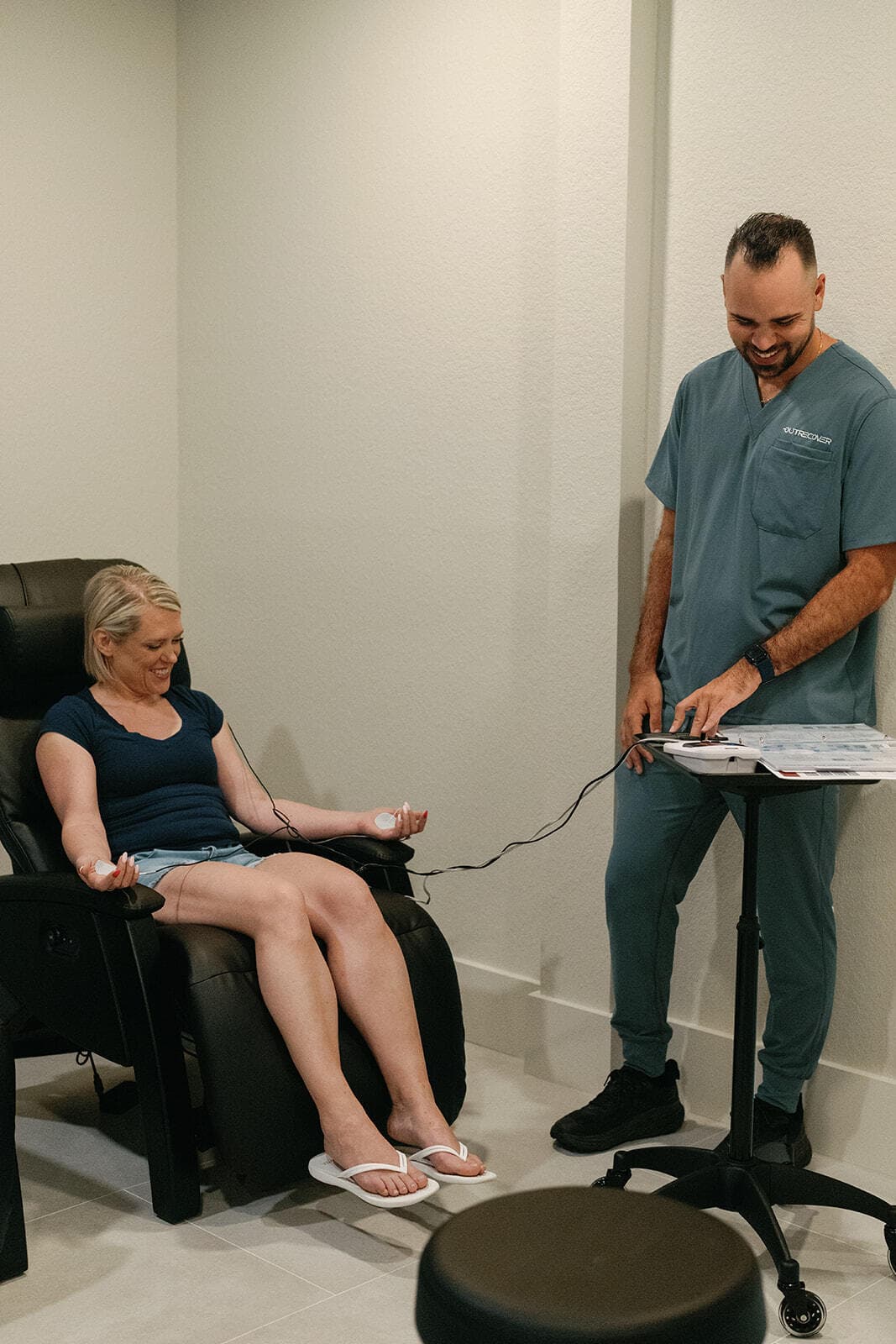
At OutRecover in North Naples, these four therapies sit inside back-pain packages, and there is no sciatica package. OutReset is built for sudden back pain and spasms and includes all four in one visit. OutRelief is for lower back and neck pain that makes everyday life harder, and OutMove is for back stiffness. If you have a pacemaker or other implanted electronic device, tell the staff first, since H-Wave is not suitable. And if you are a golfer with a sore back, see our golf back pain guide.
What to do this week
- Check the emergency list above. If any item fits, go to an emergency room now.
- If the pain is severe, spreading, or has lasted more than a week, book a visit with your primary care clinician or a physical therapist.
- Keep moving, use heat, and set up your sleeping position.
- If you want recovery-studio therapies as a comfort add-on, tell your clinician first and ask what they would want to rule out. Wellness services are not a substitute for a clinician's plan.
Sources
- American Academy of Orthopaedic Surgeons. Sciatica. OrthoInfo. https://orthoinfo.aaos.org/en/diseases--conditions/sciatica/
- Mayo Clinic. Sciatica: Symptoms and causes. https://www.mayoclinic.org/diseases-conditions/sciatica/symptoms-causes/syc-20377435
- Mayo Clinic. Sciatica: Diagnosis and treatment. https://www.mayoclinic.org/diseases-conditions/sciatica/diagnosis-treatment/drc-20377441
- MedlinePlus (National Library of Medicine). Sciatica. https://medlineplus.gov/sciatica.html
- Cleveland Clinic. Sciatica. https://my.clevelandclinic.org/health/diseases/12792-sciatica
- Cleveland Clinic. Cauda Equina Syndrome. Last updated 2024. https://my.clevelandclinic.org/health/diseases/22132-cauda-equina-syndrome
- Worcestershire Acute Hospitals NHS Trust. Cauda Equina Syndrome (patient leaflet), undated. https://www.worcsacute.nhs.uk/leaflets/cauda-equina-syndrome
- National Institute for Health and Care Excellence. Low back pain and sciatica in over 16s: assessment and management (NG59), 2016, amended 2020. https://www.nice.org.uk/guidance/ng59/chapter/Recommendations
- Qaseem A, et al. Noninvasive Treatments for Acute, Subacute, and Chronic Low Back Pain: A Clinical Practice Guideline From the American College of Physicians. Annals of Internal Medicine, 2017. https://pubmed.ncbi.nlm.nih.gov/28192789/
- Hagen KB, et al. Bed rest for acute low-back pain and sciatica. Cochrane Database of Systematic Reviews, 2004. https://pubmed.ncbi.nlm.nih.gov/15495012
- Dove L, et al. How effective are physiotherapy interventions in treating people with sciatica? A systematic review and meta-analysis. European Spine Journal, 2023. https://pmc.ncbi.nlm.nih.gov/articles/PMC9925551
- Rasmussen-Barr E, et al. Nonsteroidal Anti-inflammatory Drugs for Sciatica: An Updated Cochrane Review. Spine, 2017. https://pubmed.ncbi.nlm.nih.gov/28399072
- Mathieson S, et al. Trial of Pregabalin for Acute and Chronic Sciatica. New England Journal of Medicine, 2017. https://pubmed.ncbi.nlm.nih.gov/28328324
- Giménez-Campos MS, et al. A systematic review and meta-analysis of the effectiveness and adverse events of gabapentin and pregabalin for sciatica pain. Atención Primaria, 2021. https://pubmed.ncbi.nlm.nih.gov/34637958
- Zhang J, et al. Efficacy of epidural steroid injection in the treatment of sciatica secondary to lumbar disc herniation: a systematic review and meta-analysis. Frontiers in Neurology, 2024. https://pubmed.ncbi.nlm.nih.gov/38841695
- Verheijen EJA, et al. Epidural steroid compared to placebo injection in sciatica: a systematic review and meta-analysis. European Spine Journal, 2021. https://pubmed.ncbi.nlm.nih.gov/33974132
- Jacobs WCH, et al. Surgery versus conservative management of sciatica due to a lumbar herniated disc: a systematic review. European Spine Journal, 2011. https://pubmed.ncbi.nlm.nih.gov/20949289
- Ambaliya S, et al. A systematic review and meta-analysis on surgery for lumbar disc herniation: optimal timing of surgery, return to work and outcomes compared with conservative management. Brain and Spine, 2026. https://pmc.ncbi.nlm.nih.gov/articles/PMC12908051
- Cambridge University Hospitals NHS Foundation Trust. Back pain (patient information). https://www.cuh.nhs.uk/patient-information/back-pain
- Cleveland Clinic. How To Sleep With Sciatica: 8 Tips. https://health.clevelandclinic.org/how-to-get-better-sleep-with-sciatica-pain
- de la Barra Ortiz HA, et al. Effectiveness of high-intensity laser therapy in patients with spinal radiculopathy: a systematic review with meta-analysis. Lasers in Medical Science, 2025. https://pubmed.ncbi.nlm.nih.gov/40719876
- Sun X, et al. Efficacy of pulsed electromagnetic field on pain and physical function in patients with low back pain: a systematic review and meta-analysis. Clinical Rehabilitation, 2022. https://pubmed.ncbi.nlm.nih.gov/35077249
- Kull P, et al. Efficacy of pulsed electromagnetic field therapy on pain and physical function in patients with non-specific low back pain: a systematic review. Wiener Medizinische Wochenschrift, 2023. https://pubmed.ncbi.nlm.nih.gov/37999784
- Tomazoni SS, et al. Photobiomodulation therapy does not decrease pain and disability in people with non-specific low back pain: a systematic review. Journal of Physiotherapy, 2020. https://pubmed.ncbi.nlm.nih.gov/32680739
- Williamson TK, et al. H-Wave Device Stimulation: A Critical Review. Journal of Personalized Medicine, 2021. https://pmc.ncbi.nlm.nih.gov/articles/PMC8619115
