Two different operations share the name meniscus surgery, and their recoveries have little in common. After a partial meniscectomy, where the surgeon trims the torn edge away, most people are back on the leg within days and back to most activities in a few weeks. After a meniscus repair, where the surgeon stitches the tear closed, you protect the stitches for months. Find out which one you had, because every date in your plan follows from that answer.
How long does meniscus surgery recovery take?
A trim takes about 3 to 6 weeks of rehabilitation and a repair about 3 to 6 months, according to the American Academy of Orthopaedic Surgeons, 2026. The gap exists because of blood supply. The outer third of the meniscus has a rich one, so a tear there may heal and can often be repaired. The inner two-thirds has little, so those tears cannot knit back together and are usually trimmed.
| Trim (partial meniscectomy) | Repair (stitches) | |
|---|---|---|
| Rehabilitation | About 3 to 6 weeks (AAOS, 2026) | About 3 to 6 months (AAOS, 2026) |
| Weight on the leg | Often right away, sometimes crutches for the first week (HSS, 2026) | Set by your surgeon; protocols vary |
| Driving | Once off narcotic pain medicine, typically 1 to 3 days (HSS, 2026) | 1 to 2 weeks for a left knee, 2 to 3 weeks for a right (HSS, 2026) |
| Back to sports | 4 to 8 weeks | 6 to 9 months, up to nine for competitive athletes |
The Hospital for Special Surgery (HSS) gives the sports figures in the last row. Its repair estimate runs longer than the AAOS rehabilitation range, so expect a spread and let your surgeon set your dates.
What happens week by week after a trim?
Expect a short, steady climb. Swelling and soreness peak in the first days, you ice and prop the leg up, and you build motion and strength back over a few weeks. A British Medical Journal (BMJ) guideline puts full recovery from knee arthroscopy at two to six weeks, with pain, swelling and limited function along the way (Siemieniuk, 2017).
| When | What to expect |
|---|---|
| First 2 to 3 days | Ice 4 to 6 times a day, leg propped on pillows, elastic bandage and dressing kept on and dry until your surgeon says otherwise (MedlinePlus, 2026) |
| First week | Crutches are common; your surgeon decides when to put weight on the leg (AAOS, 2026). HSS says many people can bear full weight at once |
| Weeks 1 to 3 | Driving usually returns within 1 to 3 weeks after a minor procedure; motion and strengthening exercises begin (AAOS, 2026) |
| Weeks 4 to 8 | Most people resume normal sports (HSS, 2026); higher-impact activity may wait longer |
What happens month by month after a repair?
Repair recovery runs in months because stitched tissue needs time to hold. Weight bearing and bending limits are the part that varies most, and your surgeon sets them for your tear and your repair. One published protocol shows the general shape. It is an example, so follow your own surgeon's orders.
| When | What to expect |
|---|---|
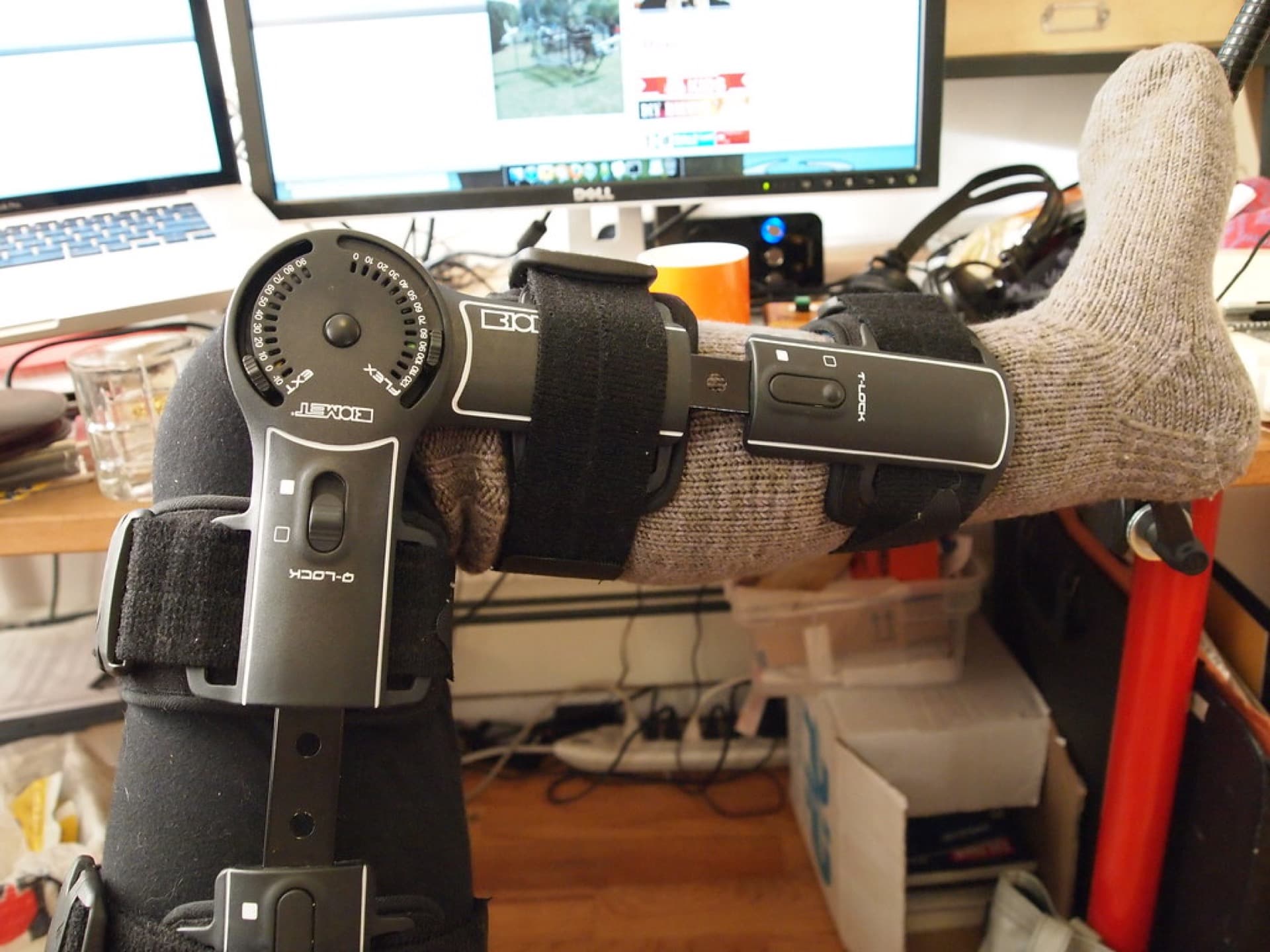
| Weeks 0 to 6 | Non-weight-bearing or partial weight bearing at the surgeon's call, hinged brace limiting bend to 0 to 90 degrees, thigh-muscle activation exercises |
| Weeks 7 to 8 | Weight bearing and motion as tolerated, strengthening begins |
| Months 3 to 6 | Rehabilitation continues; the AAOS range for a repair ends here (AAOS, 2026) |
| Months 6 to 9 | Return to full activity; competitive athletes may need the full nine (HSS, 2026) |
The first two rows come from a single center's published protocol, 2024. Others allow more. A review of weight-bearing after repair, 2015 found good results in 70% to 94% of people on restricted protocols and 64% to 96% on accelerated ones with immediate full weight bearing, and judged the outcomes similar. It also said the studies used inconsistent criteria, so a direct comparison is hard. Do not measure your plan against a friend's.
Repair keeps your own tissue, and the price is a longer recovery. A Swedish cohort of people aged 15 to 40, operated on between 2010 and 2014, found a four-fold higher rate of any later knee operation after repair than after a trim (Boric-Persson, 2025).
Do you need meniscus surgery at all?
For degenerative tears in middle-aged adults, often not. Several trials found that supervised exercise does about as well as trimming, and one found that a trim did no better than a sham operation. That evidence is about the decision to operate. If you have already had surgery, it does not change your plan, and rehabilitation exercise stays part of it either way (AAOS, 2026).
| Trial | Who | What it found |
|---|---|---|
| FIDELITY (2013) | 146 people aged 35 to 65, degenerative medial tear, no knee arthritis | A trim was no better than sham surgery at 12 months. At five years, patient-reported outcomes still did not differ in any relevant way (2020) |
| ESCAPE (2018) | 321 people aged 45 to 70 | Exercise-based physical therapy was noninferior to a trim for knee function at 24 months, and still was at five years (2022) |
| MeTeOR (2013) | 351 people aged 45 and over, tear plus mild to moderate arthritis | Similar improvement at 6 and 12 months; 30% assigned to therapy alone had surgery by month 6 |
The BMJ's 2017 guideline panel made a strong recommendation against arthroscopy for nearly all degenerative knee disease, citing harm and no important lasting benefit (Siemieniuk, 2017).
Read these results exactly. Noninferior still allows a small gap: in ESCAPE at five years, the surgery group improved 29.6 points and the therapy group 25.1, a gap smaller than the trial's 11-point margin. About 21% of the therapy group (32 of 153) still had surgery within six months, and the researchers could not predict who (Noorduyn, 2022). The trials studied degenerative tears. A knee that locks is a different question: the BMJ panel lists whether people who cannot fully straighten the knee benefit as unanswered. If arthritis sits alongside your tear, see our guide to knee osteoarthritis treatment.
Which warning signs mean you should call your surgeon?
Serious problems are uncommon. In a national surgical database, 30-day complication rates were under 1% for both repair and trim (Lai, 2023). Call your surgeon, the same day, if you have any of these (MedlinePlus, 2026, Cleveland Clinic, 2026):
- Blood soaking through the dressing that does not stop with pressure
- Pain that does not ease with your pain medicine, or gets worse
- Swelling or pain in the calf, which can signal a blood clot
- A foot or toes that look darker than normal or feel cool
- Redness, pain, swelling or yellowish drainage at an incision
- A temperature above 101°F (38.3°C)
What should you ask your surgeon?
Bring these to your next visit and write the answers down:
- Did I have a trim or a repair, and which part of the meniscus?
- How much weight can I put on the leg, and until what date?
- Do I need crutches or a brace, and how far can I bend the knee?
- When does physical therapy start?
- When can I drive, and when can I go back to work and sport?
- Which milestones tell you I am ready for the next step?
- May I add any new recovery service, and from what date?
Where do studio services fit after surgeon clearance?
Evidence for recovery-studio therapies after meniscus surgery specifically is limited, and we cannot tell you any of them shortens it. What follows is what exists. Start nothing new without your surgeon's clearance.
Blood flow restriction (BFR). Light exercise with cuffs that limit blood flow can build muscle without heavy loads. A small randomized pilot after knee arthroscopy (17 people finished) found about twice the strength gain with BFR added to therapy and no adverse events, and screened for clots by ultrasound (Tennent, 2017). A larger sham-controlled trial after ACL reconstruction (48 athletes) found BFR no more effective than standard rehabilitation (Erickson, 2025). Mixed evidence, so ask your surgeon first. See KAATSU blood flow restriction and the research summary.
Red light, PEMF, hyperbaric oxygen and compression. The post-surgery trials we found for these were in knee replacement, with none in meniscus surgery. One example: a nonblinded trial of 30 knee-replacement patients found red-light therapy reduced swelling (Chia, 2025). Treat them as supportive sessions around your rehabilitation, which they cannot replace. For swelling basics, read how to reduce swelling after surgery. Service pages: red light, PEMF, hyperbaric oxygen, compression.
Packages. OutRepair is the best fit: its own page lists knee arthroscopy under who it is for, and it combines hyperbaric oxygen, red light (swappable for PEMF) and an IV that needs medical approval. If swelling is your main problem once cleared, OutRestore is built for it, and OutFlow suits post-op swelling when compression is not allowed. Each page says sessions after surgery follow your surgeon's clearance.
Your next step
Before your next appointment, find out whether you had a trim or a repair and get your weight-bearing and bending dates in writing. Once your surgeon clears you, tell the studio your surgery type and date so sessions can be scheduled around them.
Sources
- American Academy of Orthopaedic Surgeons. Meniscus Tears. OrthoInfo, accessed 2026. https://orthoinfo.aaos.org/en/diseases--conditions/meniscus-tears/
- American Academy of Orthopaedic Surgeons. Knee Arthroscopy. OrthoInfo, accessed 2026. https://orthoinfo.aaos.org/en/treatment/knee-arthroscopy/
- Hospital for Special Surgery. Meniscus Surgery: Meniscectomy and Meniscus Repair. HSS Health Library, accessed 2026. https://www.hss.edu/health-library/conditions-and-treatments/meniscus-surgery-meniscectomy
- National Library of Medicine. Knee arthroscopy - discharge. MedlinePlus, accessed 2026. https://medlineplus.gov/ency/patientinstructions/000199.htm
- Cleveland Clinic. Knee Arthroscopy (Knee Scope): What It Is and Recovery. Accessed 2026. https://my.clevelandclinic.org/health/treatments/17153-knee-arthroscopy
- Sihvonen R, et al. Arthroscopic partial meniscectomy versus sham surgery for a degenerative meniscal tear (FIDELITY). N Engl J Med, 2013. https://pubmed.ncbi.nlm.nih.gov/24369076
- Sihvonen R, et al. Arthroscopic partial meniscectomy for a degenerative meniscus tear: a 5 year follow-up of the FIDELITY trial. Br J Sports Med, 2020. https://pubmed.ncbi.nlm.nih.gov/32855201
- van de Graaf VA, et al. Effect of early surgery vs physical therapy on knee function among patients with nonobstructive meniscal tears (ESCAPE). JAMA, 2018. https://pubmed.ncbi.nlm.nih.gov/30285177
- Noorduyn JCA, et al. Effect of physical therapy vs arthroscopic partial meniscectomy in people with degenerative meniscal tears: five-year follow-up of the ESCAPE trial. JAMA Netw Open, 2022. https://pubmed.ncbi.nlm.nih.gov/35802374
- Noorduyn JCA, et al. In patients eligible for meniscal surgery who first receive physical therapy, multivariable prognostic models cannot predict who will eventually undergo surgery. Knee Surg Sports Traumatol Arthrosc, 2022. https://pubmed.ncbi.nlm.nih.gov/33550450
- Katz JN, et al. Surgery versus physical therapy for a meniscal tear and osteoarthritis (MeTeOR). N Engl J Med, 2013. https://pubmed.ncbi.nlm.nih.gov/23506518
- Siemieniuk RAC, et al. Arthroscopic surgery for degenerative knee arthritis and meniscal tears: a clinical practice guideline. BMJ, 2017. https://www.bmj.com/content/357/bmj.j1982
- VanderHave KL, Perkins C, Le M. Weightbearing versus nonweightbearing after meniscus repair. Sports Health, 2015. https://pubmed.ncbi.nlm.nih.gov/26502413
- Yamanashi Y, et al. Blood flow restriction training for meniscus repair surgery. Video J Sports Med, 2024. https://pubmed.ncbi.nlm.nih.gov/40308986
- Boric-Persson F, et al. Increased reoperation rates after meniscus repair compared to arthroscopic partial meniscectomy. Knee Surg Sports Traumatol Arthrosc, 2025. https://pubmed.ncbi.nlm.nih.gov/40686041
- Lai WC, et al. Low early complication rates after arthroscopic meniscus repair and meniscectomy. Knee Surg Sports Traumatol Arthrosc, 2023. https://pubmed.ncbi.nlm.nih.gov/37449988
- Tennent DJ, et al. Blood flow restriction training after knee arthroscopy: a randomized controlled pilot study. Clin J Sport Med, 2017. https://pubmed.ncbi.nlm.nih.gov/27749358
- Erickson LN, et al. The efficacy of blood flow restriction training to improve quadriceps muscle function after ACL reconstruction. Med Sci Sports Exerc, 2025. https://pubmed.ncbi.nlm.nih.gov/39350350
- Chia WT, et al. The impact of photobiomodulation therapy on swelling reduction and recovery enhancement in total knee arthroplasty: a randomized clinical trial. Photobiomodul Photomed Laser Surg, 2025. https://pubmed.ncbi.nlm.nih.gov/39786308
