Liposuction recovery is mostly a swelling story. Bruising fades within about ten days, most swelling settles over two to three weeks, and the last of it can take months, so the shape you see in week one is not the shape you will have later. What helps most is plain: a well-fitted compression garment, short walks, and your surgeon's instructions followed closely. Below is a stage-by-stage timeline, the warning signs that need a call or a 911, and an honest look at lymphatic massage and where a recovery studio fits.
What does liposuction recovery look like, week by week?
The American Society of Plastic Surgeons (ASPS) gives a four-stage timeline, and the Aesthetic Society adds detail on swelling. The two agree on the shape: rough first week, better by week three, and a long tail of improving swelling. Your own timeline depends on how many areas were treated and how much fat was removed, and your surgeon's plan comes first.
| When | What the sources describe |
|---|---|
| First 48 hours | Swelling and bruising build. The Aesthetic Society says swelling peaks around 48 hours. |
| Week 1 | ASPS says to monitor pain, swelling and bruising and to limit activity significantly. A plastic surgeon's review (2013) notes swelling is soft and mildly tender and can keep increasing through days 10 to 14. |
| Weeks 2 to 3 | You start to feel much better and may return to work, depending on your job. Exercise stays limited. The Aesthetic Society says most swelling disappears within two to three weeks. |
| Weeks 4 to 5 | Bruising should be gone and swelling should start to subside, per ASPS. |
| Week 6 and beyond | Continued improvement. ASPS says you may gradually increase activity and add gentle exercise. The Aesthetic Society says strenuous exercise waits four to six weeks. |
Bruising "typically disappears within seven to ten days," according to the Aesthetic Society, while ASPS's table is more conservative and puts it by weeks 4 to 5. Sutures, if placed, usually come out seven to ten days after surgery.
How long do you wear a compression garment, and does it help?
Garment timelines differ by source and by surgeon: the Aesthetic Society says four to six weeks, an ASPS blog on liposuction says continue until week four or as directed, and an ASPS page on compression says day and night for one to three weeks, then nights only after your surgeon approves. Wear it exactly as your surgeon tells you.
ASPS says a garment limits fluid build-up under the skin and encourages the body to reabsorb it. The research behind that is thinner than the advice. A 2024 systematic review of liposuction for lipedema covered 20 studies, found that 11 reported using garments, and called the inconsistency a sign of no standardized practice, asking for studies on how well garments work. That review looked at a different condition, so read it as a sign of the evidence gap rather than a verdict on garments.
Fit matters in practice. The 2013 review above, a single surgeon's experience, links seromas to garments that fit poorly or are repeatedly taken off and put back on. If yours is too loose after the swelling drops, ASPS says to ask about a smaller size.
What about drains, incisions and fluid?
Not every liposuction patient has a drain. The Aesthetic Society says that in some cases your surgeon places a drainage tube to move fluid away from the wound, and that you or your caregiver should feel capable of emptying and resetting it before you leave. ASPS says you may be asked to record how much fluid empties into the reservoir.
Bring these questions to your pre-op visit, based on ASPS's own list:
- How long will I wear the pressure garment, and when can I take it off to bathe?
- Will I have a drain, and who empties it?
- When are dressings or sutures removed?
- When can I walk farther, return to work and resume exercise?
- Which symptoms mean I call you, and which mean I go to the emergency room?
When do liposuction results settle?
An ASPS surgeon's blog post says final results show between one and three months after the procedure, depending on how much fat was removed. The Aesthetic Society is more cautious: expect to wait at least several months, with slight residual swelling for up to four months, and a fluctuating return of 10 to 15 percent swelling with exercise or heavy activity for six to nine months. Neither source promises a particular outcome, and neither should you expect one from a photo gallery.
Two more rules from the Aesthetic Society matter in Southwest Florida: wait a minimum of six weeks before sun and heat exposure, including sunbathing, because of the possibility of swelling. Hot tubs and saunas are questions for your surgeon before you try them.
The same post notes that some skin may look loose after treatment, that it can firm up over time, and that sometimes a surgeon discusses tightening if it does not.
Warning signs after liposuction: when to call, and when to call 911
Most complications are uncommon, and your surgeon's office is the first call for anything on the first list. For the second list, do not wait for a callback.
Call your surgeon the same day:
- Infection. MedlinePlus lists pus or drainage, a bad smell, fever or chills, a hot, red, painful wound. Infection after liposuction is rare in the 2013 review (under 1 percent reported across authors), and that is an older snapshot.
- A fluid pocket (seroma). The same review says a localized collection is usually noticed around day 5 to 7, and in one surgeon's series of cases it settled with extra padding in many patients. Seromas were most common on the outer and back thighs and lower abdomen, and your surgeon decides how to treat one.
- Pain that is extreme or lasts. The Aesthetic Society says to contact your surgeon.
Call 911 or go to the emergency room now:
- A blood clot that has reached the lungs. The CDC says to seek medical help immediately for signs of a pulmonary embolism, and its risk sheet lists difficulty breathing, a fast or irregular heartbeat, chest pain that worsens with a deep breath or cough, coughing up blood, lightheadedness or fainting. A clot in the leg can cause swelling, pain, tenderness and redness, and the CDC says about half of people with a DVT have no symptoms at all. Walking soon after surgery helps lower clot risk, per the Aesthetic Society.
- Fat embolism. A 2023 review of 38 published cases of pulmonary fat embolism after liposuction and fat grafting found common symptoms were trouble breathing, low blood pressure, a fast heartbeat, low oxygen and confusion. Onset was within 24 hours in 76 percent, and ranged up to 13 days. The review found that the earlier symptoms start, the more severe the course tends to be.
Is BBL recovery different from liposuction recovery?
Yes, in one important way: a Brazilian butt lift adds fat grafting, and the grafting brings its own risk. A 2022 joint statement from plastic surgery societies says gluteal fat grafting poses significant risk compared with other elective aesthetic procedures, and that deaths from fat embolism are occurring with disturbing frequency. The Aesthetic Society's task force recommendations (2017) include avoiding injection into deep muscle. The 2022 statement adds that, as of its writing, Florida's Board of Medicine requires fat to be placed in the subcutaneous space, and describes emergency rules limiting procedures per day and requiring ultrasound guidance. That was the rule in August 2022, and Florida has acted on this procedure since, so treat it as dated. Ask your surgeon which current Florida requirements apply, and check the Florida Board of Medicine's office surgery page.
This guide does not give BBL-specific rules for sitting, sleeping position or garments, because we did not find a source we could cite for them. Ask your surgeon for written instructions, and treat the warning signs above, especially trouble breathing, as emergencies. For BBL, add these questions: Is the fat placed only above the muscle? Is ultrasound used? Is the surgeon board certified in plastic surgery?
Does lymphatic massage after liposuction work?
The evidence is limited and leans slightly positive for swelling. A 2026 systematic review of manual lymphatic drainage after cosmetic surgery found seven studies, mostly liposuction and abdominoplasty. The authors concluded it gives moderate benefit for swelling, with inconsistent effects on pain and fibrosis, and said high-quality randomized trials are still needed.
The details matter. The studies were small and varied, so the authors could not pool them. The liposuction data came mainly from an 18-woman trial that combined massage with ultrasound and an observational study of 293 women with lipedema, which had no control group. A 20-woman comparison after tummy tuck with liposuction found a larger swelling drop with massage than with a garment alone (9.8 versus 6.6 cm in the review's text, 6.8 in its table; the review reports P = 0.11), but the difference was not statistically significant. Better results came when sessions started early (days 2 to 5) and ran 6 to 12 sessions, and that timing belongs to your surgical team. See our guide on reducing swelling after surgery for how this compares with knee and hip surgery, where a 2024 meta-analysis found no benefit from manual lymphatic drainage after knee replacement.
In the sources we opened, we found no trial of full-body or pneumatic compression devices specifically after liposuction. That reflects the limits of what we read, and it means no one can honestly promise you a result from a device.
Where does a recovery studio fit after liposuction?
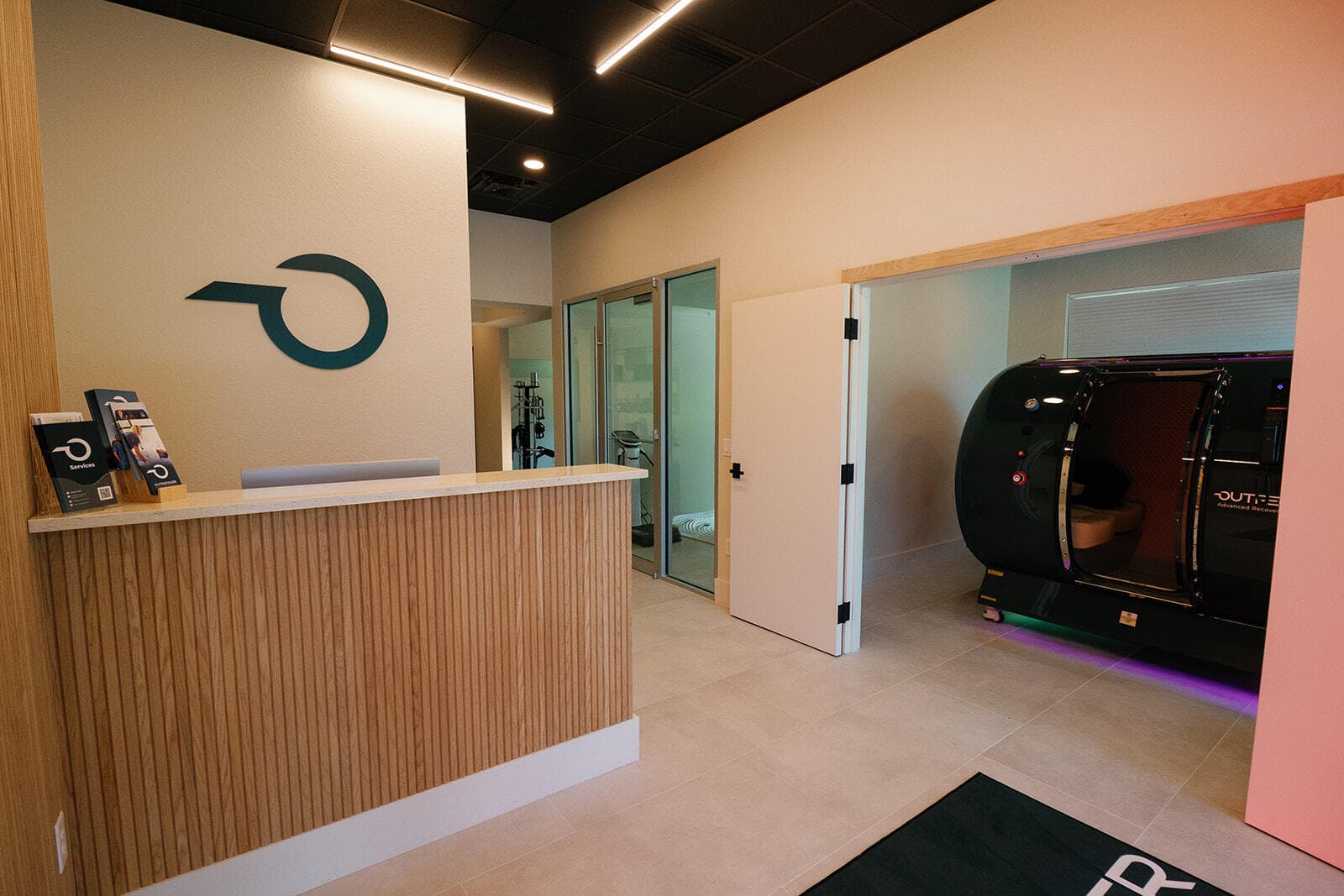
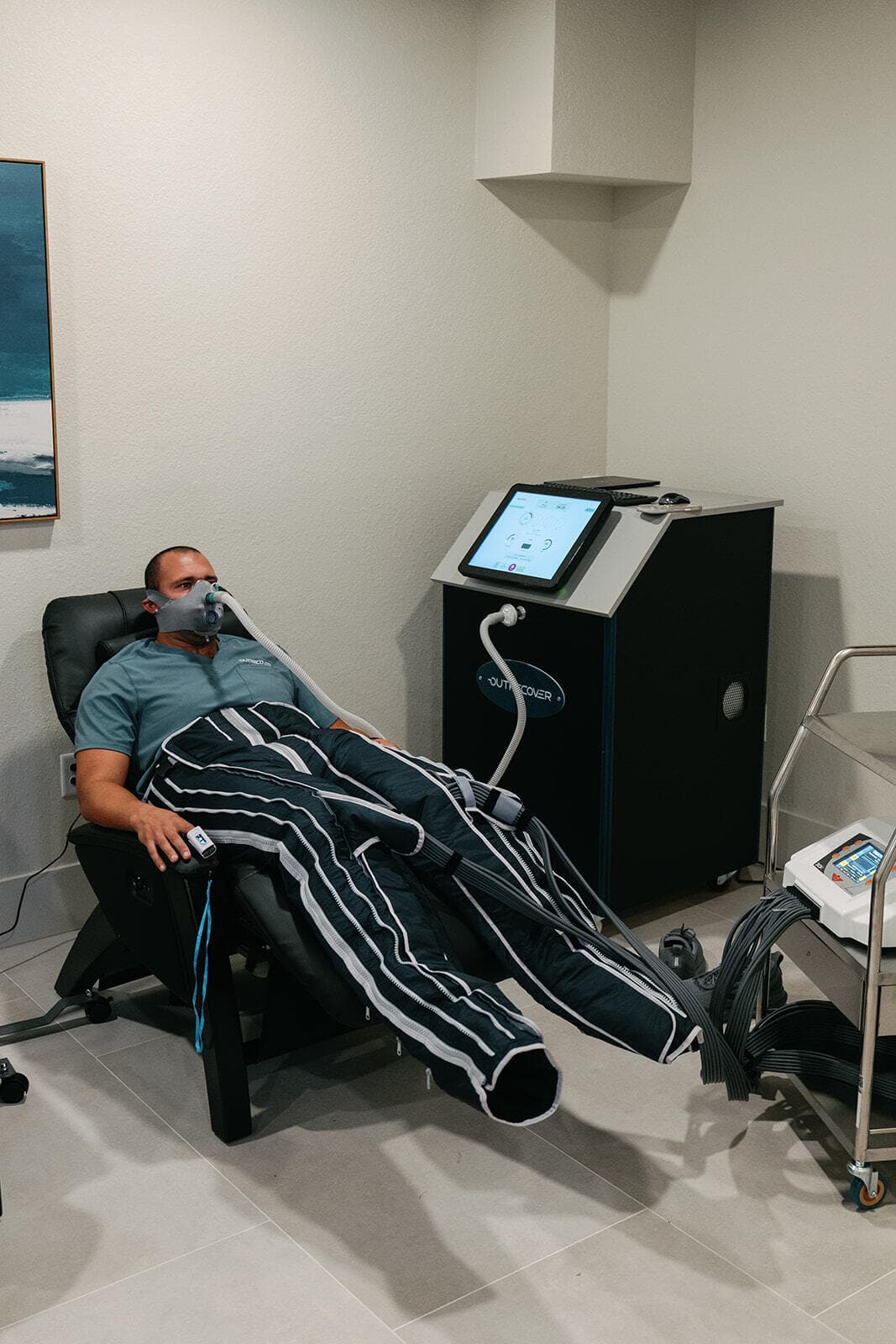
Only after your surgeon says yes, and as a supplement to the plan above, never a substitute. OutRecover's lymphatic compression page lists post-liposuction and plastic surgery recovery among its uses, describes passive full-body compression, and tells you to check with your surgeon first, especially in the first weeks. It also says to consult a physician if you have congestive heart failure, pulmonary edema or active infection. Its research summary covers lymphedema, not liposuction, so it does not settle the question above.
The closest fit by its own description is OutHeal, the signature surgery program, whose page names liposuction among the procedures it is built for and schedules sessions around your surgery date and your surgeon's clearance. It adds hyperbaric oxygen and an IV, and we found no liposuction trial for those, so ask your surgeon about each piece. If swelling is the only concern, OutRestore is narrower: it is built for swelling and circulation support and lists swelling after injury or surgery "once cleared." OutFlow suits swelling when compression is not allowed. Heat is its own question: the Aesthetic Society's six-week rule on heat exposure means asking before booking an infrared sauna. If you also had a tummy tuck, read our tummy tuck recovery guide.
Your next step
Before surgery or at your first follow-up, ask your surgeon three things: how long the garment stays on, when you can add anything new, and what to do if you notice a warning sign. Then, if you want help with swelling, ask whether lymphatic compression fits your plan. If your surgeon agrees, tell the studio your surgery date and they will schedule around it, per the package pages. Services here are wellness-based and do not replace your surgeon's care.
Sources
- American Society of Plastic Surgeons. Liposuction Recovery. ASPS, current page (no date shown; checked 2026-11-06). https://www.plasticsurgery.org/cosmetic-procedures/liposuction/recovery
- The Aesthetic Society. Liposuction: Aftercare & Recovery. Current page (no date shown; checked 2026-11-06). https://www.theaestheticsociety.org/procedures/body/liposuction/aftercare-recovery
- American Society of Plastic Surgeons. What to expect after liposuction: a look at recovery and results. ASPS blog, current page. https://www.plasticsurgery.org/news/blog/what-to-expect-after-liposuction
- American Society of Plastic Surgeons. The importance of compression after plastic surgery. ASPS blog, current page. https://www.plasticsurgery.org/news/blog/the-importance-of-compression-after-plastic-surgery
- Dixit VV, et al. Unfavourable outcomes of liposuction and their management. Indian Journal of Plastic Surgery, 2013. https://pmc.ncbi.nlm.nih.gov/articles/PMC3901919
- Mortada H, et al. Safety and Effectiveness of Liposuction Modalities in Managing Lipedema: Systematic Review and Meta-analysis. Archives of Plastic Surgery, 2024. https://pmc.ncbi.nlm.nih.gov/articles/PMC11436335
- MedlinePlus. Surgical wound infection - treatment. NIH, reviewed 2024-09-30. https://medlineplus.gov/ency/article/007645.htm
- Centers for Disease Control and Prevention. About Venous Thromboembolism (Blood Clots). CDC, current page. https://www.cdc.gov/blood-clots/about/index.html
- Centers for Disease Control and Prevention. Venous Thromboembolism: Know the Risks, Signs & Symptoms of Blood Clots. CDC infographic. https://www.cdc.gov/blood-clots/media/pdfs/vte_risk-infogr.pdf
- Kao YM, et al. Pulmonary Fat Embolism Following Liposuction and Fat Grafting: A Review of Published Cases. Healthcare (Basel), 2023. https://pmc.ncbi.nlm.nih.gov/articles/PMC10218620
- American Society of Plastic Surgeons and partner societies. Gluteal Fat Grafting: A joint safety statement. Plastic Surgery News Extra, 2022-08-18. https://www.plasticsurgery.org/for-medical-professionals/publications/psn-extra/news/gluteal-fat-grafting-a-joint-safety-statement
- The Aesthetic Society. ASERF Outlines Recommendations to Increase Safety of Gluteal Fat Grafting Procedures. Press release, 2017-11-28. https://www.theaestheticsociety.org/media/press-releases/aserf-outlines-recommendations-increase-safety-gluteal-fat-grafting-procedures
- Alsairefi S, et al. Efficacy of Manual Lymphatic Drainage in Reducing Postoperative Complications After Cosmetic Plastic Surgery: A Systematic Review. Plastic and Reconstructive Surgery Global Open, 2026. https://pmc.ncbi.nlm.nih.gov/articles/PMC13641654