NAD IV therapy is a drip of a molecule your cells already use, and the human research on it is thin. A few small studies show what happens to NAD+ levels in the blood. No study has yet tested whether the drip improves energy, aging or performance in healthy adults. Vitamin drips such as the Myers cocktail have a slightly longer record, and it is mostly a record of small trials that did not beat a placebo. Here is what is known, what is not, and how to decide with a clinician.
What is NAD+, and why does it fall with age?
NAD+ is a coenzyme found in every cell. It helps turn food into energy and supports DNA repair and enzymes called sirtuins. A 2021 review in Nature Reviews Molecular Cell Biology reports that tissue and cellular NAD+ levels decline gradually with age in several species, including rodents and humans (Covarrubias, 2021).
That decline is less settled than wellness marketing suggests. A 2021 review in Nutrients set out to test the claim that NAD+ falls with age in every tissue. It found reliable declines in skeletal muscle, some fat tissue and parts of the brain, but conflicting reports for liver (Peluso, 2021). So "NAD+ drops as you age" is reasonable for some tissues. "Low NAD+ is why you feel tired" is not something these reviews show.
What is NAD IV therapy, and what do human studies show?
NAD IV therapy means NAD+ itself, delivered through a vein over a period of hours. A 2026 systematic review of 113 studies found no eligible outcomes trials of intravenous or intramuscular NAD+ for anti-aging or wellness, and concluded that effectiveness for those goals is inconclusive (Gallagher, 2026). What exists is small:
| Study | What was done | What it can tell you |
|---|---|---|
| Grant et al., 2019 | 11 healthy men; 8 received 750 mg NAD+ over 6 hours, 3 received saline | Blood and urine chemistry changed as the body broke the NAD+ down. No adverse events were observed. It did not measure energy, memory or health outcomes. |
| Braidy, 2018, as described in a 2026 narrative review | 8 healthy adults aged 70 to 80 received 1,000 mg daily for 6 days, with no control group | Markers of oxidative stress and inflammation fell. Too small and uncontrolled to show a benefit. |
| Reyna et al., 2026 | A look back at 14 clinic clients (6 on NAD+, 8 on a related compound) | A tolerability report. It tests no benefit. |
Grant's study is now seven years old, and it reported what happened to the molecule. It says little about the people. Its authors state that more research is needed. Treat any claim that an NAD+ drip "restores" anything as a hypothesis.
What about oral NAD+ precursors like NR and NMN?
The pills have more evidence than the drips, and it is still modest. The same 2026 systematic review found that oral nicotinamide riboside (NR) and nicotinamide mononucleotide (NMN) consistently raised blood NAD-related markers and were generally well tolerated over weeks to months. Effects on function, metabolism and other health outcomes were mixed and often null (Gallagher, 2026).
A 2026 meta-analysis of NMN trials pooled 15 randomized trials. Across 10 trials with 383 participants, NMN did not increase adverse events. It found no significant effect on body weight, fasting glucose, HbA1c, lipids or systolic blood pressure, and a slight drop in diastolic pressure. The authors note the trials were small and short, from 14 days to 24 weeks (Yang, 2026). Raising a blood marker is a first step, and it leaves open whether you will feel or perform differently.
Can an NAD+ drip be uncomfortable?
Yes, and the rate matters. In the 2026 tolerability report, all six clients who received IV NAD+ reported moderate to severe abdominal cramping, nausea, vomiting, faster heart rate, throat pain, congestion and chest pressure during the infusion. Symptoms stopped when it ended, and clients slowed the rate themselves (Reyna, 2026). The narrative review lists flushing, cramping and chest pressure, particularly at faster rates (Alangari, 2026).
That is a small, uncontrolled sample, so it cannot say how common these reactions are. It does say this: ask how fast the drip will run, and tell the nurse right away if you feel chest pressure, cramping or flushing.
What are the benefits of IV therapy and the Myers cocktail?
The Myers cocktail is an infusion of B vitamins, vitamin C and magnesium and calcium, among others. The MSD Manual, a standard clinical reference, notes that medical spas offer IV multivitamins to increase energy, enhance immunity and reduce stress, and says there is a lack of supporting evidence and of regulation (MSD Manual, 2025). The same page says these infusions are used in routine hospital care for people who are undernourished, for example from heavy alcohol use.
The best-known trial of the Myers cocktail is a 2009 pilot in fibromyalgia. Thirty-four adults were randomized to weekly infusions or lactated Ringer's solution for 8 weeks. Both groups improved. No statistically significant difference appeared between them at 8 or 16 weeks, and the authors called the benefit over placebo "as yet uncertain" (Ali, 2009). That study is 17 years old and tested one condition. It does not tell a healthy person what a drip will do.
So the honest answer on "iv therapy benefits": hydration and replacing a real deficiency are well understood. Beyond that, the research does not back the energy, immunity and recovery claims that drip menus make.
What does the research say about high-dose vitamin C?
High-dose IV vitamin C is studied mostly in specific medical settings, above all in people with cancer. The National Cancer Institute's evidence summary, updated in 2025, says early studies look promising and the therapy appears well tolerated, but the trials lack rigor in design (NCI, 2025). One pilot of weekly 60 g infusions in men with advanced prostate cancer saw no fall in PSA and no tumor shrinkage. None of this is evidence of benefit for a healthy person.
The studio's OutShield and OutShield Plus formulas list high-dose vitamin C. If that is on your drip, the screening below applies to you in particular.
What are the risks, and who should not get an IV?
An IV bypasses the digestive system, so a mistake shows up fast. The MSD Manual lists these concerns:
- Magnesium or potassium infusions can cause arrhythmias or muscle weakness in people whose blood levels are abnormal.
- An infusion run too fast can lower blood pressure and cause light-headedness or fainting.
- Contaminated equipment has caused serious infections in the bloodstream, including deaths.
- Safety in pregnancy and breastfeeding has not been studied.
A 2010 review of IV vitamin C use says practitioners should not give high-dose IV vitamin C to people with kidney disease, G6PD deficiency, a history of oxalate kidney stones or paroxysmal nocturnal hemoglobinuria (Padayatty, 2010). That is a snapshot from 16 years ago, so ask your clinician what current practice is.
Tell the screening clinician about every medicine, kidney or heart problem, pregnancy, and any surgery on the calendar. If you are recovering from or preparing for surgery, clear any IV with your surgeon first.
Has anyone warned IV companies about their claims?
Yes. In September 2018 the Federal Trade Commission charged a Texas company, iV Bars, with deceptive and unsupported health claims, including that its Myers cocktail treated cancer, multiple sclerosis and congestive heart failure. The final consent order was approved in 2019 (FTC, 2018 and 2019). It bars those claims unless backed by competent and reliable scientific evidence.
The Food and Drug Administration has also acted in this space. In October 2026 it sent a warning letter to an IV hydration company over umbilical cord and exosome "stem cell IV" products, calling them unapproved new drugs (FDA, 2026). That letter is about different products than vitamin or NAD+ drips. It shows regulators are reading IV marketing, so you should too.
How do you judge an IV provider?
Use this checklist before you book:
- Licensed medical staff place and monitor the IV, under a named physician.
- You complete a health screening before your first infusion, well ahead of the chair.
- The provider can tell you what is in the bag, the dose and how long it runs.
- Claims stay at "supports" or "hydrates" and never "cures" or "treats" a disease.
- They tell you what the evidence does not show without being asked.
- They are comfortable with you checking with your own doctor.
Where do studio IVs fit?
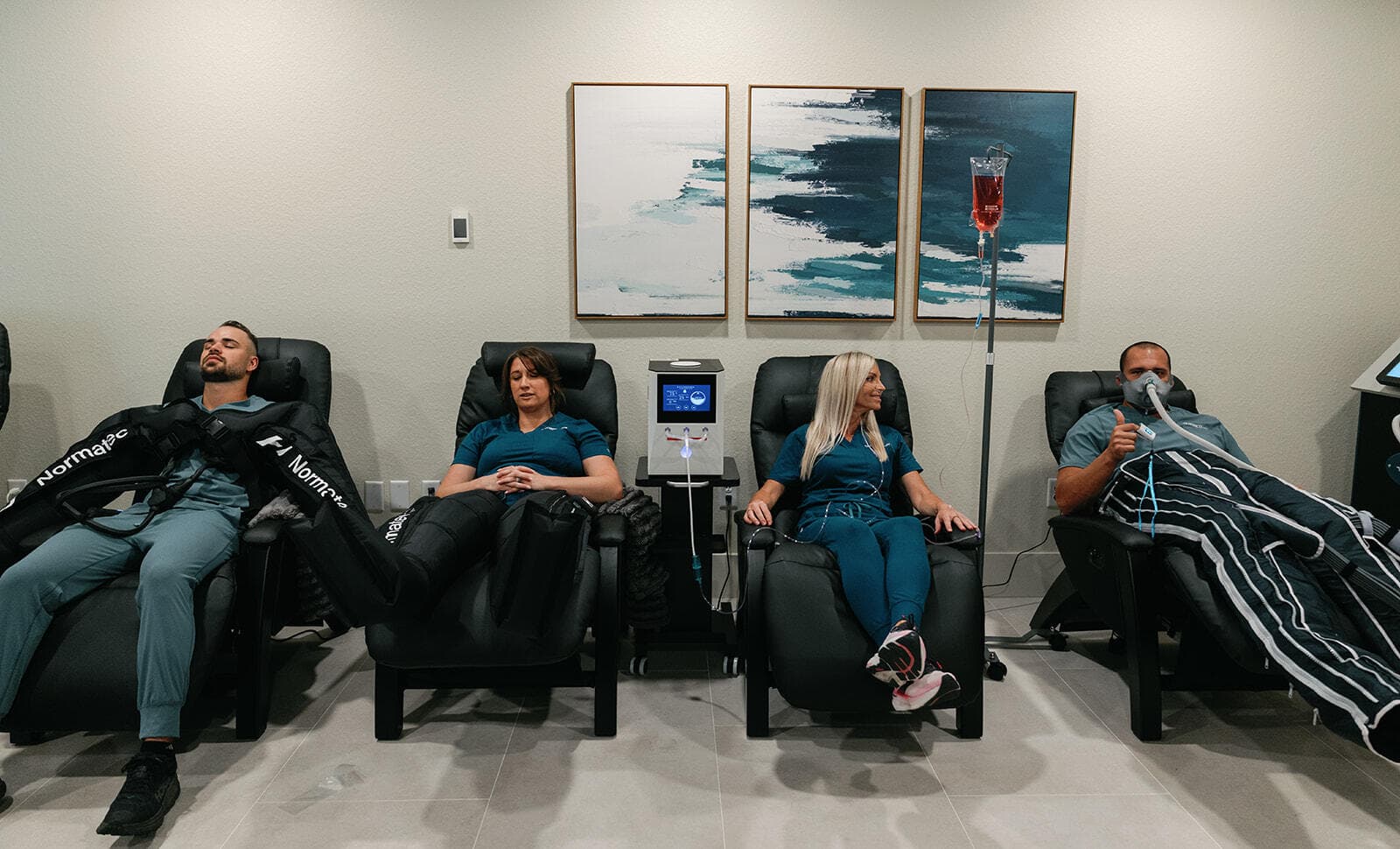
IV infusions at OutRecover are provided by OutInfuse Wellness, a physician-supervised practice. The service page says licensed healthcare professionals give the infusions under physician oversight, IVs need medical approval before your first one, and a brief intake assessment comes first. It lists several formulas and an NAD+ option, which it describes as supporting cellular energy, brain function and healthy aging. The research above does not show those outcomes for IV NAD+, so read that wording as the studio's description of the product.
IVs also appear inside packages. OutRevive is the IV wellness package, with a choice of formula or NAD+ 250 mg at each visit, plus compression and molecular hydrogen. The published human NAD+ infusion studies used other doses, so ask the clinician about dose and run time. OutPrepare and OutHeal include an IV alongside surgery-related care, and OutPerform includes an athletic IV. To learn what the compression boots do, read our compression boots guide, and the hydrogen research summary covers the hydrogen add-on.
Nothing in these studies shows that any package speeds surgical recovery. A drip is a wellness service that sits beside your surgeon's or physical therapist's plan.
What should you do next?
Make a decision rule for yourself. If you have a diagnosed deficiency or a medical reason for an IV, ask your doctor first and follow that plan. If you are curious and healthy, treat a drip as an optional experience with unproven benefit, ask the six questions above, and start with a single visit rather than a series. If you are near surgery, pregnant, or have kidney or heart disease, talk to your own physician before booking.
You can ask the studio about the IV intake on the IV infusions page, or take the 2-minute quiz on the site.
Sources
- Covarrubias AJ, Perrone R, Grozio A, Verdin E. NAD+ metabolism and its roles in cellular processes during ageing. Nature Reviews Molecular Cell Biology, 2021. https://pubmed.ncbi.nlm.nih.gov/33353981
- Peluso A, Damgaard MV, Mori MAS, Treebak JT. Age-Dependent Decline of NAD+: Universal Truth or Confounded Consensus? Nutrients, 2021. https://www.mdpi.com/2072-6643/14/1/101
- Gallagher C, Emmanuel OO. NAD+ supplementation for anti-aging and wellness: a PRISMA-guided systematic review of preclinical and clinical evidence. Ageing Research Reviews, 2026. https://pubmed.ncbi.nlm.nih.gov/41655607
- Grant R, Berg J, Mestayer R, et al. A pilot study investigating changes in the human plasma and urine NAD+ metabolome during a 6 hour intravenous infusion of NAD+. Frontiers in Aging Neuroscience, 2019. https://pmc.ncbi.nlm.nih.gov/articles/PMC6751327
- Alangari A, Arif J, Al Qureshah F, Alkhodairy F. Narrative review of intravenous NAD+ and NAD+ precursors in wellness and translational medicine. Frontiers in Aging, 2026. https://pmc.ncbi.nlm.nih.gov/articles/PMC13601825
- Reyna K, Heinzen G, Patel N, et al. Intravenous infusion of NAD+ versus nicotinamide riboside: a retrospective tolerability pilot study in a real-world setting. Frontiers in Aging, 2026. https://pmc.ncbi.nlm.nih.gov/articles/PMC12907335
- Yang W, Huang J, Tang Z, Chen C, Sun Y. Safety and metabolism-related outcomes of oral nicotinamide mononucleotide supplementation in adults: a systematic review and meta-analysis. Nutrients, 2026. https://pmc.ncbi.nlm.nih.gov/articles/PMC13414721
- MSD Manual Professional Edition. Intravenous Vitamin Therapy (Myers' Cocktail). MSD Manual, 2025. https://www.msdmanuals.com/professional/special-subjects/dietary-supplements/intravenous-vitamin-therapy-myers-cocktail
- Ali A, Njike VY, Northrup V, et al. Intravenous Micronutrient Therapy (Myers' Cocktail) for Fibromyalgia: A Placebo-Controlled Pilot Study. Journal of Alternative and Complementary Medicine, 2009. https://pmc.ncbi.nlm.nih.gov/articles/PMC2894814
- National Cancer Institute. Intravenous Vitamin C (PDQ), health professional version. NCI, updated 2025. https://www.cancer.gov/about-cancer/treatment/cam/hp/vitamin-c-pdq
- Padayatty SJ, Sun AY, Chen Q, et al. Vitamin C: Intravenous Use by Complementary and Alternative Medicine Practitioners and Adverse Effects. PLoS ONE, 2010. https://pmc.ncbi.nlm.nih.gov/articles/PMC2898816
- Federal Trade Commission. FTC Brings First-ever Action Targeting "iV Cocktail" Therapy Marketer. FTC, 2018. https://www.ftc.gov/news-events/news/press-releases/2018/09/ftc-brings-first-ever-action-targeting-iv-cocktail-therapy-marketer
- Federal Trade Commission. FTC Approves Final Consent Order against Company and Owner Who Allegedly Made Unsupported Health Claims for Intravenously Injected Therapy Products. FTC, 2019. https://www.ftc.gov/news-events/news/press-releases/2019/02/ftc-approves-final-consent-order-against-company-owner-who-allegedly-made-unsupported-health-claims
- U.S. Food and Drug Administration. Warning Letter to Calibrate IV Hydration, CBER 26-729846. FDA, 2026. https://www.fda.gov/inspections-compliance-enforcement-and-criminal-investigations/warning-letters/calibrate-iv-hydration-729846-10132026