Lymphedema treatment begins with a doctor confirming the diagnosis, then moves to a program run by a certified lymphedema therapist: manual lymphatic drainage, compression bandaging and garments, exercise and skin care. A recovery studio is not part of that program, and this guide says where it could sit beside it, if your clinician agrees. If a limb has swollen after cancer treatment, or a doctor has called your leg swelling lymphedema, read the first three sections before anything else.
What is lymphedema, and why does a doctor need to confirm it?
Lymphedema is swelling from a buildup of lymph fluid between the skin and muscle. The National Cancer Institute says it can start soon after cancer treatment or years later, usually develops slowly, and is a chronic condition that cannot be cured but can be treated. Lymph nodes removed in surgery, radiation scarring and a tumor blocking flow are the usual causes.
Not all swelling is lymphedema. Mayo Clinic lists infection, injury, blood clots, heart failure, kidney disease and vein problems as other causes. The CDC says to see a doctor right away to be sure no cause needing immediate treatment, like a blood clot, is behind it. A doctor may compare limb sizes (the CDC says a gap of about 2 cm usually means lymphedema) and order imaging.
For general leg and ankle swelling that is not lymphedema, see swollen ankles.
What are the signs of infection to act on today?
Cellulitis, a bacterial skin infection, is the complication to watch. NCI lists pain, tenderness, redness and swelling, skin warm to the touch, and fever, and says to call your doctor right away because untreated cellulitis can become life-threatening. The National Lymphedema Network position paper (posted 2026) adds that it can show up without fever and can look like a blood clot or stasis dermatitis, so a clinician has to judge it.
Use this as a decision rule:
| What you see | What to do |
|---|---|
| Redness, warmth, new pain or tenderness in the swollen limb | Call your doctor right away |
| Any of those plus fever or chills | Call right away; if you cannot reach anyone, go to urgent care or the emergency room |
| A red area that is getting bigger, or skin that looks tight and glossy | Contact your provider right away (MedlinePlus) |
Mayo Clinic gives the same instruction: fever with redness or a color change in a limb with lymphedema needs a professional right away. Do not book any wellness session while you suspect an infection.
What is the standard lymphedema treatment?
The standard is complete decongestive therapy (CDT), delivered by a certified lymphedema therapist, a physical or occupational therapist trained in lymphedema (NCI). The NCI PDQ summary for clinicians (updated December 2024) calls CDT the standard of care for stage II lymphedema and describes two phases.
| Phase | What happens | Per NCI PDQ |
|---|---|---|
| 1. Decongestion | Skin care, exercise, manual lymphatic drainage and compression bandages | Daily, about 15 days on average |
| 2. Maintenance | Skin care, exercise, drainage as needed, compression garments | Ongoing |
The same summary notes that the best program has not been established. It also says flat-knit garments work better than elastic ones for stages II and III in both phases, while elastic garments suit stage I, which is why a fitting by a therapist matters. The NLN paper calls CDT the gold standard for conservative care and notes that compression bandaging should not be used with acute infection, arterial insufficiency or decompensated heart failure. That is another reason the first step is a medical check, not a self-start.
How strong is the evidence?
Mixed, and thinner than the confident tone around lymphedema products suggests. The International Society of Lymphology 2020 consensus says plainly that no treatment method has undergone a satisfactory meta-analysis or rigorous long-term controlled study, and that some uncertainty is to be expected.
Examples from the NCI PDQ summary show the texture:
- A systematic review of ten studies of manual lymphatic drainage in breast cancer found four reported fewer cases of lymphedema, while seven did not show a difference in volume.
- A trial of 103 women found CDT lost more volume than garments alone (250 mL against 143 mL), but the groups started at different sizes and the average reduction did not differ.
- Exercise is safe and may help. Early worries that it causes harm have not been confirmed.
Compression is the part with the broadest agreement. Your therapist will adjust all of it to your stage, your limb and your other health conditions.
Do pneumatic compression pumps help lymphedema?
Pumps can help as an add-on to therapy and are not a replacement for it. The NLN paper calls intermittent pneumatic compression (IPC) an adjunct to CDT rather than a stand-alone treatment. The NCI PDQ summary says IPC should be used with compression garments and only if garments are not enough, and raises a theoretical concern that pressures above 60 mm Hg and long-term use may injure lymphatic vessels.
The research is split:
- A 2024 meta-analysis of trials in arm lymphedema after breast cancer found CDT with a pump and CDT alone gave similar results.
- A 2025 meta-analysis of 14 trials and 1,397 patients found pumps reduced new breast cancer lymphedema, but called their effect on established, chronic lymphedema limited.
- A 2012 review found no consensus on how often or how hard to use a pump.
- A 2026 review of seven leg-lymphedema trials said differences between studies prevented a meta-analysis.
If a pump is prescribed, your therapist sets the pressure and schedule. Guessing at either is where the cautions apply.
Where could a studio's lymphatic compression fit?
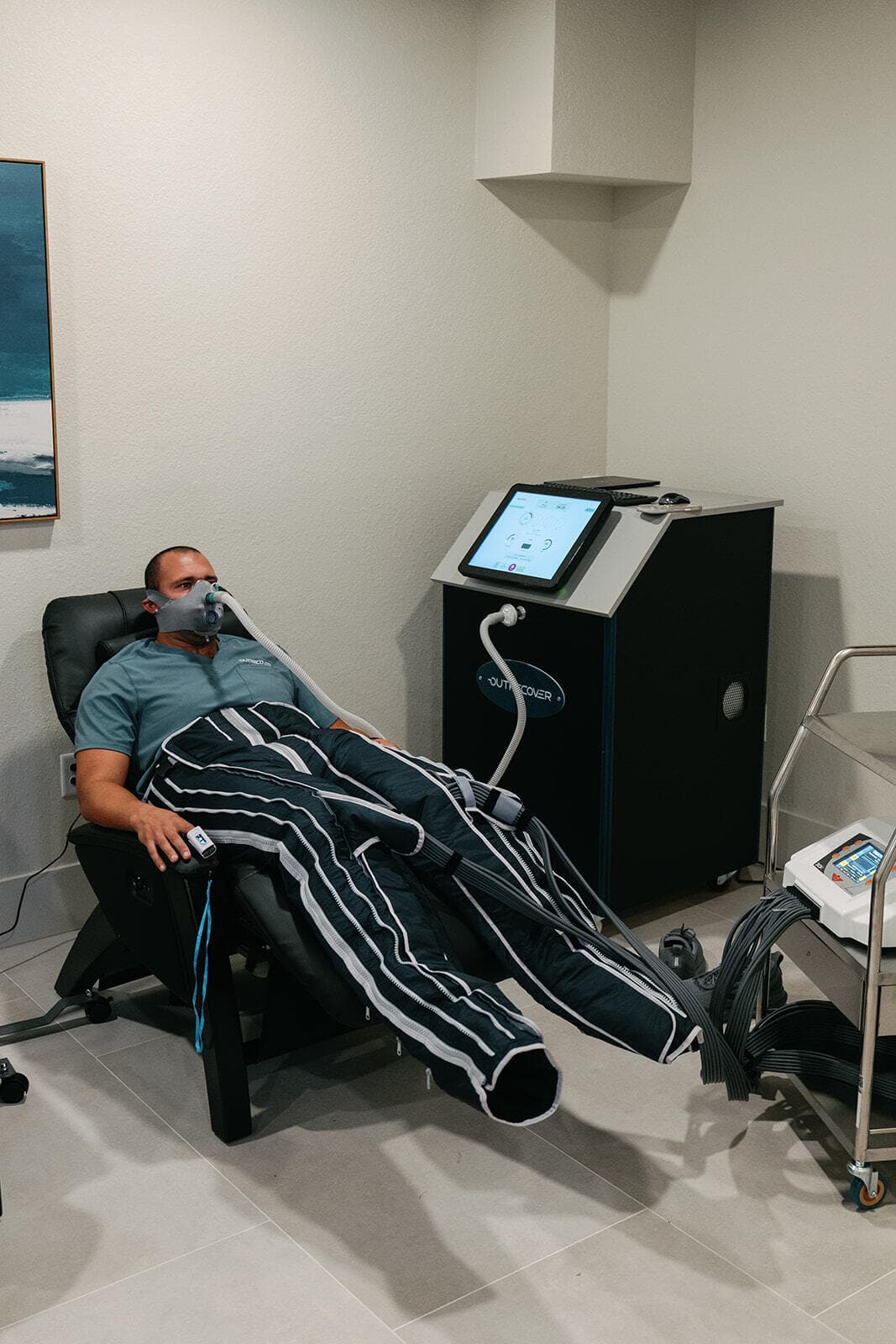
At most, as a clinician-approved circulation session beside your therapy and never in place of it. OutRecover's lymphatic compression uses a full-body BOA Max suit that applies programmed compression from the feet to the core, in a passive session of 45 minutes. Its page lists post-surgical swelling, post-liposuction recovery, full-body recovery and fluid retention as uses. Lymphedema treatment is not on that list.
Here is what that means for you:
- It is not CDT. There is no bandaging, garment fitting, skin care plan or therapist-led drainage in a studio session.
- The pump evidence concerns clinical devices prescribed inside a treatment plan. It does not show what a studio suit does for lymphedema, and the studio's research page discusses compression for lymphedema in general.
- Its own caution applies. The page says to consult your physician with congestive heart failure, pulmonary edema or active infections. Add any current cellulitis, a suspected clot, or untreated swelling of unknown cause.
- Pressure is a question for your clinician. Given the PDQ's concern about high pressures, ask your therapist whether a session is appropriate and at what settings, and tell the studio what they say.
If your clinician clears it, tell the studio about the lymphedema before booking. The only package that bundles this service is OutRestore. It is built for heavy, tired legs and swelling after training or after surgery once cleared. It is not built for lymphedema, so it is not the plan to start with. Plain compression boots are a different tool again (compression boots).
What should you do next?
Work through this list in order:
- Get the swelling examined. If you have not had a diagnosis, call your doctor or oncology team. Say what changed and when.
- Ask for a referral to a certified lymphedema therapist. NCI suggests asking whether one is available to you.
- Start CDT and keep the garments up. NCI also lists skin protection, healthy weight, avoiding extreme heat and sun, raising the limb, and safe exercise.
- Know the infection signs and keep your doctor's number where you can find it.
- Only then consider add-ons. Ask your therapist about pumps. Ask your clinician before any studio session. For swelling from a procedure that is not lymphedema, see reducing swelling after surgery.
This guide is general information and not medical advice. Services at a recovery studio are wellness-based and do not diagnose or treat lymphedema.
Sources
- National Cancer Institute. Lymphedema (patient information). cancer.gov, accessed 2026-11-05. https://www.cancer.gov/about-cancer/treatment/side-effects/lymphedema
- National Cancer Institute. Lymphedema (PDQ), Health Professional Version. cancer.gov, updated December 2024. https://www.cancer.gov/about-cancer/treatment/side-effects/lymphedema/lymphedema-hp-pdq
- Executive Committee of the International Society of Lymphology. The diagnosis and treatment of peripheral lymphedema: 2020 Consensus Document. Lymphology, 2020. https://pubmed.ncbi.nlm.nih.gov/32521126
- National Lymphedema Network. Lymphedema Diagnosis and Treatment Position Paper (v9.25). lymphnet.org, posted 2026. https://lymphnet.org/wp-content/uploads/2026/05/WITH_References_-_Lymph_Diagnosis_and_Treatmen.pdf
- Centers for Disease Control and Prevention. Lymphedema (Cancer Survivors). cdc.gov, accessed 2026-11-05. https://www.cdc.gov/cancer-survivors/patients/lymphedema.html
- Mayo Clinic. Lymphedema: Symptoms and causes. mayoclinic.org, accessed 2026-11-05. https://www.mayoclinic.org/diseases-conditions/lymphedema/symptoms-causes/syc-20374682
- MedlinePlus. Cellulitis (Medical Encyclopedia). National Library of Medicine, accessed 2026-11-05. https://medlineplus.gov/ency/article/000855.htm
- Yao M, Peng P, Ding X, Sun Q, Chen L. Comparison of intermittent pneumatic compression pump as adjunct to decongestive lymphatic therapy against decongestive therapy alone for upper limb lymphedema after breast cancer surgery: a systematic review and meta-analysis. Breast Care, 2024. https://pubmed.ncbi.nlm.nih.gov/38894955
- Su L, Huang H, Tong Y, et al. Intermittent pneumatic compression devices for the prevention and treatment of breast cancer-related lymphedema: a systematic review and meta-analysis. Supportive Care in Cancer, 2025. https://pubmed.ncbi.nlm.nih.gov/41272206
- Feldman JL, Stout NL, Wanchai A, et al. Intermittent pneumatic compression therapy: a systematic review. Lymphology, 2012. https://pubmed.ncbi.nlm.nih.gov/22768469
- O'Donnell TF, Tedesco A, Fish J. A systematic review of contemporary randomized controlled trials for treatment of lower extremity lymphedema by intermittent pneumatic compression devices. Journal of Vascular Surgery: Venous and Lymphatic Disorders, 2026. https://pubmed.ncbi.nlm.nih.gov/41997536